| The horrors of war remain at the front of Henry Kissinger’s mind as he surveys the world shortly after his 100th birthday.In one of his longest television interviews of recent times, Kissinger told Bloomberg News Editor-in-Chief John Micklethwait that few modern politicians have any experience of conflict and that can cloud their judgment.“Leaders who have not had an experience of catastrophe or the edge of catastrophe sometimes believe that they have more options than they really do,” he said. “That is characteristic of our time.”Kissinger also spoke about the prospects for Vladimir Putin’s survival, Britain’s post-Brexit future and Germany’s role in Europe. He gave a rare insight into his personal feelings as he talked about about how witnessing Nazi concentration camps shaped him as a young man. And he spoke at length about the Vietnam War. (Click here to see the full interview)But his starkest warning was over the prospect of a war between the US and China over Taiwan.“On the current trajectory of relations, I think some military conflict is probable,” Kissinger said. The remarks, delivered by the former secretary of state as he looked back on his life and career, were some of his most downbeat yet on the tensions between the world’s dominant and competing economies.Still, he said, “the current trajectory of relations must be altered.” He noted that diplomacy is returning, with his latest successor, Antony Blinken, bound to visit Beijing in the coming days. He will be the highest-level US official to visit in five years. It’s now up to both sides to step back from “the top of a precipice,” Kissinger said.The author of numerous books including “On China,” written a year before President Xi Jinping took power, is closely watched for his views on Asian geopolitics because his secret trip to China in 1971 laid the groundwork for the historic normalization of US-China ties.All these years later, he said he’s still undecided about the outcome of the strains between the US and China, given that “they have not yet actually engaged in the sort of dialogues that I’ve suggested.”But the one thing he said he knows for sure is that wars between two superpowers cannot be won. Or as he put it, they are “winnable only at costs that are out of proportion.” — Nick Wadhams |
| WATCH: Kissinger speaks about the dangers of conflict over Taiwan Source: BloombergCheck out the latest Washington Edition newsletter. You can sign up to get it in your inbox every weekday. |
Putin’s Struggle. Vladimir Putin’s survival in power is “improbable” if the war in Ukraine forces Russia to abandon military aggression and accept a peace deal with Europe, Kissinger said. Ukraine should emerge from the conflict as a strong democracy and it’s preferable that Russia avoids collapse or slides into “resentful impotence,” he added. Kissinger said he wanted Russia to recognize that its relations with Europe should be based on agreement and “I believe that this war will, if it’s ended properly, make it achievable.”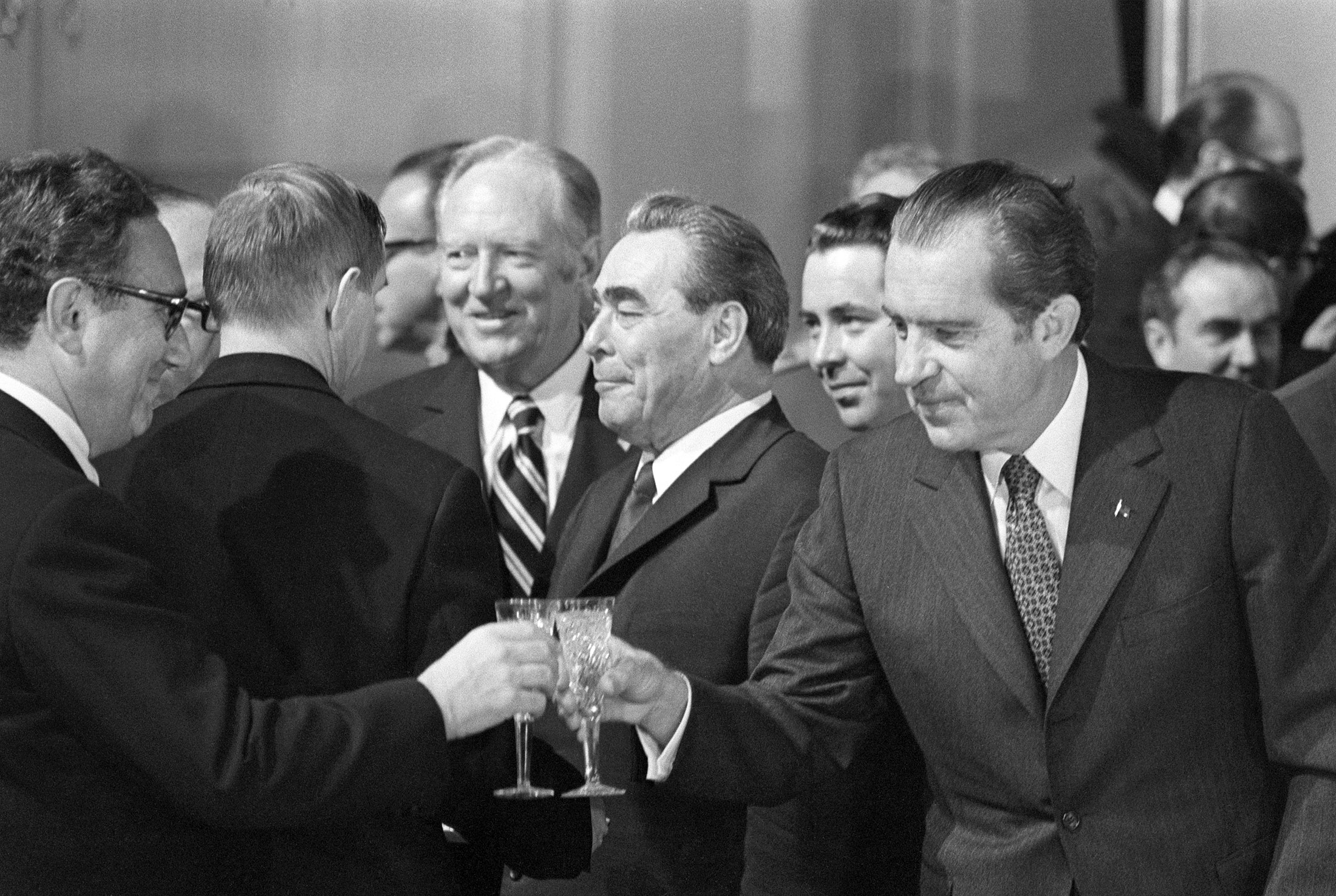 President Richard Nixon and Kissinger in Moscow in 1972 after signing of a strategic-arms limitation agreement with Soviet leaders. Photographer: Bettmann/Getty ImagesGermany’s Role. Europe’s political center of gravity is moving inexorably toward Germany, presenting Berlin with a fresh challenge over how to wield that power, Kissinger said. He sees parallels with the situation at the end of the 19th century when the first chancellor, Otto von Bismarck, stepped down, putting the newly united Germany at a crossroads. The “tragedy” that led to two world wars just a few decades later lay in Germany’s failure to recognize its own “transformation” and that “the leading country has to be an example of moderation and wisdom in balancing the interests of all the countries” in Europe. “We are at this moment now where a new structure of Europe has to be created based on this reality.” President Richard Nixon and Kissinger in Moscow in 1972 after signing of a strategic-arms limitation agreement with Soviet leaders. Photographer: Bettmann/Getty ImagesGermany’s Role. Europe’s political center of gravity is moving inexorably toward Germany, presenting Berlin with a fresh challenge over how to wield that power, Kissinger said. He sees parallels with the situation at the end of the 19th century when the first chancellor, Otto von Bismarck, stepped down, putting the newly united Germany at a crossroads. The “tragedy” that led to two world wars just a few decades later lay in Germany’s failure to recognize its own “transformation” and that “the leading country has to be an example of moderation and wisdom in balancing the interests of all the countries” in Europe. “We are at this moment now where a new structure of Europe has to be created based on this reality.” 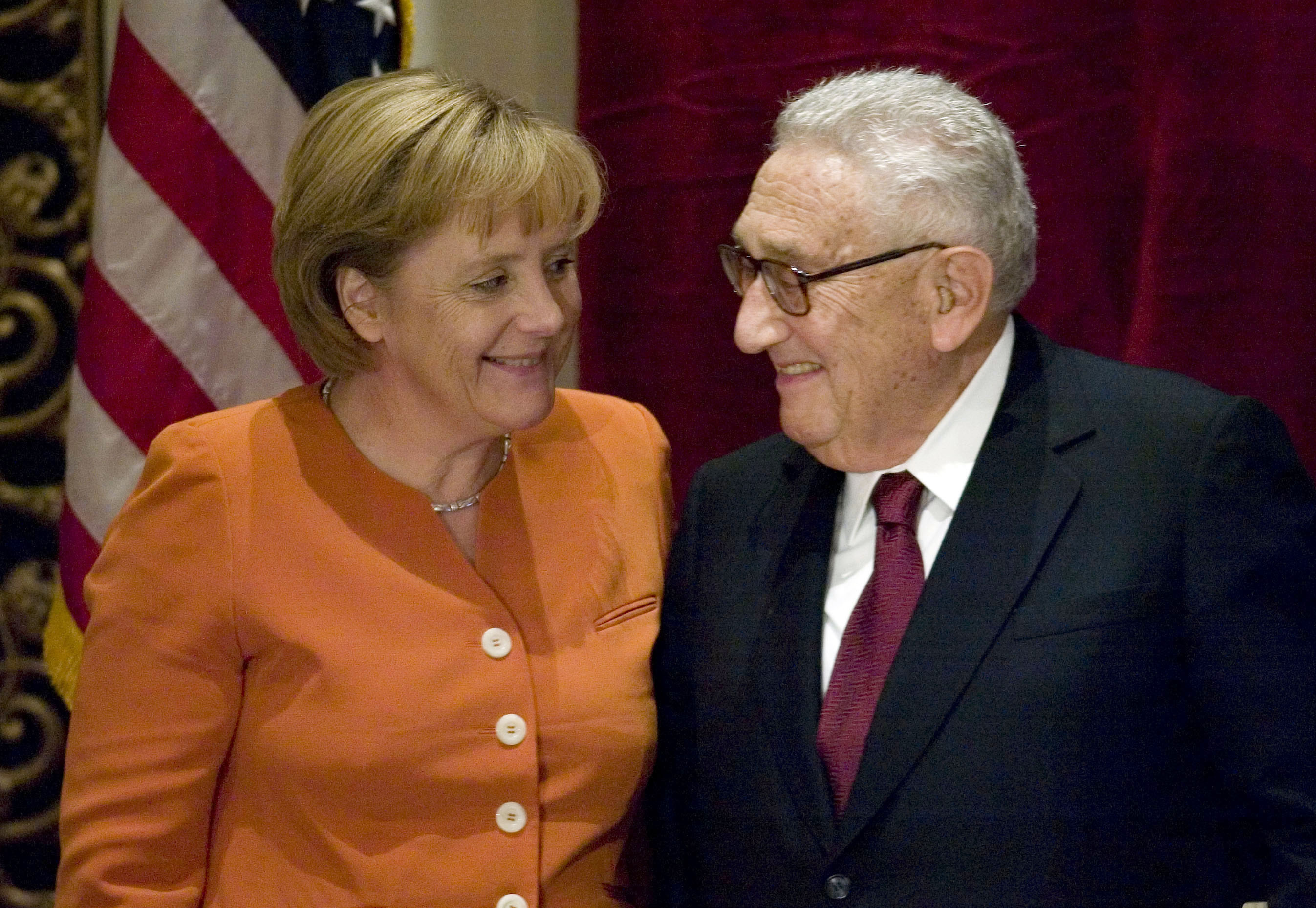 German Chancellor Angela Merkel greets Kissinger during the Appeal of Conscience World Statesman Award ceremony in New York in 2007. Photographer: Jin Lee/BloombergBritain’s Future. “Psychologically” the UK outside the European Union is now better placed to burnish ties with the Americans than a country like France that remains inside the bloc, Kissinger said. Whatever path the EU takes in terms of its own integration, it’s hard to imagine it doing so without cooperating with and pursuing parallel politics to the US, he said. That, coupled with Britain’s long history of “special partnership” with the US, means that there is now “a great opportunity for it to act as a link between a unifying Europe and America.” German Chancellor Angela Merkel greets Kissinger during the Appeal of Conscience World Statesman Award ceremony in New York in 2007. Photographer: Jin Lee/BloombergBritain’s Future. “Psychologically” the UK outside the European Union is now better placed to burnish ties with the Americans than a country like France that remains inside the bloc, Kissinger said. Whatever path the EU takes in terms of its own integration, it’s hard to imagine it doing so without cooperating with and pursuing parallel politics to the US, he said. That, coupled with Britain’s long history of “special partnership” with the US, means that there is now “a great opportunity for it to act as a link between a unifying Europe and America.” 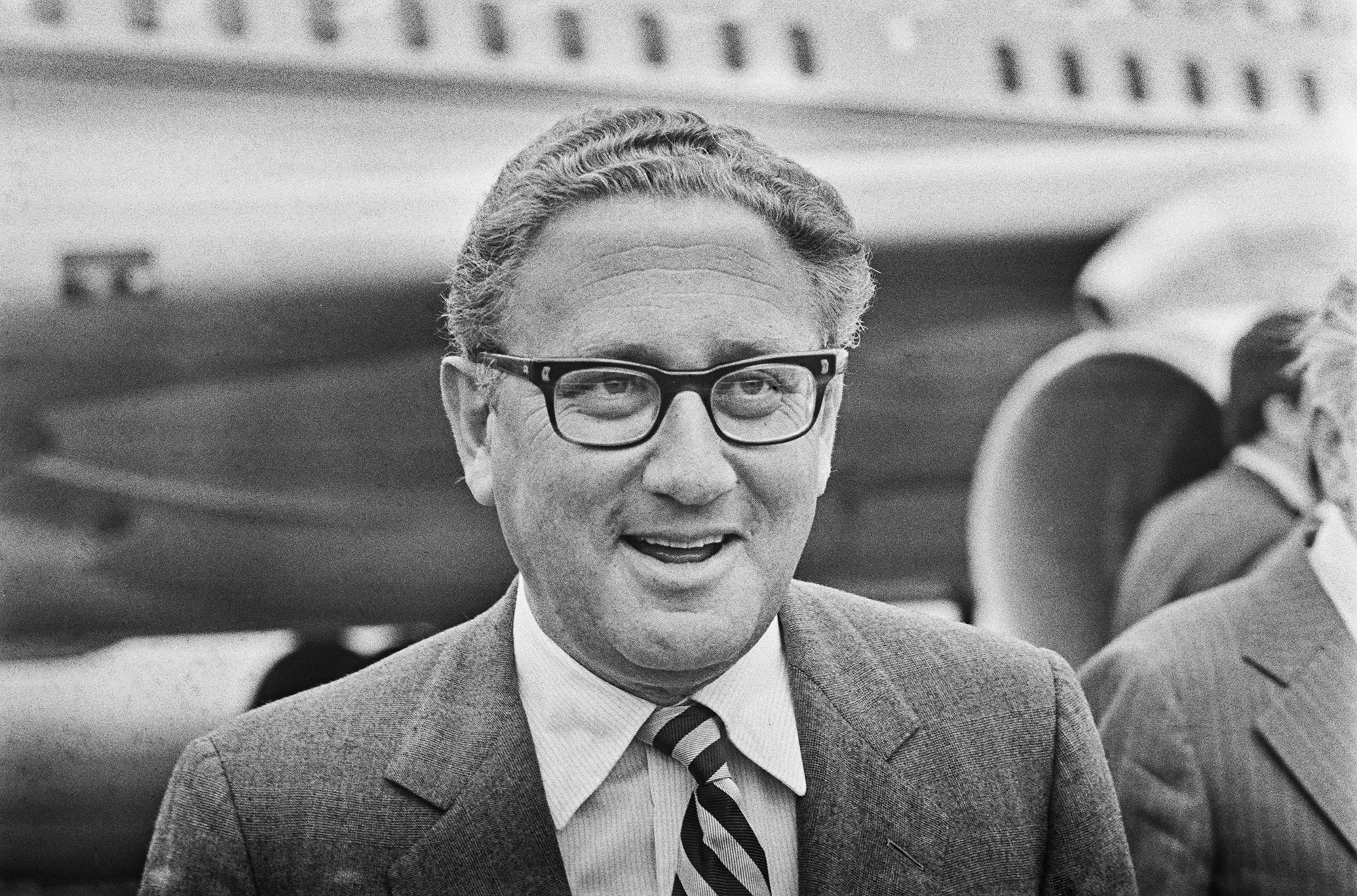 Kissinger at Heathrow Airport in London in 1972. Photographer: Evening Standard/Hulton Archive/Getty ImagesIndia Rising. While Kissinger described India’s stance of non-alignment during the Cold War as “a source of considerable irritation,” he called its current policy “extremely thoughtful.” India performs best when it defends its own interests, and many of them overlap with those of the US, he said. “India is a great power and in the decades ahead it will grow comparably to China.” Kissinger at Heathrow Airport in London in 1972. Photographer: Evening Standard/Hulton Archive/Getty ImagesIndia Rising. While Kissinger described India’s stance of non-alignment during the Cold War as “a source of considerable irritation,” he called its current policy “extremely thoughtful.” India performs best when it defends its own interests, and many of them overlap with those of the US, he said. “India is a great power and in the decades ahead it will grow comparably to China.” 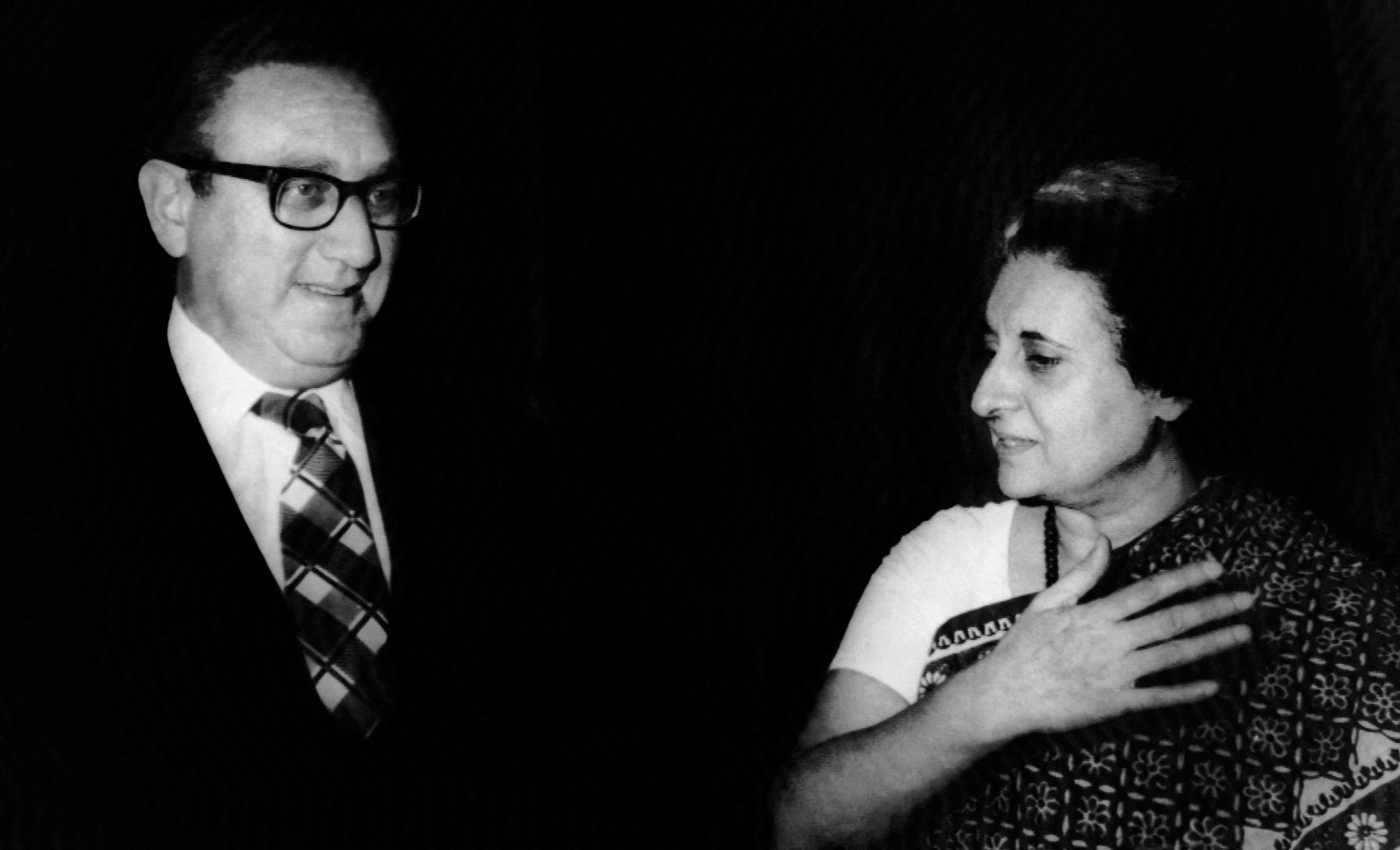 Kissinger meets Indian Prime Minister Indira Gandhi in New Delhi on Oct. 28, 1974. Photographer: AFP/Getty ImagesAmerica Divided. Kissinger also turned to the state of US politics and took the view that the country has become worryingly polarized ahead of the 2024 presidential elections. The current debate has shifted to an “extreme theory of America first which is applied to both sides but in such a way that it focuses too much on America and not on global issues.” For him the risk is clear: “America will become isolated” if it keeps looking inwards. Asked about the Joe Biden administration’s foreign policy approach, he had this to say: “I think the current administration is trying to do a serious job of that but it is so afraid of attacks on itself that it doesn’t do itself justice.” Kissinger meets Indian Prime Minister Indira Gandhi in New Delhi on Oct. 28, 1974. Photographer: AFP/Getty ImagesAmerica Divided. Kissinger also turned to the state of US politics and took the view that the country has become worryingly polarized ahead of the 2024 presidential elections. The current debate has shifted to an “extreme theory of America first which is applied to both sides but in such a way that it focuses too much on America and not on global issues.” For him the risk is clear: “America will become isolated” if it keeps looking inwards. Asked about the Joe Biden administration’s foreign policy approach, he had this to say: “I think the current administration is trying to do a serious job of that but it is so afraid of attacks on itself that it doesn’t do itself justice.”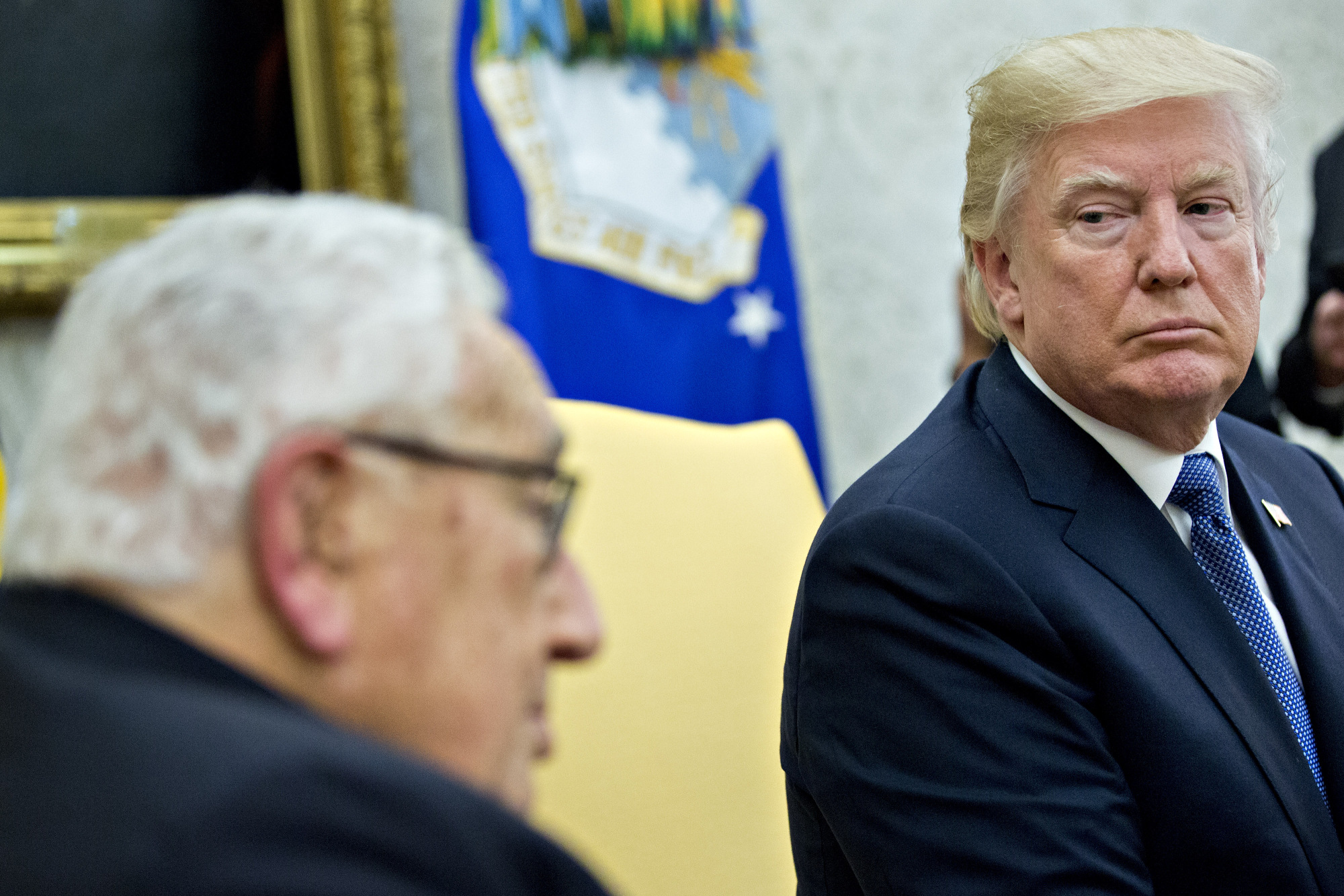 President Donald Trump listens as Kissinger speaks during a meeting in the Oval Office on Oct. 10, 2017. Photographer: Andrew Harrer/BloombergWithdrawal from Vietnam. He pushed back against criticism over his handling of the Vietnam War, saying Presidents Richard Nixon and Gerald Ford, under whom he served as national security adviser and secretary of state, made the best of a difficult situation after inheriting massive commitments of US forces and facing public opposition to the conflict. “I honestly believe we did the best we could,” he said. If not for Watergate and congressional opposition to US involvement in Vietnam, the political settlement and South Vietnamese government might have survived until the US-China opening and been able to resist external pressures, Kissinger said. “It was the saddest moment of my public life when I had to sit in the security adviser’s office and recommend the final withdrawal.” President Donald Trump listens as Kissinger speaks during a meeting in the Oval Office on Oct. 10, 2017. Photographer: Andrew Harrer/BloombergWithdrawal from Vietnam. He pushed back against criticism over his handling of the Vietnam War, saying Presidents Richard Nixon and Gerald Ford, under whom he served as national security adviser and secretary of state, made the best of a difficult situation after inheriting massive commitments of US forces and facing public opposition to the conflict. “I honestly believe we did the best we could,” he said. If not for Watergate and congressional opposition to US involvement in Vietnam, the political settlement and South Vietnamese government might have survived until the US-China opening and been able to resist external pressures, Kissinger said. “It was the saddest moment of my public life when I had to sit in the security adviser’s office and recommend the final withdrawal.”  Kissinger delivers a eulogy at the state funeral of Ford at the National Cathedral in Washington on Jan. 2, 2007. Photographer: Dennis Brack/BloombergPostscript … At the end of the interview, Kissinger reflected on a harrowing visit to the Ahlem concentration camp in his early 20s where a meeting with an emaciated inmate left a permanent mark and a sense of horror at what mankind is capable of. It resulted in a private essay that he had never intended to be made public: “I wrote that for myself. I had no intention of publishing it because feelings about humanity can affect your own actions.” In his youth, he saw “war in its most immediate form” and that chaos and disintegration of society becomes something “so elemental it becomes part of you.” It had a profound impact on Kissinger’s thinking. In his words, how to prevent the “barbaric side” of humanity from breaking out became a core pillar of his diplomacy. How would he like to be remembered? Kissinger said it was out of his control: “I tried to do the best I could.” Kissinger delivers a eulogy at the state funeral of Ford at the National Cathedral in Washington on Jan. 2, 2007. Photographer: Dennis Brack/BloombergPostscript … At the end of the interview, Kissinger reflected on a harrowing visit to the Ahlem concentration camp in his early 20s where a meeting with an emaciated inmate left a permanent mark and a sense of horror at what mankind is capable of. It resulted in a private essay that he had never intended to be made public: “I wrote that for myself. I had no intention of publishing it because feelings about humanity can affect your own actions.” In his youth, he saw “war in its most immediate form” and that chaos and disintegration of society becomes something “so elemental it becomes part of you.” It had a profound impact on Kissinger’s thinking. In his words, how to prevent the “barbaric side” of humanity from breaking out became a core pillar of his diplomacy. How would he like to be remembered? Kissinger said it was out of his control: “I tried to do the best I could.” |
Balance of Power – great interview with Henry Kissinger – a good read; in a special addition of Bloomberg
June 21, 2023 by Steven R. Gerbsman
 Blog of Intellectual Capital
Leave a comment