| The horrors of war remain at the front of Henry Kissinger’s mind as he surveys the world shortly after his 100th birthday.In one of his longest television interviews of recent times, Kissinger told Bloomberg News Editor-in-Chief John Micklethwait that few modern politicians have any experience of conflict and that can cloud their judgment.“Leaders who have not had an experience of catastrophe or the edge of catastrophe sometimes believe that they have more options than they really do,” he said. “That is characteristic of our time.”Kissinger also spoke about the prospects for Vladimir Putin’s survival, Britain’s post-Brexit future and Germany’s role in Europe. He gave a rare insight into his personal feelings as he talked about about how witnessing Nazi concentration camps shaped him as a young man. And he spoke at length about the Vietnam War. (Click here to see the full interview)But his starkest warning was over the prospect of a war between the US and China over Taiwan.“On the current trajectory of relations, I think some military conflict is probable,” Kissinger said. The remarks, delivered by the former secretary of state as he looked back on his life and career, were some of his most downbeat yet on the tensions between the world’s dominant and competing economies.Still, he said, “the current trajectory of relations must be altered.” He noted that diplomacy is returning, with his latest successor, Antony Blinken, bound to visit Beijing in the coming days. He will be the highest-level US official to visit in five years. It’s now up to both sides to step back from “the top of a precipice,” Kissinger said.The author of numerous books including “On China,” written a year before President Xi Jinping took power, is closely watched for his views on Asian geopolitics because his secret trip to China in 1971 laid the groundwork for the historic normalization of US-China ties.All these years later, he said he’s still undecided about the outcome of the strains between the US and China, given that “they have not yet actually engaged in the sort of dialogues that I’ve suggested.”But the one thing he said he knows for sure is that wars between two superpowers cannot be won. Or as he put it, they are “winnable only at costs that are out of proportion.” — Nick Wadhams |
| WATCH: Kissinger speaks about the dangers of conflict over Taiwan Source: BloombergCheck out the latest Washington Edition newsletter. You can sign up to get it in your inbox every weekday. |
Putin’s Struggle. Vladimir Putin’s survival in power is “improbable” if the war in Ukraine forces Russia to abandon military aggression and accept a peace deal with Europe, Kissinger said. Ukraine should emerge from the conflict as a strong democracy and it’s preferable that Russia avoids collapse or slides into “resentful impotence,” he added. Kissinger said he wanted Russia to recognize that its relations with Europe should be based on agreement and “I believe that this war will, if it’s ended properly, make it achievable.”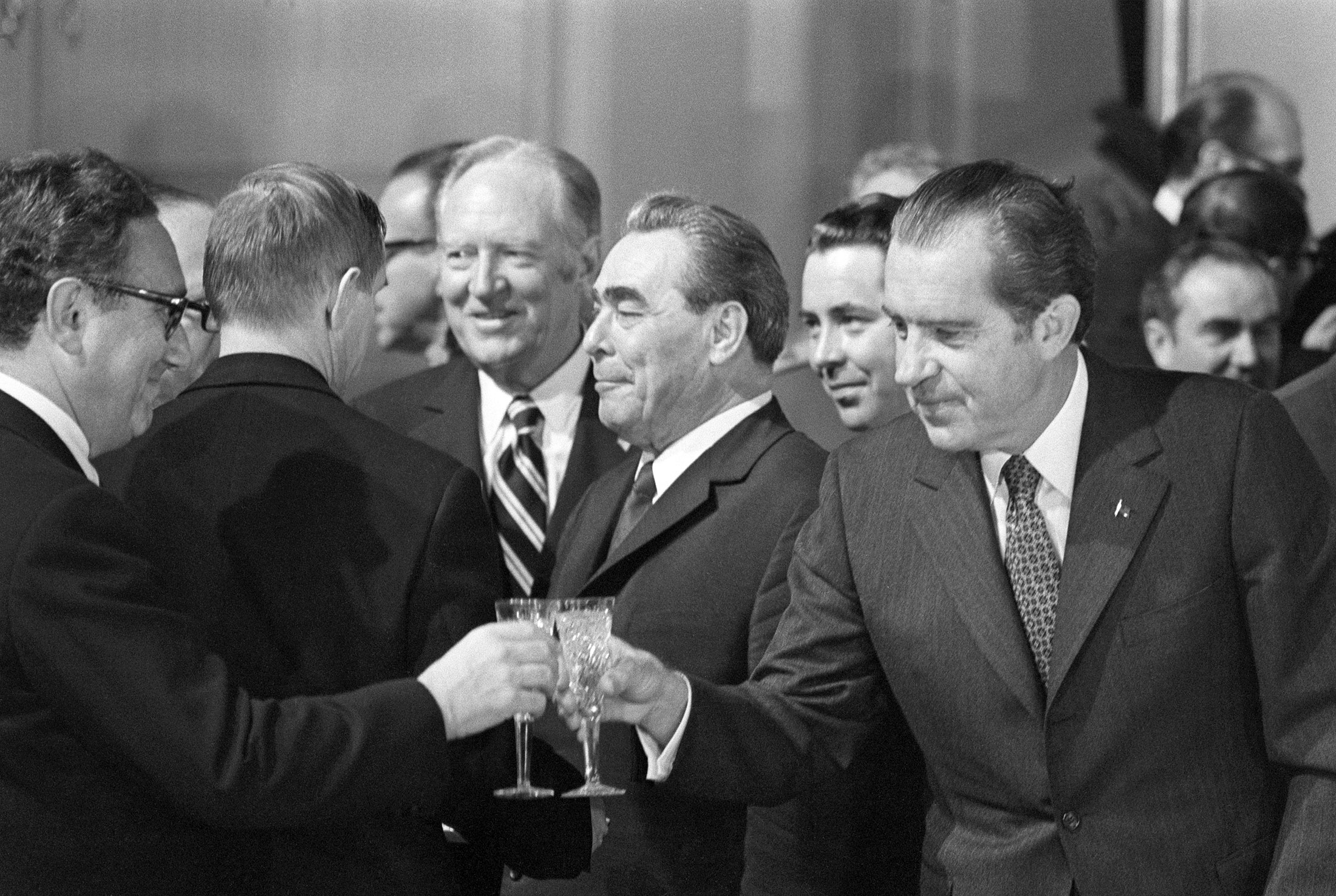 President Richard Nixon and Kissinger in Moscow in 1972 after signing of a strategic-arms limitation agreement with Soviet leaders. Photographer: Bettmann/Getty ImagesGermany’s Role. Europe’s political center of gravity is moving inexorably toward Germany, presenting Berlin with a fresh challenge over how to wield that power, Kissinger said. He sees parallels with the situation at the end of the 19th century when the first chancellor, Otto von Bismarck, stepped down, putting the newly united Germany at a crossroads. The “tragedy” that led to two world wars just a few decades later lay in Germany’s failure to recognize its own “transformation” and that “the leading country has to be an example of moderation and wisdom in balancing the interests of all the countries” in Europe. “We are at this moment now where a new structure of Europe has to be created based on this reality.” President Richard Nixon and Kissinger in Moscow in 1972 after signing of a strategic-arms limitation agreement with Soviet leaders. Photographer: Bettmann/Getty ImagesGermany’s Role. Europe’s political center of gravity is moving inexorably toward Germany, presenting Berlin with a fresh challenge over how to wield that power, Kissinger said. He sees parallels with the situation at the end of the 19th century when the first chancellor, Otto von Bismarck, stepped down, putting the newly united Germany at a crossroads. The “tragedy” that led to two world wars just a few decades later lay in Germany’s failure to recognize its own “transformation” and that “the leading country has to be an example of moderation and wisdom in balancing the interests of all the countries” in Europe. “We are at this moment now where a new structure of Europe has to be created based on this reality.”  German Chancellor Angela Merkel greets Kissinger during the Appeal of Conscience World Statesman Award ceremony in New York in 2007. Photographer: Jin Lee/BloombergBritain’s Future. “Psychologically” the UK outside the European Union is now better placed to burnish ties with the Americans than a country like France that remains inside the bloc, Kissinger said. Whatever path the EU takes in terms of its own integration, it’s hard to imagine it doing so without cooperating with and pursuing parallel politics to the US, he said. That, coupled with Britain’s long history of “special partnership” with the US, means that there is now “a great opportunity for it to act as a link between a unifying Europe and America.” German Chancellor Angela Merkel greets Kissinger during the Appeal of Conscience World Statesman Award ceremony in New York in 2007. Photographer: Jin Lee/BloombergBritain’s Future. “Psychologically” the UK outside the European Union is now better placed to burnish ties with the Americans than a country like France that remains inside the bloc, Kissinger said. Whatever path the EU takes in terms of its own integration, it’s hard to imagine it doing so without cooperating with and pursuing parallel politics to the US, he said. That, coupled with Britain’s long history of “special partnership” with the US, means that there is now “a great opportunity for it to act as a link between a unifying Europe and America.”  Kissinger at Heathrow Airport in London in 1972. Photographer: Evening Standard/Hulton Archive/Getty ImagesIndia Rising. While Kissinger described India’s stance of non-alignment during the Cold War as “a source of considerable irritation,” he called its current policy “extremely thoughtful.” India performs best when it defends its own interests, and many of them overlap with those of the US, he said. “India is a great power and in the decades ahead it will grow comparably to China.” Kissinger at Heathrow Airport in London in 1972. Photographer: Evening Standard/Hulton Archive/Getty ImagesIndia Rising. While Kissinger described India’s stance of non-alignment during the Cold War as “a source of considerable irritation,” he called its current policy “extremely thoughtful.” India performs best when it defends its own interests, and many of them overlap with those of the US, he said. “India is a great power and in the decades ahead it will grow comparably to China.”  Kissinger meets Indian Prime Minister Indira Gandhi in New Delhi on Oct. 28, 1974. Photographer: AFP/Getty ImagesAmerica Divided. Kissinger also turned to the state of US politics and took the view that the country has become worryingly polarized ahead of the 2024 presidential elections. The current debate has shifted to an “extreme theory of America first which is applied to both sides but in such a way that it focuses too much on America and not on global issues.” For him the risk is clear: “America will become isolated” if it keeps looking inwards. Asked about the Joe Biden administration’s foreign policy approach, he had this to say: “I think the current administration is trying to do a serious job of that but it is so afraid of attacks on itself that it doesn’t do itself justice.” Kissinger meets Indian Prime Minister Indira Gandhi in New Delhi on Oct. 28, 1974. Photographer: AFP/Getty ImagesAmerica Divided. Kissinger also turned to the state of US politics and took the view that the country has become worryingly polarized ahead of the 2024 presidential elections. The current debate has shifted to an “extreme theory of America first which is applied to both sides but in such a way that it focuses too much on America and not on global issues.” For him the risk is clear: “America will become isolated” if it keeps looking inwards. Asked about the Joe Biden administration’s foreign policy approach, he had this to say: “I think the current administration is trying to do a serious job of that but it is so afraid of attacks on itself that it doesn’t do itself justice.”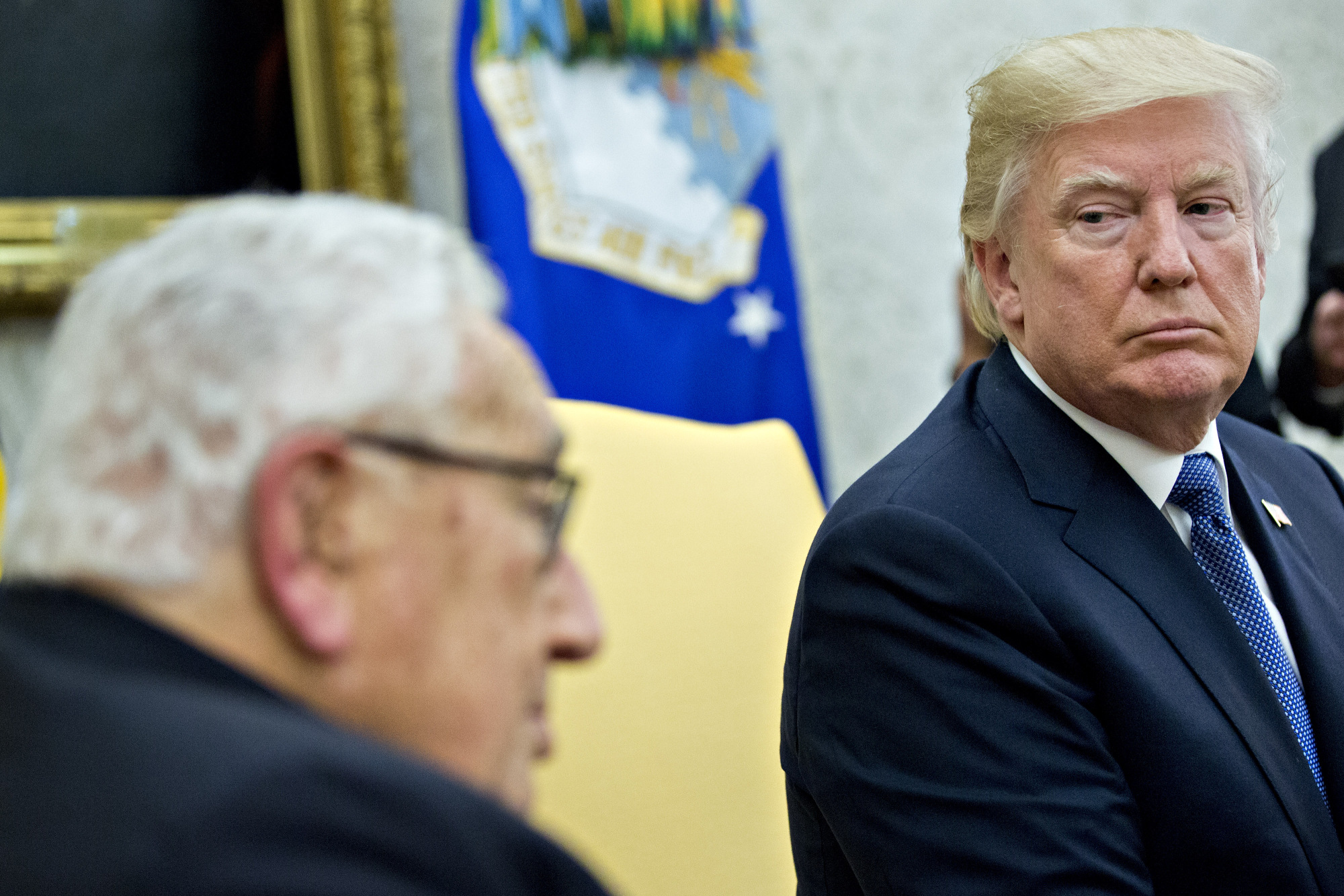 President Donald Trump listens as Kissinger speaks during a meeting in the Oval Office on Oct. 10, 2017. Photographer: Andrew Harrer/BloombergWithdrawal from Vietnam. He pushed back against criticism over his handling of the Vietnam War, saying Presidents Richard Nixon and Gerald Ford, under whom he served as national security adviser and secretary of state, made the best of a difficult situation after inheriting massive commitments of US forces and facing public opposition to the conflict. “I honestly believe we did the best we could,” he said. If not for Watergate and congressional opposition to US involvement in Vietnam, the political settlement and South Vietnamese government might have survived until the US-China opening and been able to resist external pressures, Kissinger said. “It was the saddest moment of my public life when I had to sit in the security adviser’s office and recommend the final withdrawal.” President Donald Trump listens as Kissinger speaks during a meeting in the Oval Office on Oct. 10, 2017. Photographer: Andrew Harrer/BloombergWithdrawal from Vietnam. He pushed back against criticism over his handling of the Vietnam War, saying Presidents Richard Nixon and Gerald Ford, under whom he served as national security adviser and secretary of state, made the best of a difficult situation after inheriting massive commitments of US forces and facing public opposition to the conflict. “I honestly believe we did the best we could,” he said. If not for Watergate and congressional opposition to US involvement in Vietnam, the political settlement and South Vietnamese government might have survived until the US-China opening and been able to resist external pressures, Kissinger said. “It was the saddest moment of my public life when I had to sit in the security adviser’s office and recommend the final withdrawal.”  Kissinger delivers a eulogy at the state funeral of Ford at the National Cathedral in Washington on Jan. 2, 2007. Photographer: Dennis Brack/BloombergPostscript … At the end of the interview, Kissinger reflected on a harrowing visit to the Ahlem concentration camp in his early 20s where a meeting with an emaciated inmate left a permanent mark and a sense of horror at what mankind is capable of. It resulted in a private essay that he had never intended to be made public: “I wrote that for myself. I had no intention of publishing it because feelings about humanity can affect your own actions.” In his youth, he saw “war in its most immediate form” and that chaos and disintegration of society becomes something “so elemental it becomes part of you.” It had a profound impact on Kissinger’s thinking. In his words, how to prevent the “barbaric side” of humanity from breaking out became a core pillar of his diplomacy. How would he like to be remembered? Kissinger said it was out of his control: “I tried to do the best I could.” Kissinger delivers a eulogy at the state funeral of Ford at the National Cathedral in Washington on Jan. 2, 2007. Photographer: Dennis Brack/BloombergPostscript … At the end of the interview, Kissinger reflected on a harrowing visit to the Ahlem concentration camp in his early 20s where a meeting with an emaciated inmate left a permanent mark and a sense of horror at what mankind is capable of. It resulted in a private essay that he had never intended to be made public: “I wrote that for myself. I had no intention of publishing it because feelings about humanity can affect your own actions.” In his youth, he saw “war in its most immediate form” and that chaos and disintegration of society becomes something “so elemental it becomes part of you.” It had a profound impact on Kissinger’s thinking. In his words, how to prevent the “barbaric side” of humanity from breaking out became a core pillar of his diplomacy. How would he like to be remembered? Kissinger said it was out of his control: “I tried to do the best I could.” |
Posted in Uncategorized | Leave a Comment »


Posted in Uncategorized | Leave a Comment »

Update to “The Bidding Process, Procedures for Sale of Assets and Intellectual Property of Clip Health
Further to Gerbsman Partners sales letter of May 8, 2023 regarding the sale of Clip Health, I am attaching Exhibit A, two-way NDA; Exhibit B Equipment List; Exhibit C Patent and Trademark List; Exhibit D, Clip Health technical and IP preview and Exhibit E – Table of Contents for Due Diligence Room.
Clip Health is a Fremont, CA-based company that has built a scale-ready, validated, mobile app connected, decentralized-diagnostics platform—with multiple biosensing modalities—for the accurate detection or measurement of viruses, bacteria, proteins, enzymes, hormones, drugs, small molecules, bacteria, and hapten-tagged DNA/RNA from respiratory/genital swabs, blood & blood products, saliva, and urine, also usable for veterinary, food safety, industrial, and environmental applications.
The acquisition of Clip Health’s assets will enable immediate access to a broad portfolio of proprietary technology, comprising 3 issued patents, 4 pending patents, and trade secrets in software and process know-how. These patents and trade secrets cover labeling chemistry composition and methods of use, sample preparation, data acquisition/analysis for sample processing, and manufacturing. Also available is ready access to validated, customized equipment (see Exhibit B) and proprietary tooling to enable high-volume manufacturing of test kits; these assets are currently under an equipment lease.
Clip Health’s funding total, not including product revenue, is $53M. This includes $3.5M in venture capital funding from prominent Silicon Valley investors including Khosla Ventures and Y Combinator; $43M in service contract revenue from the National Institutes of Health (NIH), Biomedical Advanced Research and Development Authority (BARDA), and the Department of Defense (DoD); $3M in NIH grants; $3.5M in strategic partnership revenues. No secured debt obligations.
Please review the “Important Legal Notice” below in that potential purchasers should not rely on any information contained provided by Clip Health or Gerbsman Partners (or their respective staff, agents, and attorneys) in connection herewith, whether transmitted orally or in writing as a statement, opinion, or representation of fact. Interested parties should satisfy themselves through independent investigations as they or their legal and financial advisors see fit.
Ken, Eric and I will be following up to review the updated Bidding Process, schedule due diligence meetings and answer any questions regarding the “Date Certain M&A Process”. Bala Raja and Andrew Paterson will be available for a zoom meeting.
Any and all the assets Clip Health will be sold on an “as is, where is” basis and will be subject to “The Bidding Process for Interested Buyers”, outlined below.
Gerbsman Partners has been retained by Clip Health to solicit interest for the acquisition of all, or substantially all, the assets of Clip Health.
LEGAL NOTICE
The information in this memorandum does not constitute the whole or any part of an offer or a contract.
The information contained in this memorandum relating to Clip Health’s assets has been supplied by Clip Health. It has not been independently investigated or verified by Gerbsman Partners or its agents.
Potential purchasers should not rely on any information contained in this memorandum or provided by Clip Health or Gerbsman Partners (or their respective staff, agents, and attorneys) in connection herewith, whether transmitted orally or in writing as a statement, opinion, or representation of fact. Interested parties should satisfy themselves through independent investigations as they or their legal and financial advisors see fit.
Clip Health, Gerbsman Partners, and their respective staff, agents, and attorneys, (i) disclaim any and all implied warranties concerning the truth, accuracy, and completeness of any information provided in connection herewith and (ii) do not accept liability for the information, including that contained in this memorandum, whether that liability arises by reasons of Clip Health’s or Gerbsman Partners’ negligence or otherwise.
Any sale of the Clip Health Assets will be made on an “as-is,” “where-is,” and “with all faults” basis, without any warranties, representations, or guarantees, either express or implied, of any kind, nature, or type whatsoever from, or on behalf of Clip Health or Gerbsman Partners. Without limiting the generality of the foregoing, Clip Health and Gerbsman Partners and their respective staff, agents, and attorneys, hereby expressly disclaim any and all implied warranties concerning the condition of the Clip Health Assets and any portions thereof, including, but not limited to, environmental conditions, compliance with any government regulations or requirements, the implied warranties of habitability, merchantability, or fitness for a particular purpose.
This memorandum contains confidential information and is not to be supplied to any person without Gerbsman Partners’ prior consent. This memorandum and the information contained herein are subject to the non-disclosure agreement attached hereto as Exhibit A.
THE BIDDING PROCESS FOR INTERESTED BUYERS
Interested and qualified parties will be expected to sign a nondisclosure agreement (attached hereto as Exhibit A) to have access to key members of the management and intellectual capital teams and the due diligence “war room” documentation (the “Due Diligence Access”). Each interested party, as a consequence of the Due Diligence Access granted to it, shall be deemed to acknowledge and represent (i) that it is bound by the bidding procedures described herein; (ii) that it has an opportunity to inspect and examine the Clip Health Assets and to review all pertinent documents and information with respect thereto; (iii) that it is not relying upon any written or oral statements, representations, or warranties of Clip Health, Gerbsman Partners, or their respective staff, agents, or attorneys; and (iv) all such documents and reports have been provided solely for the convenience of the interested party, and neither Clip Health nor Gerbsman Partners (or their respective, staff, agents, or attorneys) makes any representations as to the accuracy or completeness of the same.
Following an initial round of due diligence, interested parties will be invited to participate with a sealed bid, for the acquisition of the Clip Health Assets. Sealed bids must be submitted so that the bid is actually received by Gerbsman Partners no later than Friday, June 9, 2023 at 3:00 pm Pacific Time (the “Bid Deadline”) at Clip Health’s office, located at 48389 Fremont Blvd Ste 112, Fremont, CA 94538. Please also email steve@gerbsmanpartners.com with any bid.
Bids should identify those assets being tendered for in a specific and identifiable way. Bidders interested in specific Clip Health Assets must submit a separate bid for such assets. Be specific as to the assets desired.
Any person or other entity making a bid must be prepared to provide independent confirmation that they possess the financial resources to complete the purchase where applicable. All bids must be accompanied by a refundable deposit check in the amount of $200,000 (payable to Luminostics, Inc. DBA Clip Health). The winning bidder will be notified within 3 business days after the Bid Deadline. Non-successful bidders will have their deposit returned to them.
Clip Health reserves the right to, in its sole discretion, accept or reject any bid, or withdraw any or all assets from sale. Interested parties should understand that it is expected that the highest bid will be chosen as the winning bidder and bidders may not have the opportunity to improve their bids after submission.
Clip Health will require the successful bidder to close within 7 business days. Any or all of the assets of Clip Health will be sold on an “as is, where is” basis, with no representation or warranties whatsoever.
All sales, transfer, and recording taxes, stamp taxes, or similar taxes, if any, relating to the sale of the Clip Health Assets shall be the sole responsibility of the successful bidder and shall be paid to Clip Health at the closing of each transaction.
For additional information, please see below and/or contact:
- Steven R. Gerbsman
- Kenneth Hardesty
• Eric Bell
Posted in Uncategorized | Leave a Comment »

Sale of Luminostics, Inc. d/b/a Clip Health
Gerbsman Partners (gerbsmanpartners.com) has been retained by Luminostics, Inc. d/b/a Clip Health (“Clip” or “Clip Health” or the company), (cliphealth.com) to solicit interest for the acquisition of all, or substantially all, of the assets of Clip Health. Please see attached: Exhibit A, two-way NDA; Exhibit B Equipment List; Exhibit C Patent and Trademark List; Exhibit D, Detail Sales Letter with company, product and technical information.
Clip Health is a Fremont, CA-based company that has built a scale-ready, validated, mobile app connected, decentralized-diagnostics platform—with multiple biosensing modalities—for the accurate detection or measurement of viruses, bacteria, proteins, enzymes, hormones, drugs, small molecules, bacteria, and hapten-tagged DNA/RNA from respiratory/genital swabs, blood & blood products, saliva, and urine, also usable for veterinary, food safety, industrial, and environmental applications.
The acquisition of Clip Health’s assets will enable immediate access to a broad portfolio of proprietary technology, comprising 3 issued patents, 4 pending patents, and trade secrets in software and process know-how. These patents and trade secrets cover labeling chemistry composition and methods of use, sample preparation, data acquisition/analysis for sample processing, and manufacturing. Also available is ready access to validated, customized equipment (see Exhibit B) and proprietary tooling to enable high-volume manufacturing of test kits; these assets are currently under an equipment lease.
Clip Health’s funding total, not including product revenue, is $53M. This includes $3.5M in venture capital funding from prominent Silicon Valley investors including Khosla Ventures and Y Combinator; $43M in service contract revenue from the National Institutes of Health (NIH), Biomedical Advanced Research and Development Authority (BARDA), and the Department of Defense (DoD); $3M in NIH grants; $3.5M in strategic partnership revenues. No secured debt obligations.
The Clip Health technology platform’s unique combination of…
- accuracy (97.3% average accuracy in 3 clinical studies with ~900 participants; 100x lower LoD vs. conventional rapid testing methods) and speed (5 to 15 minutes from sample to result);
- usability in home and non-laboratory settings (ease-of-use by lay users validated in a multi-side study with 300 participants aged 14 to 89);
- low unit cost (~$1 test COGS and ~$30 hardware COGS); and
- analytical versatility (immunoassays with proprietary “glow in the dark” persistent luminescence chemistry, colorimetry, and fluorescence readout; platform expandable to electrochemistry)
…is unmatched amongst mature biosensing technologies globally. Tests based on this platform have been manufactured at-scale already (>700,000 units produced compliant with FDA 21 CFR Part 820) on validated manufacturing lines and other infrastructure readily usable for future tests. Clip Health’s technical leadership stems from patented inventions in nanomaterials chemistry and biosensing, along with proprietary know-how in disciplines ranging from electromechanical design to machine learning and AI.
The 1st generation of Clip’s platform received FDA EUA authorization in the form of the Clip COVID Rapid Antigen Test; this product was distributed nationwide in 2021 and 2022 for CLIA-waived point-of-care use, e.g., in drive-through testing centers, primary and urgent care clinics, and employer settings.
The 2nd generation of Clip’s technology platform, the consumer-focused Core Analyzer Platform, which is >10x cheaper than Clip’s 1st generation platform while improving performance, has been validated for accuracy and at-home usability in a prospective clinical study. The Core Analyzer is a portable, palm-sized piece of hardware—powered by AA batteries and re-usable 1000s of times—that works in concert with a smartphone app. It mates with single-use cartridges containing Clip’s biosensing chemistry specific to the target being measured. The Clip Health iOS/Android app guides a user through the testing, provides a result, and serves as the gateway to personalized treatment decisions, EHR/LIMS integrations, and other follow-up testing- or monitoring-led care delivery for acute and chronic disease.
Clip Health highlights
For-sale assets (products, IP, infrastructure):
- Patented persistent luminescent strontium aluminate “glow in the dark” nanoparticle technology that can enable >100-fold lower limits of detection (LoD)—all else being equal—compared to colorimetric lateral flow assays that incorporate colloidal gold labels. Proven multiple times, e.g., Chlamydia trachomatis and Neisseria gonorrhoeae assays using Clip’s glow-in-the-dark technology have an LoD of ~250 genome-equivalents/mL (~20 femtomolar detection of LPS antigen). Chlamydia assay validated in ~400-participant clinical studies to be 98% accurate compared to Cepheid GeneXpert.
- Two design-locked, transferred-to-manufacturing lateral flow assays on the Core Analyzer platform for SARS-CoV-2 detection (~5-minute test) and multiplexed detection and differentiation of SARS-CoV-2, Flu A, and Flu B (~15-minute test); other in-development assays besides chlamydia/gonorrhea include HIV p24 antigen, and NT-proBNP.
- Capital equipment for high-volume automated manufacturing of lateral flow assays, validated operationally in 2022 under a Department of Defense inspection, with a maximum annual capacity of >40 million test kits/year; key know-how on efficiently setting up manufacturing lines using this equipment.
- IP assets (3 issued patents, 4 pending patents, and trade secrets) covering:
- Granted patents in US, EU, China, with broad claims (and continuation claims under prosecution) to “glow in the dark” sensitivity-enhancing technology co-invented by Clip Health co-founder/CTO (these patents are part of active exclusive license from the University of Houston, with license readily assignable to Clip Health’s acquirer)
- Core Analyzer hardware (production-ready) for high-sensitivity multiplexing and precise quantitation with CVs under 10%, with built-in detection modalities compatible with persistent luminescence, colorimetry (can digitize existing visual LFAs for enhanced usability and lower FDA risk), and chemiluminescence; easily upgradable compatibility with fluorescent quantum dots, europium (Eu3+) labels, and electrochemistry
- Sample preparation methods and devices including for analyte extraction from swabs (nasal/nasopharyngeal, genital, etc.) via mechanically actuated sequential fluid dispensing and metering mechanisms
- Proprietary libraries of signal processing algorithms for quantitative image processing, deployable on iOS/Android mobile devices or the cloud, that enable precise quantitation, positional registration of critical features, background correction, kinetic analysis (i.e. time-series data processing), noise reduction, and other features which enhance accuracy
- Machine learning models for enhanced classification accuracy (result interpretation) compared to conventional threshold-based algorithms
Corporate history & team:
- $53M funding total. $3.5M in venture capital funding from prominent Silicon Valley investors including Khosla Ventures and Y Combinator; $43M in contract revenue from NIH RADx program, BARDA, and DoD; $3M in NIH grants; $3.5M in strategic partnership revenues. No secured debt obligations.
- Founded in 2014 in Houston, TX by Bala Raja and Andrew Paterson to commercialize their PhD research. Raised seed financing in November 2016 and capital-efficiently de-risked technology through STD test development, with a small team, from 2017 to early 2020, culminating in successful clinical study.
- COVID-19 focus beginning mid-2020 led to significant funding followed by commercial launch and nationwide distribution of 1st product, EUA-approved rapid antigen test for point-of-care use, in 2021. This was followed by the ground-up design, development, and validation in 2021-2022 of the 2nd generation, consumer-focused Core Analyzer platform followed by an FDA EUA submission for an over-the-counter (OTC) COVID-19 test. FDA de-prioritization of this OTC EUA resulted in an attempted pivot in 2023 to product focus on at-home heart failure management; fundraising attempts to support further development failed.
- Summary highlights of current executive team’s backgrounds:
- Bala Raja, CEO/founder — PhD in Chem/BioE with focus on bacterial diagnostics & microfluidics; Y Combinator alum
- Andrew Paterson, CTO/founder — PhD in Chem/BioE; co-inventor of Clip’s core “glow in the dark” technology; Y Combinator alum
- Cynthia Merrell, VP of QA/RA — 30-year medical device veteran with >15 FDA/CE approvals in HW/SW/chemistry products
- Annie McKenna, VP of Clinical & BizOps — led ops-heavy health initiatives in Africa & India; Harvard BA & Hopkins MPH
- Rahil Jain, Head of Product Management — PM in Health at Apple; 2x consumer electronics founder; PhD in Electrical Engineering
- Jeremy Walker, Head of Assay Development — technical or team lead on 7 commercialized point-of-care rapid tests; inventor on 6 patents
Clip Health currently has no recurring revenues from product sales or collaborations. Its value lies in the company’s assets produced by its proprietary technology, along with key Intellectual Capital
LEGAL NOTICE
The information in this memorandum does not constitute the whole or any part of an offer or a contract.
The information contained in this memorandum relating to Clip Health’s assets has been supplied by Clip Health. It has not been independently investigated or verified by Gerbsman Partners or its agents.
Potential purchasers should not rely on any information contained in this memorandum or provided by Clip Health or Gerbsman Partners (or their respective staff, agents, and attorneys) in connection herewith, whether transmitted orally or in writing as a statement, opinion, or representation of fact. Interested parties should satisfy themselves through independent investigations as they or their legal and financial advisors see fit.
Clip Health, Gerbsman Partners, and their respective staff, agents, and attorneys, (i) disclaim any and all implied warranties concerning the truth, accuracy, and completeness of any information provided in connection herewith and (ii) do not accept liability for the information, including that contained in this memorandum, whether that liability arises by reasons of Clip Health’s or Gerbsman Partners’ negligence or otherwise.
Any sale of the Clip Health Assets will be made on an “as-is,” “where-is,” and “with all faults” basis, without any warranties, representations, or guarantees, either express or implied, of any kind, nature, or type whatsoever from, or on behalf of Clip Health or Gerbsman Partners. Without limiting the generality of the foregoing, Clip Health and Gerbsman Partners and their respective staff, agents, and attorneys, hereby expressly disclaim any and all implied warranties concerning the condition of the Clip Health Assets and any portions thereof, including, but not limited to, environmental conditions, compliance with any government regulations or requirements, the implied warranties of habitability, merchantability, or fitness for a particular purpose.
This memorandum contains confidential information and is not to be supplied to any person without Gerbsman Partners’ prior consent. This memorandum and the information contained herein are subject to the non-disclosure agreement attached hereto as Exhibit A.
THE BIDDING PROCESS FOR INTERESTED BUYERS
Interested and qualified parties will be expected to sign a nondisclosure agreement (attached hereto as Exhibit A) to have access to key members of the management and intellectual capital teams and the due diligence “war room” documentation (the “Due Diligence Access”). Each interested party, as a consequence of the Due Diligence Access granted to it, shall be deemed to acknowledge and represent (i) that it is bound by the bidding procedures described herein; (ii) that it has an opportunity to inspect and examine the Clip Health Assets and to review all pertinent documents and information with respect thereto; (iii) that it is not relying upon any written or oral statements, representations, or warranties of Clip Health, Gerbsman Partners, or their respective staff, agents, or attorneys; and (iv) all such documents and reports have been provided solely for the convenience of the interested party, and neither Clip Health nor Gerbsman Partners (or their respective, staff, agents, or attorneys) makes any representations as to the accuracy or completeness of the same.
Following an initial round of due diligence, interested parties will be invited to participate with a sealed bid, for the acquisition of the Clip Health Assets. Sealed bids must be submitted so that the bid is actually received by Gerbsman Partners no later than Friday, June 9, 2023 at 3:00 pm Pacific Time (the “Bid Deadline”) at Clip Health’s office, located at 48389 Fremont Blvd Ste 112, Fremont, CA 94538. Please also email steve@gerbsmanpartners.com with any bid.
Bids should identify those assets being tendered for in a specific and identifiable way. Bidders interested in specific Clip Health Assets must submit a separate bid for such assets. Be specific as to the assets desired.
Any person or other entity making a bid must be prepared to provide independent confirmation that they possess the financial resources to complete the purchase where applicable. All bids must be accompanied by a refundable deposit check in the amount of $200,000 (payable to Luminostics, Inc. DBA Clip Health). The winning bidder will be notified within 3 business days after the Bid Deadline. Non-successful bidders will have their deposit returned to them.
Clip Health reserves the right to, in its sole discretion, accept or reject any bid, or withdraw any or all assets from sale. Interested parties should understand that it is expected that the highest bid will be chosen as the winning bidder and bidders may not have the opportunity to improve their bids after submission.
Clip Health will require the successful bidder to close within 7 business days. Any or all of the assets of Clip Health will be sold on an “as is, where is” basis, with no representation or warranties whatsoever.
All sales, transfer, and recording taxes, stamp taxes, or similar taxes, if any, relating to the sale of the Clip Health Assets shall be the sole responsibility of the successful bidder and shall be paid to Clip Health at the closing of each transaction.
For additional information, please see below and/or contact:
- Steven R. Gerbsman
- Kenneth Hardesty
• Eric Bell
Posted in Uncategorized | Leave a Comment »
Sale of Luminostics, Inc. d/b/a Clip Health
Gerbsman Partners (gerbsmanpartners.com) has been retained by Luminostics, Inc. d/b/a Clip Health (“Clip” or “Clip Health” or the company), (cliphealth.com) to solicit interest for the acquisition of all, or substantially all, of the assets of Clip Health. Please see attached: Exhibit A, two-way NDA; Exhibit B Equipment List; Exhibit C Patent and Trademark List; Exhibit D, Detail Sales Letter with company, product and technical information.
Clip Health is a Fremont, CA-based company that has built a scale-ready, validated, mobile app connected, decentralized-diagnostics platform—with multiple biosensing modalities—for the accurate detection or measurement of viruses, bacteria, proteins, enzymes, hormones, drugs, small molecules, bacteria, and hapten-tagged DNA/RNA from respiratory/genital swabs, blood & blood products, saliva, and urine, also usable for veterinary, food safety, industrial, and environmental applications.
The acquisition of Clip Health’s assets will enable immediate access to a broad portfolio of proprietary technology, comprising 3 issued patents, 4 pending patents, and trade secrets in software and process know-how. These patents and trade secrets cover labeling chemistry composition and methods of use, sample preparation, data acquisition/analysis for sample processing, and manufacturing. Also available is ready access to validated, customized equipment (see Exhibit B) and proprietary tooling to enable high-volume manufacturing of test kits; these assets are currently under an equipment lease.
Clip Health’s funding total, not including product revenue, is $53M. This includes $3.5M in venture capital funding from prominent Silicon Valley investors including Khosla Ventures and Y Combinator; $43M in service contract revenue from the National Institutes of Health (NIH), Biomedical Advanced Research and Development Authority (BARDA), and the Department of Defense (DoD); $3M in NIH grants; $3.5M in strategic partnership revenues. No secured debt obligations.
The Clip Health technology platform’s unique combination of…
- accuracy (97.3% average accuracy in 3 clinical studies with ~900 participants; 100x lower LoD vs. conventional rapid testing methods) and speed (5 to 15 minutes from sample to result);
- usability in home and non-laboratory settings (ease-of-use by lay users validated in a multi-side study with 300 participants aged 14 to 89);
- low unit cost (~$1 test COGS and ~$30 hardware COGS); and
- analytical versatility (immunoassays with proprietary “glow in the dark” persistent luminescence chemistry, colorimetry, and fluorescence readout; platform expandable to electrochemistry)
…is unmatched amongst mature biosensing technologies globally. Tests based on this platform have been manufactured at-scale already (>700,000 units produced compliant with FDA 21 CFR Part 820) on validated manufacturing lines and other infrastructure readily usable for future tests. Clip Health’s technical leadership stems from patented inventions in nanomaterials chemistry and biosensing, along with proprietary know-how in disciplines ranging from electromechanical design to machine learning and AI.
The 1st generation of Clip’s platform received FDA EUA authorization in the form of the Clip COVID Rapid Antigen Test; this product was distributed nationwide in 2021 and 2022 for CLIA-waived point-of-care use, e.g., in drive-through testing centers, primary and urgent care clinics, and employer settings.
The 2nd generation of Clip’s technology platform, the consumer-focused Core Analyzer Platform, which is >10x cheaper than Clip’s 1st generation platform while improving performance, has been validated for accuracy and at-home usability in a prospective clinical study. The Core Analyzer is a portable, palm-sized piece of hardware—powered by AA batteries and re-usable 1000s of times—that works in concert with a smartphone app. It mates with single-use cartridges containing Clip’s biosensing chemistry specific to the target being measured. The Clip Health iOS/Android app guides a user through the testing, provides a result, and serves as the gateway to personalized treatment decisions, EHR/LIMS integrations, and other follow-up testing- or monitoring-led care delivery for acute and chronic disease.
Clip Health highlights
For-sale assets (products, IP, infrastructure):
- Patented persistent luminescent strontium aluminate “glow in the dark” nanoparticle technology that can enable >100-fold lower limits of detection (LoD)—all else being equal—compared to colorimetric lateral flow assays that incorporate colloidal gold labels. Proven multiple times, e.g., Chlamydia trachomatis and Neisseria gonorrhoeae assays using Clip’s glow-in-the-dark technology have an LoD of ~250 genome-equivalents/mL (~20 femtomolar detection of LPS antigen). Chlamydia assay validated in ~400-participant clinical studies to be 98% accurate compared to Cepheid GeneXpert.
- Two design-locked, transferred-to-manufacturing lateral flow assays on the Core Analyzer platform for SARS-CoV-2 detection (~5-minute test) and multiplexed detection and differentiation of SARS-CoV-2, Flu A, and Flu B (~15-minute test); other in-development assays besides chlamydia/gonorrhea include HIV p24 antigen, and NT-proBNP.
- Capital equipment for high-volume automated manufacturing of lateral flow assays, validated operationally in 2022 under a Department of Defense inspection, with a maximum annual capacity of >40 million test kits/year; key know-how on efficiently setting up manufacturing lines using this equipment.
- IP assets (3 issued patents, 4 pending patents, and trade secrets) covering:
- Granted patents in US, EU, China, with broad claims (and continuation claims under prosecution) to “glow in the dark” sensitivity-enhancing technology co-invented by Clip Health co-founder/CTO (these patents are part of active exclusive license from the University of Houston, with license readily assignable to Clip Health’s acquirer)
- Core Analyzer hardware (production-ready) for high-sensitivity multiplexing and precise quantitation with CVs under 10%, with built-in detection modalities compatible with persistent luminescence, colorimetry (can digitize existing visual LFAs for enhanced usability and lower FDA risk), and chemiluminescence; easily upgradable compatibility with fluorescent quantum dots, europium (Eu3+) labels, and electrochemistry
- Sample preparation methods and devices including for analyte extraction from swabs (nasal/nasopharyngeal, genital, etc.) via mechanically actuated sequential fluid dispensing and metering mechanisms
- Proprietary libraries of signal processing algorithms for quantitative image processing, deployable on iOS/Android mobile devices or the cloud, that enable precise quantitation, positional registration of critical features, background correction, kinetic analysis (i.e. time-series data processing), noise reduction, and other features which enhance accuracy
- Machine learning models for enhanced classification accuracy (result interpretation) compared to conventional threshold-based algorithms
Corporate history & team:
- $53M funding total. $3.5M in venture capital funding from prominent Silicon Valley investors including Khosla Ventures and Y Combinator; $43M in contract revenue from NIH RADx program, BARDA, and DoD; $3M in NIH grants; $3.5M in strategic partnership revenues. No secured debt obligations.
- Founded in 2014 in Houston, TX by Bala Raja and Andrew Paterson to commercialize their PhD research. Raised seed financing in November 2016 and capital-efficiently de-risked technology through STD test development, with a small team, from 2017 to early 2020, culminating in successful clinical study.
- COVID-19 focus beginning mid-2020 led to significant funding followed by commercial launch and nationwide distribution of 1st product, EUA-approved rapid antigen test for point-of-care use, in 2021. This was followed by the ground-up design, development, and validation in 2021-2022 of the 2nd generation, consumer-focused Core Analyzer platform followed by an FDA EUA submission for an over-the-counter (OTC) COVID-19 test. FDA de-prioritization of this OTC EUA resulted in an attempted pivot in 2023 to product focus on at-home heart failure management; fundraising attempts to support further development failed.
- Summary highlights of current executive team’s backgrounds:
- Bala Raja, CEO/founder — PhD in Chem/BioE with focus on bacterial diagnostics & microfluidics; Y Combinator alum
- Andrew Paterson, CTO/founder — PhD in Chem/BioE; co-inventor of Clip’s core “glow in the dark” technology; Y Combinator alum
- Cynthia Merrell, VP of QA/RA — 30-year medical device veteran with >15 FDA/CE approvals in HW/SW/chemistry products
- Annie McKenna, VP of Clinical & BizOps — led ops-heavy health initiatives in Africa & India; Harvard BA & Hopkins MPH
- Rahil Jain, Head of Product Management — PM in Health at Apple; 2x consumer electronics founder; PhD in Electrical Engineering
- Jeremy Walker, Head of Assay Development — technical or team lead on 7 commercialized point-of-care rapid tests; inventor on 6 patents
Clip Health currently has no recurring revenues from product sales or collaborations. Its value lies in the company’s assets produced by its proprietary technology, along with key Intellectual Capital
LEGAL NOTICE
The information in this memorandum does not constitute the whole or any part of an offer or a contract.
The information contained in this memorandum relating to Clip Health’s assets has been supplied by Clip Health. It has not been independently investigated or verified by Gerbsman Partners or its agents.
Potential purchasers should not rely on any information contained in this memorandum or provided by Clip Health or Gerbsman Partners (or their respective staff, agents, and attorneys) in connection herewith, whether transmitted orally or in writing as a statement, opinion, or representation of fact. Interested parties should satisfy themselves through independent investigations as they or their legal and financial advisors see fit.
Clip Health, Gerbsman Partners, and their respective staff, agents, and attorneys, (i) disclaim any and all implied warranties concerning the truth, accuracy, and completeness of any information provided in connection herewith and (ii) do not accept liability for the information, including that contained in this memorandum, whether that liability arises by reasons of Clip Health’s or Gerbsman Partners’ negligence or otherwise.
Any sale of the Clip Health Assets will be made on an “as-is,” “where-is,” and “with all faults” basis, without any warranties, representations, or guarantees, either express or implied, of any kind, nature, or type whatsoever from, or on behalf of Clip Health or Gerbsman Partners. Without limiting the generality of the foregoing, Clip Health and Gerbsman Partners and their respective staff, agents, and attorneys, hereby expressly disclaim any and all implied warranties concerning the condition of the Clip Health Assets and any portions thereof, including, but not limited to, environmental conditions, compliance with any government regulations or requirements, the implied warranties of habitability, merchantability, or fitness for a particular purpose.
This memorandum contains confidential information and is not to be supplied to any person without Gerbsman Partners’ prior consent. This memorandum and the information contained herein are subject to the non-disclosure agreement attached hereto as Exhibit A.
THE BIDDING PROCESS FOR INTERESTED BUYERS
Interested and qualified parties will be expected to sign a nondisclosure agreement (attached hereto as Exhibit A) to have access to key members of the management and intellectual capital teams and the due diligence “war room” documentation (the “Due Diligence Access”). Each interested party, as a consequence of the Due Diligence Access granted to it, shall be deemed to acknowledge and represent (i) that it is bound by the bidding procedures described herein; (ii) that it has an opportunity to inspect and examine the Clip Health Assets and to review all pertinent documents and information with respect thereto; (iii) that it is not relying upon any written or oral statements, representations, or warranties of Clip Health, Gerbsman Partners, or their respective staff, agents, or attorneys; and (iv) all such documents and reports have been provided solely for the convenience of the interested party, and neither Clip Health nor Gerbsman Partners (or their respective, staff, agents, or attorneys) makes any representations as to the accuracy or completeness of the same.
Following an initial round of due diligence, interested parties will be invited to participate with a sealed bid, for the acquisition of the Clip Health Assets. Sealed bids must be submitted so that the bid is actually received by Gerbsman Partners no later than Friday, June 9, 2023 at 3:00 pm Pacific Time (the “Bid Deadline”) at Clip Health’s office, located at 48389 Fremont Blvd Ste 112, Fremont, CA 94538. Please also email steve@gerbsmanpartners.com with any bid.
Bids should identify those assets being tendered for in a specific and identifiable way. Bidders interested in specific Clip Health Assets must submit a separate bid for such assets. Be specific as to the assets desired.
Any person or other entity making a bid must be prepared to provide independent confirmation that they possess the financial resources to complete the purchase where applicable. All bids must be accompanied by a refundable deposit check in the amount of $200,000 (payable to Luminostics, Inc. DBA Clip Health). The winning bidder will be notified within 3 business days after the Bid Deadline. Non-successful bidders will have their deposit returned to them.
Clip Health reserves the right to, in its sole discretion, accept or reject any bid, or withdraw any or all assets from sale. Interested parties should understand that it is expected that the highest bid will be chosen as the winning bidder and bidders may not have the opportunity to improve their bids after submission.
Clip Health will require the successful bidder to close within 7 business days. Any or all of the assets of Clip Health will be sold on an “as is, where is” basis, with no representation or warranties whatsoever.
All sales, transfer, and recording taxes, stamp taxes, or similar taxes, if any, relating to the sale of the Clip Health Assets shall be the sole responsibility of the successful bidder and shall be paid to Clip Health at the closing of each transaction.
For additional information, please see below and/or contact:
- Steven R. Gerbsman
- Kenneth Hardesty
• Eric Bell
“A good leader creates followers. A great leader creates leaders”
“Never, never, never give up.” – Winston Churchill
“The seeds planted today are the flowers that will bloom tomorrow.”
Posted in Uncategorized | Leave a Comment »
 Blog of Intellectual Capital