Feeds:
Posts
Comments

Archive for the ‘Social Networks’ Category

Article from TechCrunch.
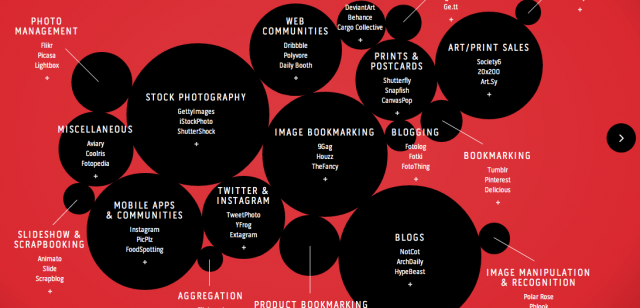
Your Powerpoint pitchdeck is so boring. So. Freaking. Boring. Although tech bloggers aren’t sent startup’s actual pitchdecks as often as investors are (thankfully), we’re still walked through them on dreadful, “let me read to you from my Powerpoint” phone calls more often than should be socially acceptable. That’s why when image aggregator Piccsy, which is simultaneously a competitor to Pinterest as well as a top 20 content source for the site,  pinged us to take a look at its pitch deck, we were pleasantly surprised. A pitchdeck that’s actually fun to read? Can such a thing exist?

Piccsy.com/investors hosts the company’s public pitchdeck, and it’s a striking, visual representation of the data that would be typically found in bullet-pointed slideshows. The format leads you to wander through content and explore, much like Piccsy itself does. CEO Daniel Eckler admits that he doesn’t even know how to use Powerpoint. “I’ve only ever opened the program once or twice in my life,” he says. But it wasn’t just lack of know-how that led the company to ditch the idea of the traditional deck. As outsiders from Toronto, they wanted to stand out, Eckler says.

“We began with a problem (how to get investors to see our deck) and came up with a solution (create something unique, beautiful, informative, and easy to share), as opposed to going with the status quo,” Eckler explains. “This is conceivably the first thing investors are going to relate to when they see a company. Lots of companies that are innovative in other areas are sticking to an old model with their deck, even though they have the resources (dev/design) to do something special.”

Plus, he adds, a generic, Powerpoint-style deck wouldn’t be right for a site that’s all about discovering beautiful imagery.

For what it’s worth, the novel deck has been working. 50,000 pageviews and 15 inbound investor requests came in over the weekend, and the site got linked on Hacker News (where discussion delved into criticisms over content, however, but not the style.) Said one commenter, “it’s a beautiful presentation. I’m jealous….I’d absolutely pay to get a site like that.”

Say, Piccsy – if that whole image aggregation thing doesn’t work out…

The screenshot above is just a snippet. The full site is here.

Read more on Piccsy at www.piccsy.com.

Read the original article here.

Read Full Post »

Article from NYTimes.

MENLO PARK, Calif. — Matt Cohler was employee No. 7 at Facebook. Adam D’Angelo joined his high school friend Mark Zuckerberg’s quirky little start-up in 2004 — and became its chief technology officer. Ruchi Sanghvi was the first woman on its engineering team.

All have left Facebook. None are retiring. With lucrative shares and a web of valuable industry contacts, they have left to either create their own companies, or bankroll their friends.

With Facebook’s public offering in mid-May, more will probably join their ranks in what could be one of Facebook’s lasting legacies — a new generation of tech tycoons looking to create or invest in, well, the next Facebook.

“The history of Silicon Valley has always been one generation of companies gives birth to great companies that follow,” said Mr. Cohler, who, at 35, is now a partner at Benchmark Capital, and an investor in several start-ups created by his old friends from Facebook. “People who learned at one set of companies often go on to start new companies on their own.”

“The very best companies, like Facebook,” he continued, “end up being places where people who come there really learn to build things.”

This is the story line of Silicon Valley, from Apple to Netscape to PayPal and now, to Facebook. Every public offering creates a new circle of tech magnates with money to invest. This one, though, with a jaw-dropping $100 billion valuation, will create a far richer fraternity.

Its members will be, by and large, young men, mostly white and Asian who, if nothing else, understand the value of social networks. And they have the money. Some early executives at Facebook have already sold their shares on the private market and have millions of dollars at their disposal.

Mr. Cohler, for example, is at the center of a complex web of business and social connections stemming from Facebook.

In 2002, barely two years out of Yale, he was at a party where he met Reid Hoffman, a former PayPal executive who was part of a slightly older social circle. The two men “hit it off,” as Mr. Cohler recalled on the online question-and-answer platform, Quora (which was co-founded by Mr. D’Angelo). He became Mr. Hoffman’s protégé, assisting him with his entrepreneurial investments, and following him to his new start-up, LinkedIn.

Then, Mr. Cohler joined a company that Mr. Hoffman and several other ex-PayPal executives were backing: Facebook.

Mr. Cohler stayed at Facebook from 2005 to 2008, as it went from being a college site to a mainstream social network. One of his responsibilities was to recruit the best talent he could find, including from other companies.

Mr. Cohler left the company to retool himself into a venture capitalist. He has since been valuable to his old friends from Facebook.

Through his venture firm, Mr. Cohler has raised money for several companies founded by Facebook alumni, including Quora, created in 2010 by Mr. D’Angelo and another early Facebook engineer, Charlie Cheever. Other companies include Asana, which provides software for work management and was created in 2009 by Dustin Moskovitz, a Facebook co-founder; and Peixe Urbano, a Brazilian commerce Web site conceived by Julio Vasconcellos, who managed Facebook’s Brazil office in São Paulo.

Mr. Cohler has put his own money into Path, a photo-sharing application formed in 2010 by yet another former Facebook colleague, Dave Morin. Path is also bankrolled by one of Facebook’s venture backers: Greylock Partners, where Mr. Hoffman is a partner.

And he has invested in Instagram, which was scooped up by Facebook itself for a spectacular $1 billion. “Thrilled to see two companies near and dear to my heart joining forces!” Mr. Cohler posted on Twitter after the acquisition.

Instagram clearly was a good bet; it is impossible to say whether any of the other investments Mr. Cohler or other Facebookers are making will catch fire or whether the start-ups they found will last. Certainly, there is so much money in the Valley today that start-ups have room to grow without even a notion of turning a profit.

Ms. Sanghvi, one of the company’s first 20 employees, married a fellow Facebook engineer, Aditya Agarwal. Mr. Zuckerberg attended their wedding in Goa, India.

Read the rest of this article here.

Read Full Post »

Article from AboveTheCrowd.

This morning, Intuit announcedits agreement to acquire one of Benchmark’s portfolio companies, Demandforce, for $424mm. As with Instagram, Benchmark Capital is the largest institutional investor in Demandforce. Unlike Instagram, which is a consumer application and is extremely well known, Demandforce focuses on local professional businesses and has chosen to keep an intentionally low profile – a strategy that has served them well.

Great entrepreneurs often blaze their own trails, and the founder and CEO of Demandforce, Rick Berry, is no different. In a day and age of social media, where many companies project a persona much larger than reality, Demandforce chose instead to focus on its customers and its products. We never even announced Benchmark’s funding of the company, which I believe is unprecedented. The Demandforce team always felt that the attention should be focused on the customer rather than the company.

Demandforce’s customer mission has always been the same – to help small businesses thrive in an evolving and increasingly complex connected world. Today, they are the leading provider of interactive “front office” SAAS services to thousands and thousands of professional small business owners. The Demandforce product is a powerful web-based application that seamlessly integrates with existing workflow systems, works automatically, and delivers guaranteed results. Through this, Demandforce provides local businesses – like salons, auto shops, chiropractors, dentists, and veterinarians – with affordable and easy access to the tools and platforms that large enterprises use to communicate with customers, build a strong online reputation and leverage network marketing. It you have ever received an automated communication from your dentist, it was likely sent through Demandforce.

Demandforce’s success puts it at the forefront of the burgeoning “Local Internet” wave. The combination of Internet pervasiveness and smartphone penetration has led to a complete reconfiguration with regard to how local businesses interact with their customers. These local businesses have traditionally spent over $125B/year on traditional media, and this is only in the U.S. But the channels they have historically used, such as the newspaper and the yellow pages, are increasingly compromised. These business owners know they need new solutions, and these dollars will be reallocated to these exciting new platforms. Benchmark believes this “Local Internet” wave is many times larger than the “social” and “mobile” themes with which it is often contrasted. In addition to DemandForce, Benchmark is fortunate to have backed such “Local Internet” market leaders as OpenTable (OPEN), Zillow (Z), Yelp (YELP), Peixe Urbano, GrubHub, Uber, and Nextdoor.

It has been an honor and a pleasure to work with Rick Berry, Patrick Barry, Hoang Vuong, Mark Hale, Sam Osman and Annie Tsai at Demandforce. This is truly one of the best teams ever assembled. It was also a pleasure to work with Steve Kostyshen as well as Mike Maples of Floodgate and Peter Ziebelman of Palo Alto Venture Partners, all of whom preceded us in their investment, and all of whom are passionate fans of the company.

It is certainly thrilling to see a team of entrepreneurs reach a significant milestone such as this.  That said, it is equally bittersweet as it means we will no longer be working directly with them on this incredibly compelling mission. Our loss is unquestionably Brad Smith and Intuit’s gain. Combining the leading “front office” small business SAAS vendor with the iconic Silicon Valley small business company is an incredibly compelling combination.

Read more here.

Read Full Post »

Article from SFGate.

Facebook investors Accel Partners and Goldman Sachs plan to sell as much as $1.8 billion in shares of the top social network, becoming two of the biggest sellers in the planned initial public offering.

Goldman Sachs is selling 13.2 million shares, worth as much as $461.6 million at the high end of the range outlined Thursday by Menlo Park’s Facebook. Accel Partners, an early investor in Facebook, intends to sell as much as $1.3 billion of shares.

Facebook unveiled plans Thursday to raise as much as $11.8 billion in the largest-ever Internet IPO. Executives including Chief Executive Officer Mark Zuckerberg and backers such as Digital Sky Technologies will sell a total of 157.4 million shares for as much as $35 apiece, according to a regulatory filing. None will unload their entire holding.

On Friday, Facebook received a buy recommendation from Wedbush Securities and a target price of $44, its first rating since announcing plans to sell shares in an initial public offering.

Facebook should benefit from its large, growing user base that will help it attract more spending by advertisers and boost revenue and earnings, Michael Pachter, an analyst at Wedbush in Los Angeles, said Friday in a note to investors. Mobile advertising could play an especially important part of the growth in advertising, Pachter said.

“More users should drive more usage, which in turn should drive increased advertising revenue share,” wrote Pachter. “Facebook will capture an increasing percentage of spending on offline advertising, while growing share of online advertising as well, as usage continues to increase and advertisers become more comfortable with the cost-effectiveness of online advertising.”

Facebook would be valued at more than $90 billion, and executive and investor sales would yield $5.5 billion. Existing shareholders paid an average of $1.11 a share for Facebook, the filing shows.

Facebook is offering 180 million shares to raise funds for general corporate purposes.

While Goldman Sachs is one of the IPO underwriters, it failed to win the lead role after scuttling a private sale of Facebook’s stock to U.S. investors last year. Facebook said in January 2011 that it raised $1.5 billion from Goldman Sachs and Digital Sky Technologies, valuing the company at $50 billion. Goldman Sachs, affiliated funds and Digital Sky invested $500 million, while non-U.S. investors in a Goldman Sachs fund bought $1 billion of shares.

Michael DuVally, a spokesman for Goldman Sachs, declined to comment on the plans to sell Facebook shares. Richard Wong, a partner at Accel Partners, declined to comment.

Zuckerberg will offer 30.2 million of his 533.8 million shares in the sale, bringing him as much as $1.1 billion. The majority of his net proceeds will be used to pay taxes associated with exercising a stock option.

Accel, the biggest outside holder, invested $12.2 million in Facebook in 2005 and owns 11.3 percent of Facebook’s Class B shares. At the high end of the proposed IPO price range, Accel’s remaining stake would be valued at about $5.7 billion.

Digital Sky is selling 26.3 million shares to yield as much as $919 million.

Selling may be smart for holders with large stakes who haven’t had a chance to diversify their assets, said Erik Gordon, a professor at the Ross School of Business at the University of Michigan in Ann Arbor.

Other selling stockholders include Elevation Partners, Greylock Partners, Microsoft, Zynga CEO Mark Pincus and LinkedIn Chairman Reid Hoffman. The investors are selling only parts of their Facebook stakes.

Read more here.

Read Full Post »

Article from GigaOm.

“MENLO PARK, CA – On a wind-swept chunk of land where Sun Microsystems experienced both the highest peaks and the lowest depths that the tech industry has to offer, Facebook is quietly working to define itself as an industry force in more than just social networking.

It has only been a few months since Facebook employees began occupying what used to be known as “Sun Quentin,” a self-contained cluster of office buildings on the shore of San Francisco Bay in the shadow of the Dumbarton Bridge, but the company is already starting to think of itself as an industry leader that can shift the debate within the computing revolution of our time: the transition to mobile. It invited reporters last week from several tech-oriented news organizations — Techcrunch, VentureBeat, PandoDaily, and yours truly, among others — down to its new headquarters to discuss the plans Facebook unveiled at Mobile World Congress in February to help advance HTML5 as a mobile development standard.

James Pearce, Facebook’s head of mobile developer relations, thinks that Facebook has the heft and developer relationships to be a unifying force around HTML5 through the Mobile W3C Community Group, introduced two months ago. The linchpin of the so-called “mobile Web,” HTML5 is a collection of technology specifications that has been endlessly debated by the five major Web browser companies — Apple, Google, Microsoft, Mozilla, and Opera — yet implemented piecemeal before the final standard has been agreed upon, leading to all kinds of developer confusion.

“It’s possible that browser vendors don’t know the demand” for mobile Web applications, said Pearce. “This group is kind of like a product-management process in a way.”

The Web is the way

Facebook wants to accelerate the development of a set of common standards and test suites that app developers can use to ensure their apps meet minimum requirements. It also wants to nudge HTML5 standards-makers into deciding on technology for the most crucial features.

HTML5 is extremely promising as a platform that will allow mobile developers to stop worrying about Apple’s App Store approval process and Android’s fragmentation issues, but building a mobile app entirely in HTML5 is a non-starter for many developers because they need to access things like a smartphone’s camera or graphics hardware: areas that HTML5 standards have yet to address.

Still, even Facebook–perhaps as broad an indicator of Internet activity as there is outside of Google search–sees more activity through the mobile Web than it does through iOS and Android combined, Pearce said. He thinks developers just need someone with a little clout to show them the ways of the mobile Web and force browser makers to get their act together on things like camera access.

Facebook’s real intentions are much broader. Apple and Google are notably absent from its group, although Pearce said they were invited to join. Both companies at times have invoked the promise of the mobile Web — Apple in banning Flash from iOS devices, Google in projects such as Chrome OS — but both have significant interests in native application development for iOS and Android.

Facebook, with 850 million users around the world, does not want to be tied down to either platform, especially now that Google is competing directly against it with Google+. Hence the interest in turning HTML5 into a reality: a development platform that no one company truly controls, but that may depend on Facebook’s ecosystem in order to attract users and advertisers en masse. Pearce said HTML5 developers face huge challenges around application discoverability and monetization, areas in which Facebook — with a huge user base and its own payments system — would be all too willing to help.

Widespread rumors have surfaced over the last several years about Facebook’s desire for mobile independence. The company has been said to be working on its own phone, similar to how Amazon used a basic version of Android to build a tablet designed completely around its services. It has also been reportedly interested in building a version of Facebook in HTML5 that is just as functional as native versions of the app for iOS or Android.

Facebook has been quite successful enticing developers to build applications within the desktop version of Facebook, with Zynga’s runaway growth as perhaps the best example of the opportunities it has provided to developers. Now it’s trying to see if it can extend that influence to mobile, a space currently dominated by the big kids on the Silicon Valley block; Apple and Google.

Friends wanted

“The industry was ready for this to happen, and we think of ourselves as good industry citizens,” Pearce said Thursday. He is, of course, referring to “the industry” in terms of the legions of mobile developers, as compared to the established smartphone players. Those developers might be frustrated by the experience provided by Apple and Google, but they have no other alternative to reach mobile users, given the lack of sophistication around the HTML5 standard and the degree to which we’ve all become obsessed with mobile apps since the App Store made its debut in 2008.

In order for its vision to happen, however, Facebook will have to lure a new collection of mobile-oriented companies — several of whom have been in business longer than CEO Mark Zuckerberg has been legally able to drive–into its orbit, away from Apple and Google. Prominent carriers such as AT&T and Verizon are on board as well as handset makers like Samsung and Nokia, but collaborative industry groups come and go in the technology world without ever having done much to change the conversation.

As the company’s already-legendary IPO approaches, Facebook is increasingly interested in defining its mobile strategy on its own terms, courting the tech media (“We’re trying something new,” read the invitation) in order to present its own vision for the future of mobile computing.

Facebook employees are all too aware of the fate that befell Sun, a pioneering company eventually done in by its inability to change along with a changing industry. With its social-media domination seemingly well in hand, Facebook is looking ahead to its next challenge: ensuring it can remain a destination for consumers and developers without having to toe Apple or Google’s line.”

Read Full Post »

« Newer Posts - Older Posts »