Feeds:
Posts
Comments

Article from NYTimes.

Locating a tower in San Francisco using Apple’s Maps app.

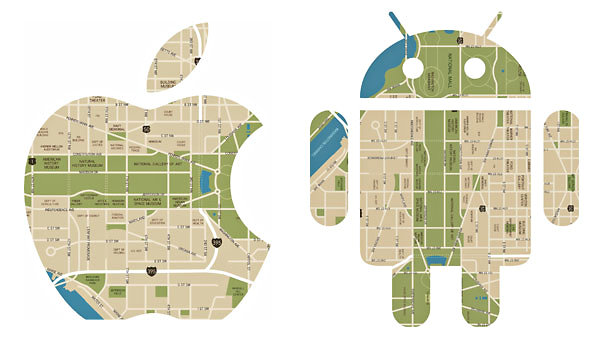
For many people, phones have become an important way to navigate the world, and mobile maps are at the core of the journey. They are often the critical element in commerce, socializing and search. So far, Google has reigned supreme in the mobile map world, with its maps on every iPhone sold so far — and, of course, on every phone based on its own Android operating system.

Last week, though, Apple gave notice it would enter the battle, announcing that in the fall, its phones would no longer carry Google maps, but instead would have Apple’s own map service built in, part of its new mobile operating system. Maps are simply too important to be left to a rival.

The question is: Can Apple build a map service that does as good a job, or a better one, than Google has?

If Apple slips up, consumers in the highly competitive smartphone market may have a good reason to turn to Android phones. If Apple succeeds, Google will be under pressure at a time when it already has to deal with other competitors in map services.

“It makes Apple more valuable and denies Google a lot of user data, and a brand presence, on the iPhone,” said Ben Bajarin, an analyst with the technology research firm Creative Strategies. If Apple cannot meet or exceed Google’s maps, he added, “it will irk their power users,” who are the most valuable customers.

Apple’s move into maps was not exactly a surprise. It has bought a few companies that make mapping features, like three-dimensional visualizations, and has secured rights to data like the names and layouts of streets in over 100 countries from TomTom, a big digital map company based in the Netherlands.

But making digital maps is not easy. Google has spent years working on its services, pouring all kinds of resources into the effort, including its Street View project to photograph and map the world. It will be hard to duplicate that depth and breadth.

“Apple has gotten into a place that is very technical, quite a challenge, and like nothing they’ve done before,” said Noam Bardin, chief executive of Waze, a mapping service that provides real-time traffic information by tracking the movement of phones.

Still, it would be foolish to underestimate Apple, said John Musser, editor of ProgrammableWeb, an online service that follows mobile application development.

“Apple so far has close to nothing in maps, because they never had a product before,” Mr. Musser said. “But they are hardly empty-handed.”

Mapping technology is a growing field that draws on everything from aerial photography to the movement of the continents, to individual comments on Web sites about a favorite hiking trail or a bad dining experience. ProgrammableWeb counts 240 mapping-related services that people building mobile map applications can draw from. That is up 73 percent from a year ago, and 243 percent from 2009.

Apple has offered few details about its plans for the map service, which is part of the new operating system, iOS 6, that was unveiled at the company’s annual developer conference in San Francisco. Some of the features may come from companies that it now owns. Apple may buy other features — like store locations and hours, and information about walking paths, landmarks and public transportation — from data companies, independent developers and consumer information services like Yelp.

Apple can expect to pay a lot of money for this information. Google declined to comment on what it spends on its map business, but others in the industry estimate that the figure is $500 million to perhaps $1 billion annually, equal to a fifth of its budget for research and development.

For consumers, an important part of the Apple service is likely to be the apps that support and enhance it. This week, Apple is set to widely release its instructions, known as a software development kit, to guide developers in designing these apps.

Those instructions are important to hundreds of independent software developers like Scott Rafer, whose start-up is making user-friendly walking directions for maps, based on things like landmarks and street views. He hopes to produce an app that is a hit in the app store, or even wins Apple’s eye as it looks for more partners.

“We’re all trying to figure out the next 100 days” before Apple releases the operating system to consumers, Mr. Rafer said. “Does Apple want gorgeous features, or do they want ubiquity?”

Read more here.

Happiness is an Unexpected Hug

20 plus  years ago I was Coach of the  Under 16 and then Under 18 Boys Select Soccer team in Ross Valley, CA.  I had young men on the team from the US, France, Mexico, Argentina, Brazil, Africa and Korea and the Caribbean.

In the 1993-1994 season, “the Raiders Football Club” had games on weekends for 4 months plus and the players also participated in 2 times a week High School soccer for their teams.   This was a special group, diverse in culture and socio-economic status and going through the challenges of being High School Juniors and Seniors.  All were maturing and experiencing the pressures of peers and society.

During this time, the Raiders Football Club became the Champions of their league and were ranked #4 in the State of California, Under 18 group.  They became a “family” during this Championship Season.

At our end of season celebration, I wondered aloud and also asked, that when I see my players 20 years from now, I expect a “hug” and will they remember to give me a “hug”.   I shared with them that as we all go through “life”, there are very few times that one can be a “Champion” and although early in age, they remember this season and this time, as no one can ever take it away from them.

This past weekend, along with previous times, I saw two of my players at a wedding.  As we saw each other, both came up to me, gave me a “hug” and said thank you and I always remember my team and those years.

I take pride that these young men were able to experience and earn “respect” on the field of battle.  Although not as skilled as most of the teams, they were tenacious, competitive and learned about what it means to be a “team”.

Along with my adult son, who still gives his Dad hugs and kisses, it is very rewarding and provides a sense of satisfaction that these young men remember to give you that “hug”.

Article by Om Malik @ GigaOm.

This is going to be a busy weekend for me. While the weather in San Francisco threatens to be “summer-like,” I am going to be sitting at home and preparing for our Structure 2012 conference. Nevertheless here are seven stories that might be worth reading this weekend.

Read more here.

By – McHugh & Co. and  member of Gerbsman Partners Board of Intellectual Capital

A while back I was retained to help develop a new strategic plan for the management team and the Board of Directors of an angel-backed technology company.

Soon after I started the project, the CEO told me that a significant angel investor/board member (Moneyman) called either she or the CFO every day at 4:45 for an update on the company. Every day, not kidding…

Was Moneyman, “Just checkin’ in…?”

Was he simply showing enthusiasm, expressing interest, acting curious, proffering sage advice, coaching the senior team and being ‘hands on’?

He wasn’t calling to coach or offer operating advice. Moneyman was meddling.

The constant, meddling actions of the controlling, outside investors in the day-to-day affairs of the organization have a direct, negative impact on the organization’s performance.

Meddling can cause a company to be Stuck in a Ditch.

The Board of Director’s Bell Curve

I think a ‘bell curve’ (normal distribution) can be used to understand the participation level of a Director. Here is my interpretation:

Over time, I’ll be writing blog posts about the broad topic of private company boards and governance.  I’ve been a member of nine boards (private equity backed, vc/angel backed or family owned). I’ve also been directly involved with many other company boards through my consulting work.

These blog posts are not going to cover what I would call the ‘board/governance basics’ (i.e. ideal member, term, compensation, etc.). That sort of content is plentiful.

I will examine the different Board personalities and styles of governance I’ve experienced over the last 20 years with a hope that these shared experiences and stories can make your Board more cohesive, and improve the interactions between management and individual board members.

How did Moneyman become a Meddler?

I’ve already said Moneyman is a #5.  I think this table sums it up.

Moneyman:

  • was impatient, increasingly frustrated and dissatisfied with the company’s overall performance…his performance expectations were not being met
  • had put a lot of personal money into the company – he had the courage to commit his money to a new venture
  • did not have a good understanding of market size and customer acceptance of the products; he thought the market was HUGE – it wasn’t
  • questioned the skills of the management team
  • had no meaningful experience in this company’s business or industry; his personal financial success came from a completely different business experience
  • had a very intense personality

All of these factors together produced a combustive mix and created a difficult relationship with the management team and some other Board members.  If he was not one of the ‘lead angel investors’, he should not have been on the Board.

What happened?

Management and the Board came together around a revised strategy, a new operating plan and a realistic set of expectations about customer acceptance and addressable market size.  Revenues increased, the company became cash flow positive and the financial pressures subsided. Moneyman became less fearful that the value of his investment was heading toward zero. He had renewed hope and the meddling diminished and became less intense.

Have you experienced the Meddler? Do you have suggestions on how to work with this type of Director?

Article from GigaOm.

“If there’s one question on which much of Facebook’s $60-billion market valuation hangs, it is whether the kind of “social advertising” the giant network offers to brands actually works or not — in other words, whether having fans and social discussion around a product translates into actual measurable sales. Facebook has now released some actual data from comScore that it says proves the value of building up a fan base on its platform, since doing so appears to increase the likelihood that a user will buy something later. But will the research convince advertisers to devote more time and money to Facebook’s social campaigns? And if so, how much of that will benefit Facebook directly?

The comScore study, which is called “The Power of Like 2: How Social Marketing Works,” (PDF download available here) is the second in a series the web-analytics firm has done with Facebook. The first report came out last July, and argued that brands using the social network need to do more than simply build up a large fan base — they need to use a combination of paid and “earned” media (that is, content that is shared voluntarily by users) to promote whatever marketing message they are focusing on. The latest report is an extension of that case, with some statistical database on what Starbucks and Target have seen from their Facebook campaigns.

Fans of a brand buy more, and so do their friends

According to comScore, Starbucks saw a “statistically significant” improvement in purchasing behavior in its stores in the weeks following exposure to promotional content on Facebook. Perhaps most important of all, the analytics firm said this behavior was seen not just among those who were already fans of the brand on the social network, but also among friends of those fans — evidence of what comScore called a “latent branding impact.” The same kind of impact was seen in a study of buying behavior at Target stores, comScore said.

In a nutshell, the report says that by the fourth week following the exposure of fans and friends of fans to certain advertising content — whether in a “sponsored story” or some other social ad format — the test group’s purchasing rate of 2.12 percent was a little over half a percentage point higher than the control groups’ rate. According to comScore, that means the social advertising on Facebook drove an increase in actual sales of almost 40 percent.

As Peter Kafka of All Things Digital notes, the comScore research is a bit of a double-edged sword for Facebook, since it shows that “earned media” — that is, the kind of social sharing that in many cases brands don’t even have to pay for — can generate a substantial bump in sales all by itself, without the need for traditional display ads. Theoretically, that’s the kind of ammunition brands like General Motors could use to justify dropping their ad spending on Facebook and relying on social sharing of their marketing content instead.

Facebook display ads work too, says comScore

One of the comScore study’s conclusions seems to be aimed directly at this idea — and also at critics who question whether Facebook’s paid ads are effective when the click-through rates on them are so low (even lower than the rates on generic web advertising). The report notes that an analysis of the data showed “statistically significant” increases in both online and in-store purchasing for a major retailer after exposure to display ads, despite the lack of clicks, and that this “highlights the importance of using view-through display ad effectiveness in a medium where click-through rates are known to be lower than average.”

Facebook’s Brad Smallwood, head of measurement and insight for the social network, was more blunt in a comment to the Wall Street Journal about the results of the comScore research, saying it proved that “It’s a myth that Facebook advertising doesn’t work.” The Journal also noted that the quiet period following its initial stock offering has ended, so Facebook is now able to respond to some of the criticisms that arose during the IPO roadshow, and the comScore study is clearly part of that effort.

One thing the study also reinforces is just how much advertisers are betting on Facebook: according to comScore’s analysis, more than 15 percent of all U.S. online display ads were “socially enabled,” meaning they contained a message asking viewers to “like” or follow the brand or the campaign on Facebook. That’s almost double the number of ads that contained those kinds of messages in November of last year, the report said. That kind of bet is what drove Salesforce to spend close to a billion dollars to buy Buddy Media, which specializes in managing Facebook pages and social campaigns.”

Read more here.