Feeds:
Posts
Comments

Posts Tagged ‘boic’

Article from GigaOm.

“Demandware who? Yeah, that is exactly what I thought. However, a tweet from financial and venture industry observer Dan Primack alerted me to the initial public offering of this Burlington, Mass.-based e-commerce platform provider that sells its services to folks like Barneys, Crocs and Tory Burch. The IPO has priced at $16 a share which values the company at $448 million. The company is raising $88 million.”

The company lost money on mere a $56 million in 2011 revenue, a sign that Wall Street is ready to punt on even marginal technology IPOs — so expect more of those to follow in coming months. Jim Cramer on CNBC’s Mad Money show said that one should not confuse a “trade with an investment.” In other words, buy at the time of IPO and then flip it. Buying later is a sucker’s bet. About Demandware, Cramer said, that if the stock priced below $15 it is good. “Anything more than that and there might not be enough juice to merit buying,” he said. Oops!”

Read more articles here.

Read Full Post »

Article by John Backus, Partner New Atlantic Ventures

“Much has been written about the explosive growth of smartphones and tablets, but apps are what make them useful and are driving their adoption. IDC estimates mobile app downloads will reach nearly 182.7 billion in 2015. There are now nearly one million apps, mostly for Apple and Android devices, and Gartner projected app revenue from app stores alone will reach $58 billion by 2014. Apps are big business.

But this sheer volume of apps creates real complexities for app developers and consumers alike. As a developer, how does your app stand apart from the pack? As a consumer, finding the right app is like looking for a needle in a haystack.

Conventional wisdom suggests that search is the answer. Chomp, Quixey and even Yahoo! let you discover apps through search. Others are trying to help you search for apps with various algorithms, through social networks and games.

I disagree with this this entire approach.

Search is not the answer for app discovery – finding the top apps is serendipitous.

We find our best apps today by talking to our friends at a restaurant, by reading about them in a blog or an article, or by stumbling upon them on a recommended or top ten list.

Not a month goes by when an entrepreneur I meet, developing a smartphone app, can’t quite answer a simple question: How will you market your app to your customers? All too often the answer lies somewhere between “Apple is going to feature my app,” and “I’m going to advertise it in other apps.” Neither is a compelling answer, nor likely to help developers build a big business.

We’re placing a big bet, alongside VC media giant, Syncom, that serendipity will drive the app discovery process. That’s why we invested in Apptap. Similar to what an ad network does today, serving you ads based on the content of the web page you are viewing, AppTap serves you apps to consider, based on that same content.

A USA Today online reader, browsing an article in the sports section, is likely interested in seeing sports-related apps. A visitor to TUAW (The Unofficial Apple Weblog) is likely to be intrigued by cutting edge Apple iPhone or iPad apps, but not by an advertisement on basket weaving. A Pandora iPhone listener, on the other hand, is likely not interested in clicking out of Pandora to check out a flashing app advertisement.

So if you are a developer, quit trying to trick customers into downloading your app via incented downloads. Don’t run random app ads, it is too reminiscent of early run-of-site banner ads. And don’t think that hoping to be featured in someone else’s app store is a good strategy.

Instead, put your app where your customers are likely to discover it, and you will be well on your way to growing your audience with users actually interested in your app.

Originally published on the Huffington Post, January 13, 2012. Follow John on Twitter @jcbackus”

Read original post here.

Read Full Post »

Article from GigaOm.

“Two Silicon Valley-backed Bay Area companies appear to be the tech vendors behind Apple’s new sizable and pioneering clean power push at its massive data center in North Carolina. Last week it was revealed that solar panel maker SunPower will provide Apple with panels for a 20 MW solar farm, while I reported earlier this month that fuel cell maker Bloom Energy looks to be the vendor behind Apple’s 5 MW fuel cell farm. The significance of Apple opting to partner with two Valley-born clean power firms illustrates that the greentech venture ecosystem can work — it just takes quite a long time.

San Jose, Calif.-based solar panel maker SunPower was founded way back in the mid-80′s by Stanford electrical engineering professor Richard Swanson, and received early funds from the Department of Energy, the Electric Power Research Institute, two venture capital firms and chip firm Cypress Semiconductor. The company went public in the Spring of 2005, bought venture-backed Berkeley, Calif.-based solar installer Powerlight in late 2006, and more recently was bought by oil giant Total.

Sunnyvale, Calif-based fuel cell maker Bloom Energy was founded a decade ago, though only came out of stealth two years ago, and was venture capital firm Kleiner Perkin’s first foray into greentech. Bloom also counts venture firm NEA as an investor, and Bloom raised its latest $150 million round of funding in late 2011.

Both companies have taken years to develop into firms that can mass produce their respective clean power technologies at scale and at a low enough cost to meet the needs of a large customer like Apple. And both companies have likely taken longer to mature than their investors had originally hoped. Kleiner Partner John Doerr said a couple years ago that he thought Bloom Energy would take nine years to go public (which, if true, would mean Bloom would have gone public last year). SunPower’s execs reportedly said back in the early(ish) days of the company that developing SunPower into a solar manufacturer took a lot longer than they anticipated.

But Apple apparently chose these two Bay Area clean power leaders for its first-of-its-kind, huge solar and clean power farms, suggesting these firms are delivering industry-leading products at the right economics for Apple. Apple is spending $1 billion on the data center, and likely between $70 million to $100 million on the solar farm. Each 100 kW Bloom fuel cell costs between $700,000 to $800,000 (before subsidies), so Apple’s fuel cell farm could cost around $35 million.

Yes, both SunPower and Bloom Energy, have had their fare share of struggles in recent years. 2011 was a particularly difficult year for SunPower, with a glut of solar panels causing prices to fall around 50 percent globally and Total’s CEO said recently that SunPower would have gone bankrupt last year without Total’s backing. Bloom Energy is a private company and doesn’t disclose its financials, but likely if Bloom was in shape to go public in 2011, it would have done so.

However, it’s no secret that greentech has been a particularly hard area for venture capitalists to invest in. The long time tables, the large capital needed, the hardcore science for the innovations, and the low cost focused energy markets, have created a difficult ecosystem for the traditional VC to make money off of. But after a long slog — which is still ongoing for SunPower and Bloom Energy in 2012 — these clean power technologies have actually broken into the mainstream. Valley, backed cleantech firms can make it — you’ve just got to sit back and wait.”

Read original article here.

Read Full Post »

Article from TechCrunch.

“Yesterday, Google announced the launch of Google Play, a rebranded Android Market which consolidates all of Google’s media offerings, including apps, music, movies and e-books, into one portal. But it appears that Google’s ambitions to create its own iTunes-like experience won’t stop there. In the Help Center for the new Google Play, empty pages titled “Audio Books” as well as “Magazines and journals” have appeared, hinting at Google’s plans into its future content offerings.

The Audio Books page was first spotted by unofficial Google news site Google Operating System, which also discovered two genres for audiobooks listed on the site (“audio books” and “audiobooks”). However, because of the duplicated spellings, this last bit is not as telling as the placeholder page in the Google Help Center. It could be that the genres are automatically generated, the blog speculates.

It wouldn’t be surprising for Google to move into audiobooks, though, an obvious complement to their current offerings, as well as into magazines, newspapers, catalogs, educational content, TV shows, and everything else that Apple is doing now within its iTunes universe. If anything, the rebranding effort with the Android Market (as much as we may hate it), seems to speak to a desire for it to be seen as a more robust, richer offering than “just” an app store.

To that end, Google even registered several domains that suggest its ambitions. These unused domains include googleplaymagazines.com, googleplaynewspapers.com, googleplaynewsstand.com, googleplaytv.com, and many other variations on those themes.

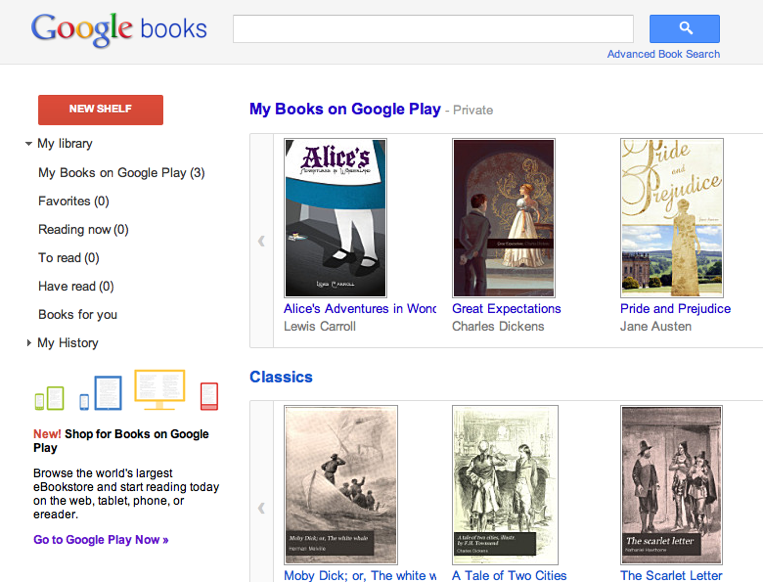
Google is also developing a consumer-facing experience for organizing purchased e-books at the home of its former online ebookstore, an Amazon-like shopping portal found at books.google.com/books. To be clear, that’s a separate storefront from its books search engine books.google.com (which also now points to Google Play). The stalled effort at creating a home for users’ purchased ebooks now has a second chance, complete with a library of books on Google Play, including a few pre-loaded classics like Great Expectations and Pride and Prejudice. Audiobooks would fit in well here, if Google moved in that direction.

Also of note, there are magazines available in this ebooks portal too, but not in the Google Play store. It’s clearly only a matter of time before the two sites (Play and Books) are even further merged making those magazines easy to find and purchase using the revamped Android Market…err…Google Play service. After all, if you have ‘em, promote ‘em.

Not surprisingly, there’s a placeholder help page for that, too, dubbed “magazines and journals.” Newspapers and TV placeholder help pages don’t yet exist, however.”

Read the whole article here.

Read Full Post »

Article from AboveTheCrowd by Bill Gurley.

“Back in October, Techcrunch announced that Dropbox had raised $250mmat a seemingly absurd valuation. Many firms, including my firm Benchmark Capital, participated. When this happened, many people asked us why this was a special company that would cause us to break our standard investment paradigm. They didn’t quite understand why this was a company that deserved once-in-a-generation special attention.

The first answer to this question is rather straightforward, but not earth shattering. Drew Houston and his team had taken a hard problem — file synchronization — and made it brain dead simple. Anyone that had used previous file synchronization programs, including Apple’s own iDisk, constantly encountered state problems. Modifications in one location would get out of synch with those in another, ruining the  entire premise of seamless synchronization. It wasn’t that these other companies did not understand the problem, it was just that they could not execute on the solution. The Dropbox team solved this, which was a critical innovation.

Although this was critical, nailing technical synchronization would not necessarily warrant outsized valuations. In order to be worth $40B one day (which is 10X the $4B reported round, the objective return of a VC investment), the company would need to hold a place in the ecosystem that is far more strategic than that of a simple high-tech problem solver. So what is it Dropbox does that is so special?

This evening, TechCrunch reported that Dropbox would automatically synch your Android photos. Once again, someone could suggest “so what, how hard is it to do that?, and why is that worth billions?”

Here is why. Once you begin using Dropbox, you become more and more indifferent to the hardware you are using, as well as the operating system on that device. Dropbox commoditizes your devices and their OS, by being your “state” system in the sky. Storing credentials and configurations of devices, and even applications are natural next steps for this company. And the further they take it, the less dependent any user becomes of the physical machine (HW and SW) that is accessing that data (and state). Imagine the number of companies, as well as the previous paradigms, this threatens.

That is a major, major deal. And it comes at a time where there are many competing platforms on both desktop and mobile. This “unsure” market backdrop ensures the need for a cross-platform solution and plays right into Dropbox’s hand. You can lose your desktop computer, you can lose your smartphone. It doesn’t matter, because all you really care about is in the Dropbox cloud.”

To read the blog, and reach Bill Gurley, please click here.


Read Full Post »

« Newer Posts - Older Posts »