Feeds:
Posts
Comments

Posts Tagged ‘Business Insider’


Microsoft’s Surface boss explains the master plan behind the new Surface Studio PC

microsoft surface panos panayMicrosoft Corporate VP of Devices Panos PanayMatt Weinberger/Business Insider

The whole point of the original Microsoft Surface tablet, released in 2012, was to show PC manufacturers and the world just how good a touchscreen-enabled Windows PC could be, Microsoft CVP of Surface Panos Panay told Business Insider earlier this year.

“We needed to ensure it would happen right,” Panay said at the time.

So when Microsoft last week unveiled the Surface Studio — a gorgeous all-in-one PC that doubles as a touchscreen drafting table for creatives — it raised a big question.

If the Surface was designed to bring the Windows PC industry around to touchscreens, what does the Surface Studio do for Microsoft?

“The entire ecosystem benefits when we create new categories and experiences that bring together the best of hardware and software,” Panay tells Business Insider. He calls the Surface Studio “a new way for people to experience Windows 10, Office, Skype and more.”

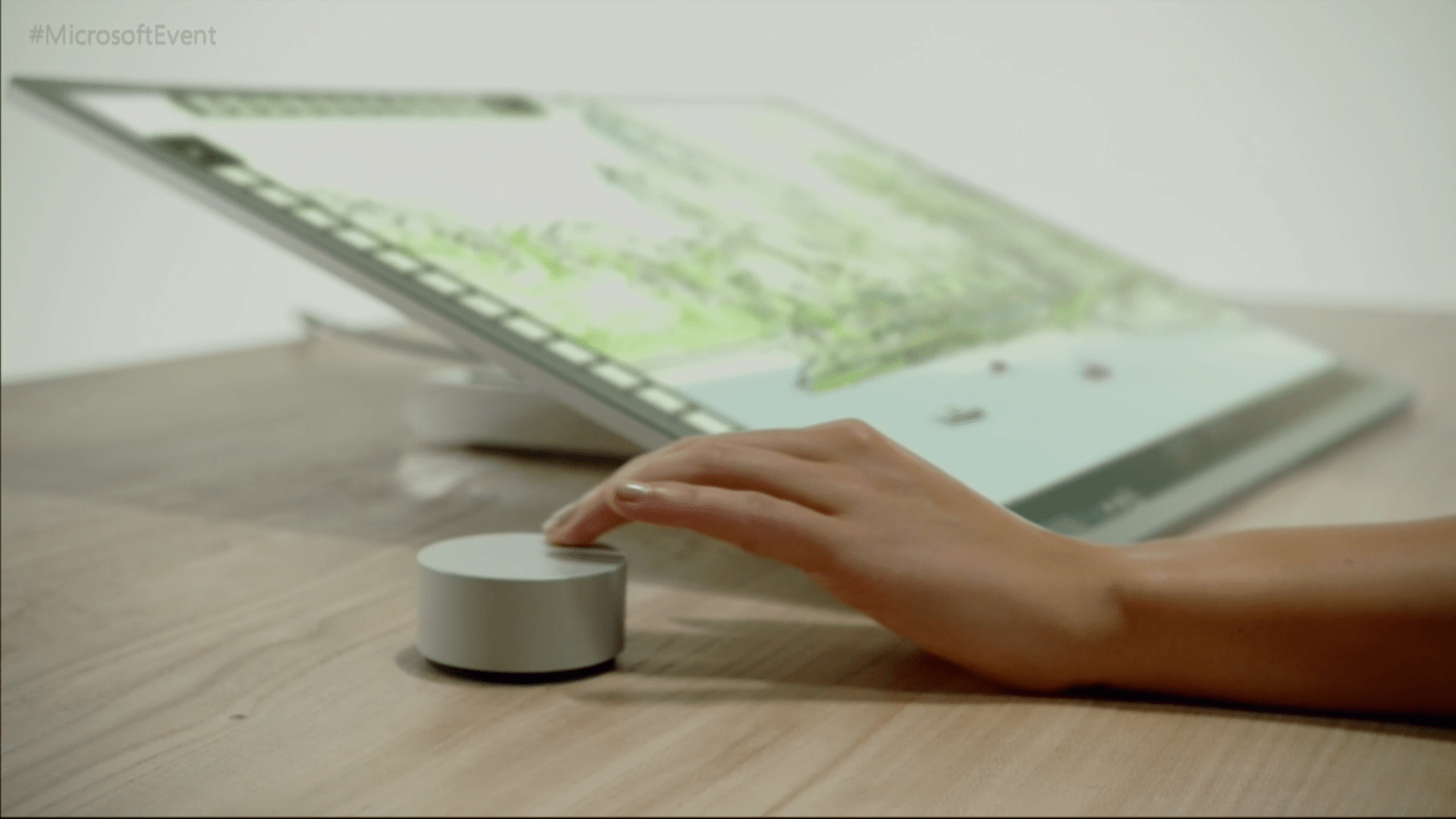
To clarify, Panay is saying that the Surface Studio brings Windows 10 and the rest of Microsoft’s family of apps to new audiences. So far, judging from the earliest reviews and impressions, the Surface Studio is at least winning the interest of the artists and creative types that have historically formed much of Apple’s base.microsoft surface studioMicrosoft Surface Studio, with the Surface Dial accessory.Microsoft

That, in turn, brings new users into the Windows 10 fold that otherwise may have stayed on Team Apple. That’s good for Microsoft, as it works around the clock to spur the growth of Windows 10 amid mounting competition. As Panay told us earlier this year, hardware is “part of the growth story for Windows and for Microsoft.”

And in the same way that you saw other companies (including Apple) copy the Surface tablet and Surface Book laptop design for their own devices, Panay says Microsoft is expecting history to repeat itself.

“With Surface, we pioneered new experiences for our customers and we’ve seen others in the industry follow suit,” Panay says. “I expect that we may see the same with this new category, and that would be a great thing for customers and for Windows.”

Which is to say, expect Windows PC manufacturers to follow Microsoft’s lead and build their own takes on the Surface Studio, the same way that companies like Lenovo and Samsung have built their own Surface Pro-like tablets.

Surface switch

On a final note: Back in August, Panay mentioned that despite the Surface Book’s trademark detachable tablet display, Microsoft thought of it as a laptop first and foremost — cool as it is to turn your screen into a standalone tablet, he didn’t expect people would make daily use of the feature.

So I asked Panay how Microsoft is thinking about the Surface Studio. Do they think it’s mostly a desktop PC, or mostly a mega-sized drawing table? Panay says that “every feature was highly scrutinized” to make it something that feels natural, even if you’re constantly switching between using it as a PC or tilted to use it as a drafting table.

microsoft surface studioThe Microsoft Surface Studio, with the Surface Dial accessory.Microsoft

“We wanted to create a device that follows you through your creative process and adapts to your need in that moment,” Panay says. “We think people will naturally flow between desktop and studio mode as they move through their process and their day.”

The Microsoft Surface studio launches this holiday season starting at $2,999.

Read Full Post »

LinkedIn is working on a project that should terrify Cisco and the rest of the $175 billion hardware industry

LinkedIn Zaid Ali Kahn, data center Zaid Ali Kahn at LinkedIn’s flagship data center, in Oregon. LinkedIn

In the shadow of its acquisition by Microsoft, LinkedIn has quietly begun talking about an internal project that has the potential to shake up the roughly $175 billion data-center hardware market.

LinkedIn’s plan is somewhat similar to what Facebook is doing with its Open Compute Project. OCP is creating brand-new “open source” data-center hardware, in which the engineers from different companies work together and everyone freely shares the designs.

In its five years, OCP has upended the data-center market and generated a cultlike following so big that when Apple forbade its networking team to join OCP, the whole team up and quit.

Likewise, LinkedIn is designing and building nearly all the pieces and parts of software and hardware that it needs for its data centers, poaching key people from Facebook and Juniper to do it.

“We are not building servers and switches and all these things because we want to be good at it. We are doing it because we believe it gives us an advantage to control our own destiny,” Zaid Ali Kahn, senior director of infrastructure architecture and operations at LinkedIn, told Business Insider.

This is a terrifying trend for vendors like Cisco and Juniper. In the past, only the biggest internet companies like Amazon, Google, and Facebook have gone this route: designing their own IT infrastructure from scratch.

LinkedIn isn’t as big as those guys. It has a handful of data centers in California, Texas, and Virginia — most of them using leased space at a hosting provider — and only recently started designing and building its own in Singapore and Oregon. The one in Portland, Oregon, is its crown jewel, and the other data centers will eventually be upgraded with the new technology.

Internally, this is known as Project Altair, and the plan to build its own network software to run on dirt-cheap commodity network hardware is known as Project Falco.

A superfast network for $1

The story begins with a Facebook network hardware engineer named Yuval Bachar. He was part of a Facebook team in 2013 that had a big goal: reducing the price of building a super-high-speed computer networks tenfold. Facebook had stolen him from Cisco, and he did a stint at Juniper, too.

LinkedIn Yuval Bachar Yuval Bachar. YouTube/@Scale

He wanted to pay $1 per gigabyte, or $100 for each piece of network equipment that normally costs $2,500 — and he publicly announced the goal at an industry conference.

He then went on to help Facebook build its industry-changing, l0w-cost, open source Wedge switch that put market leader Cisco on notice. Earlier this month, Facebook announced the second generation of that switch.

About the time Bachar announced his goal, the LinkedIn networking team was struggling with its own network, which wasn’t handling the company’s user growth very well.

“The Production Engineering Operations (PEO) team found it very difficult to meet the demands of our applications when network routers and switches are beholden to commercial vendors, who are in control of features and fixing bugs,” Kahn wrote in a blog post.

In early 2015, the team began to build its own switch, called Pigeon. In the fall, it hired Kahn to help do it. It began testing the switch early this year.

LinkedIn's Pigeon switch LinkedIn’s Pigeon switch. LinkedIn

Deja vu

In the meantime, having been a part of OCP, Bachar came up with a similar plan for LinkedIn. OCP started by creating a rack that holds stacks of computers, storage drives, and network switches.

Open19 rack The Open 19 rack. Open19.org

As a company grows, it simply adds more switches, servers, and disk drives to the rack. But the racks themselves can be expensive, including all sorts of bells and whistles that LinkedIn didn’t need.

Facebook had the same problem, so it built a stripped-down 21-inch rack, then designed its own servers and storage to put in it.

But hardly anyone else uses a 21-inch rack. “Probably 99.5% [of companies] are using a 19-inch rack,” Kahn told us.

That means for LinkedIn (or anyone else) to use Facebook’s rack, it had to renegotiate supply deals with its vendors to get gear in different sizes.

It was deja vu. Bachar led an initiative called Open 19 to create an open standard for a low-cost 19-inch rack. This rack can be stuffed with 96 servers for $50,000 total, saving $25 million across a 500-rack data center, the organization says.

Having seen the impact of OCP, vendors jumped on board, including some of the Chinese contract manufacturers that have made a killing supporting OCP. Hewlett-Packard Enterprise, which was late to OCP, is also a member.

Full-steam ahead, no turning back

Microsoft, which expects its $26.2 billion acquisition of LinkedIn to close by the end of this year, is a member of OCP and has standardized its 21-inch racks and other OCP technology.

Kahn wouldn’t comment on the impact of the acquisition, but Microsoft has promised to let LinkedIn operate independently. A person with knowledge of the situation told us projects Altair, Falco, and Open 19 are still full-steam ahead.

This person points to the fact that in September, three months after the merger was announced, the company hired Doug Hanks from Juniper Networks.

LinkedIn Doug Hanks Doug Hanks. LinkedIn/Doug Hanks

Hanks was Juniper’s director of product management and strategy, and has written a number of books on Juniper’s tech. He’s now LinkedIn’s director of engineering.

“Doug Hanks reports to me,” Kahn said. “He recently joined and we’re delighted to have him.”

“His focus is to build the network engineering team and take it to the next level and help execute a number of initiatives, understanding the blend between software and networking,” he said.

Our source said that with Hanks on board, LinkedIn plans to be almost fully reliant on its own home-grown network gear in 18 to 24 months, and then “it’s no turning back at that point.”

Kahn insists that LinkedIn’s goal differs from Facebook’s. He’s not looking to pick a public fight with the network industry led by Cisco.

In fact, he’s still buying network gear from a number of commercial vendors — as long as they allow him to ditch their software so he can install his own, he said.

“A lot of vendors are open to that, to meet the needs of a web scale company,” he said.

LinkedIn also hasn’t fully committed to giving away all of its home-grown infrastructure software, the designs of its switch, or other hardware, as OCP has. But Kahn hasn’t ruled out openly sharing its technology either.

“LinkedIn’s culture is open source, so when the time is right we will be open to that,” Kahn said.

In fact, LinkedIn was a founding member in Hewlett-Packard Enterprise’s open source project, called OpenSwitch, to build a Linux-based switch. OpenSwitch is now run by the Linux Foundation (and word is that the initiative is floundering and LinkedIn is looking for alternatives).

Meanwhile, LinkedIn has also been sharing technical articles about its network software.

Big money at stake

Internet companies using commercial network gear often spend $40 million to $140 million a year on it with vendors like Cisco, Arista, and others, one person who ran a large internet network recently told Business Insider.

Seeing a company LinkedIn’s size roll its own, they could be encouraged to try that themselves.

One person not associated with LinkedIn who built a huge data center for one of the world’s largest tech companies said that after his company starting building its own network equipment, it drove the costs down by a factor of 10: from $40,000 per Cisco switch to $4,000 per cheaper “commodity” switch capable of running home-grown software.

“Arista, Cisco, Juniper, they are all s—ing themselves about this trend,” said someone familiar with LinkedIn’s project. “The big guys, Google, Amazon, Facebook, are all doing this for economies of scale. For them, it’s all about money. It’s cheaper to build their own. At LinkedIn, cost is not the No. 1 priority at all. They want to have complete control over the user experience, to own everything in the stack. Then they can standardize it.”

Read Full Post »

Why the market is freaking out about Tesla

Elon MuskTesla CEO Elon MuskReuters/Bobby Yip

Financial opinions around Tesla are once again lurching wildly.

This always seems to happen when there’s a moment to reassess the electric-car maker’s stock. On Sunday, Tesla announced that it had greatly exceeded delivery expectations for the third quarter, with 24,500 vehicles officially sold to customers.

That news didn’t send the stock on a run. After a modest 5% bump, Tesla shares slipped back to around $210.

Then they fell off a cliff on Thursday, when Goldman Sachs downgraded its Tesla rating to “neutral” and dropped its target price to $185 from $240. This follows a much more substantial downgrade by Morgan Stanley’s reliable Tesla bull, Adam Jonas, who had earlier pulled back his target price to $245 from a lofty $465.

For many analysts, Tesla has nowhere to go but down, given that the company has probably achieved as much rapid growth as was possible and now has all its value effectively “priced in.” That situation offers a $30 billion market cap and a return of over 1,000% for the earliest Tesla investors — those who got in back in 2010, when shares were $17.

But for the past year, it’s been slowly dawning on Tesla analysts that this onetime high-tech, high-growth company out of Silicon Valley isn’t the Amazon of automobiles. Rather, it’s a maturing carmaker, a new entrant in one of the most capital-intensive businesses yet devised by humans.

Burn, baby, burn

TSLA Chart 10/7/16Ouch.Google Finance

Putting aside worries about Tesla’s other business lines — the $2.6 billion SolarCity acquisition, the emerging energy-storage enterprise, the $6 billion battery factory in Nevada — all attention has now shifted to near certainty that Tesla will once again need to sell shares to raise money, several billion in all likelihood.

Market observers have griped that there’s a deep conflict of interest between banks such as Morgan Stanley and Goldman Sachs grabbing Tesla’s stock issuances at the same time they’re making calls on its share price, but at the moment, those banks look as though they’re trimming their expectations for Tesla as an investment.

Tesla isn’t going to get a free pass on its capital burn forever. At the moment, capital discipline is all the rage in the auto industry. Fiat Chrysler Automobiles CEO Sergio Marchionne has been dining out on a scathing presentation he gave last year called “Confessions of a Capital Junkie,” in which he excoriated the auto industry for its flagrant cash-burning ways.

General Motors executive leadership is also preoccupied with how it’s spending its money — and it has a lot to spend. GM President Dan Ammann told Business Insider last week the automaker is making $1 billion a month. But GM is explicitly engaged with committing only to markets where it thinks it will see a good return on investment. That drove a decision in 2015 to exit the Russian market, one once thought to have the potential for major growth.

Triple-secret double-down mode

mary barraGM CEO Mary BarraBill Pugliano/Getty

Tesla hasn’t historically been bad at capital discipline; over the course of a year, it has a fraction of what a GM or Ford or Toyota might spend in a quarter, so it has to watch every penny. But CEO Elon Musk and his team are now in triple-secret double-down mode — I know that doesn’t make any sense, but Tesla future investment requirement are almost comically ambitious — and from the perspective of leadership, it would be dumb to let the stock slip before heading back to the markets to raise money. Musk wants to produce 500,000 vehicles annually by 2018, and getting there ain’t gonna be cheap.

The bottom line is that Tesla sees its stock price as a means to an end. The company’s own investment thesis, such as it is, asks investors to take a long-term view: Tesla will be a major player in the future of transportation. Whatever happens with the stock price day-to-day is a distraction. All that matters is that Tesla shares be considered valuable when it’s time to create a new cash pile.

Tesla is right on the edge of crossing a river when it comes to how it spends money. As it gets bigger and has to manage more lines of business, capital efficiency will become vastly more important. But for now, Tesla’s capital exists to be spent, and that’s clearly freaking out the analysts who cover the company.

Read Full Post »

It’s time for Elon Musk to think about turning the Tesla CEO job over to someone else

spacex elon musk mars colonization Musk. Mars. SpaceX/YouTube

You may have missed it, but this was the most head-warping week in Elon Musk’s life, for anyone who has been following the man’s adventures for the past decade.

Early last week, at the 67th International Astronautical Congress in Guadalajara, Mexico, Musk outlined his master plan to start colonizing Mars in less then 10 years, using his private space company, SpaceX, to realize his ambition to make humanity an interplanetary species.

Later in the week, he had to send an email around to Tesla employees reminding them not to engage in discounting on vehicles sales.

Life on Mars versus … come on down!!!

The contrast was vivid. I think I’m safe in saying that no other captain of American industry has ever grappled with something so visionary and captivating on the one hand and so drearily mundane on the other. Henry Ford wasn’t trying to go to the Moon at the same time he was building the Model T.

Too much success

Musk has become a victim of his own success. There hasn’t been a viable new American car company created since the 1930s, but in just over a decade, Musk has forged not just a new automaker, but also a carmaker that has pushed electric vehicles forward for the first time since they lost out to internal-combustion engines over 100 years ago.

And although a mission to Mars has been much discussed since the late 1960s and the moon landings, the assumption has always been that NASA would undertake it. With SpaceX, Musk is striving to remake that notion. (NASA may still do it, but NASA lacks a charismatic leader to stand up and articulate the way it’s going to happen.)

spacex elon musk mars colonization Why stop at Mars when can go to Jupiter? SpaceX/YouTube

As Tesla progresses toward being a mass-market automaker — leaving its high-tech, luxury, niche existence behind — Musk will have to deal with more head-warping. Manufacturing and selling cars isn’t very space-age; rather, it’s plug-and-chug. Supply-chain management rules the day, and sales are largely transacted one at a time, between a buyer and dealer.

Tesla wants to cut the dealer out of the picture, selling directly to the consumer, so Musk doesn’t even have that buffer. He himself has to lay down the law if he detects any slippage in his full-price-only business model.

He’s certainly price conscious when it comes to the cost of space travel — he wants to make going to Mars as cheap as buying a Tesla Model S. But the ambition required to even bring that calculation into the picture is an order of magnitude greater than what Musk has achieved with Tesla. Rocket science is, after all, rocket science.

A hard choice

I don’t personally want Musk to stop running Tesla day-to-day so that he can focus all his energies on SpaceX. But I also realize that even if Musk moves the needle just a bit on “backing up the biosphere,” as he likes to put it, in case that wayward asteroid heads our way, then that’s where his attention should be. There’s no shortage of talented leadership in the auto industry, and Tesla could probably use a more experienced hand to guide it into its next phase.

elon musk Parting would be sweet sorrow. Justin Sullivan/Getty Images

I don’t think Musk wants to “retire” as CEO of Tesla, either. Ultimately, he sees electric cars and a mission to Mars as linked; the former gets us off fossil fuels and the latter provides us with an escape hatch.

But priorities are in order, and as much as Musk, a creature of Silicon Valley, has learned the lesson of Steve Jobs and Apple — companies that sacrifice their visionaries in favor of stewards do so at their peril — he doesn’t appear to fully understand just how daunting his objective has become.

Jobs wanted to sell more computers, music players, and phones, with cool design values. He never said anything about leaving orbit and heading for a red world 34 million miles away.

Musk has his issues and his critics, and he isn’t always the finest business leader in all the land. But there’s really never been anyone else like him in American business life — or really science and technology life, either. You have to go back to Thomas Edison at least to find anyone even close.

Tesla is an important company, but for several years now, I’ve had the sense that SpaceX is more important. Space has always been something that nations do. But Musk is changing that (even though NASA is still his biggest client). The Mars plan he laid out is astonishing. And he should now allow it to take up all his time.

Read Full Post »

Amazon is eating away at Google’s core business

jeff bezos amazon ceo happy laughing smilingJeff Bezos, the founder and CEO of Amazon.Alex Wong/Getty Images

Current Prices

For more and more people, Amazon is the first port of call when it comes to researching potential purchases — and that’s bad news for Google.

Over half of Americans now go to Amazon to carry out their first search for products, turning away from search engines and other online retailers, according to a new study from the marketing company BloomReach. (The research was previously reported on by Bloomberg.)

Fifty-five percent of those surveyed made their first search on Amazon, up from 44% a year ago. At the same time, just 27% of people began at search engines, down from 34%. Retailers also saw a decline, dropping to 16% from 21%.

(The study took place on Labor Day, May 1, and surveyed 2,000 US consumers. There’s no word on data from other countries, but it seems reasonable to assume that the data might be similar in Western markets where Amazon has a similar presence as in the US.)

It’s a yet another sign of how fully Amazon is dominating online shopping — but it’s also particularly bad news for Google.

Google’s original, core business is a search engine. But more and more consumers are now opting to bypass it in favor of heading straight to the ultimate destination.

A customer pushes her shopping cart through the aisles at a Walmart store in the Porter Ranch section of Los Angeles November 26, 2013. REUTERS/Kevork Djansezian Shopping IRL is so passé.Thomson Reuters

The ads Google can serve next to product or shopping searches are especially lucrative (as they can be highly targeted at users clearly intending to spend money), making this trend more damaging than if Google’s search market were eroding in a different sector (educational searches, for example).

A Google representative declined to comment.

There’s still no guarantee, however, that people who visit Amazon first will definitely buy from there — something BloomReach acknowledges. “Just because consumers start on Amazon, that doesn’t mean they ultimately buy from Amazon,” marketing head Jason Seeba said in a statement. “Instead, they’re often comparing and researching products on search engines and other retailers.”

Plus, it’s not as if Google is dependent solely on search: Its revenue now comes from everything from its DoubleClick ad network to its Google Play purchases.

But even so, Amazon has become the unrivalled go-to destination to start Americans’ search for products — and that has to worry the world’s largest search engine.

Read Full Post »

« Newer Posts - Older Posts »