Feeds:
Posts
Comments

Posts Tagged ‘google’

Article from NYTimes.

Google’s venture capital arm is investing in a start-up founded by Apple alumni that is seeking to make mobile users a little less anonymous to advertisers.

Adelphic Mobile, based in Boston, has raised $10 million from Google Ventures and Matrix Partners, a firm that invested in the company during an earlier fund-raising round. The company has raised $12 million to date.

Adelphic was founded in 2010 by Changfeng Wang and Jennifer Lum, both of whom used to work for Quattro Wireless, a mobile advertising start-up that was acquired by Apple and became the foundation for iAd, Apple’s mobile advertising network.

Mobile advertising has been a disappointment to many people in the technology industry. The explosion of mobile devices initially prompted exhilaration among marketers about the potential for peppering people with ads on the cellphones that are always at hand. Google and Apple both bought start-ups to help bolster their mobile advertising efforts.

But many companies, including Facebook, have found it more difficult to make money from mobile advertising than through traditional Web sites. That is in part because of the limited screen real estate people have on their smartphones and their wariness about having it filled up with advertising.

“It’s not growing nearly at the rate it should have been given mobile media consumption rates,” said Ms. Lum, the president of Adelphic.

Adelphic is focused on another problem with mobile advertising: the relative poverty of data that advertisers have about the mobile users they are trying to reach. Through Web browsers on computers, it is easier to deliver targeted ads to users by keeping data on their browsing habits employing tools like browser cookies, the small identification files advertising networks place on computers.

Mobile advertisers do not know as much about users because mobile browsers and apps are not as commonly configured to allow the kinds of identification techniques that work on computers. As a result, advertisers do not know much more about the audiences they are trying to reach other than the type of cellphone they have and the wireless network they are on, Ms. Lum said.

Adelphic seeks to paint a more detailed picture of mobile Web users by using complex software to analyze dozens of “signals” about mobile users’ online activities, though Adelphic is not willing to go into too much detail about how the process works (it says it respects the privacy policies of the publishers that show its advertising).

Through its data mining, the company says it can identify the likely age of mobile users, as well as their gender and general location. In turn, the company tells advertisers it can deliver ads to the specific audiences they are after.

Rich Miner, general partner at Google Ventures, said in an interview that mobile advertising would become more effective over time and that Adelphic’s service was helping to push the market forward.

“With the growth of mobile, we’re still very early and, just like in traditional online ads, there’s still a tremendous amount of innovation and value to be created,” said Mr. Miner, who also co-founded Android. Google acquired that company and used its technology as the basis for its Android mobile operating system.

Read more here.
Read Full Post »

Article from NYTimes.

Locating a tower in San Francisco using Apple’s Maps app.

For many people, phones have become an important way to navigate the world, and mobile maps are at the core of the journey. They are often the critical element in commerce, socializing and search. So far, Google has reigned supreme in the mobile map world, with its maps on every iPhone sold so far — and, of course, on every phone based on its own Android operating system.

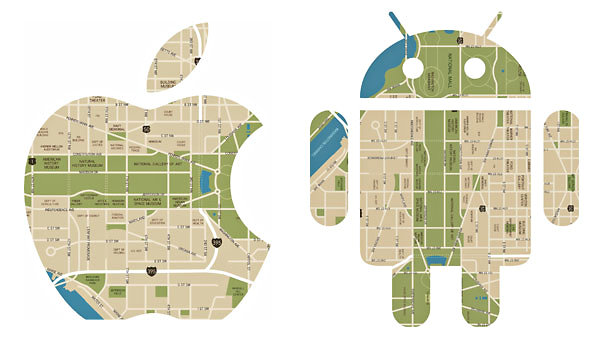
Last week, though, Apple gave notice it would enter the battle, announcing that in the fall, its phones would no longer carry Google maps, but instead would have Apple’s own map service built in, part of its new mobile operating system. Maps are simply too important to be left to a rival.

The question is: Can Apple build a map service that does as good a job, or a better one, than Google has?

If Apple slips up, consumers in the highly competitive smartphone market may have a good reason to turn to Android phones. If Apple succeeds, Google will be under pressure at a time when it already has to deal with other competitors in map services.

“It makes Apple more valuable and denies Google a lot of user data, and a brand presence, on the iPhone,” said Ben Bajarin, an analyst with the technology research firm Creative Strategies. If Apple cannot meet or exceed Google’s maps, he added, “it will irk their power users,” who are the most valuable customers.

Apple’s move into maps was not exactly a surprise. It has bought a few companies that make mapping features, like three-dimensional visualizations, and has secured rights to data like the names and layouts of streets in over 100 countries from TomTom, a big digital map company based in the Netherlands.

But making digital maps is not easy. Google has spent years working on its services, pouring all kinds of resources into the effort, including its Street View project to photograph and map the world. It will be hard to duplicate that depth and breadth.

“Apple has gotten into a place that is very technical, quite a challenge, and like nothing they’ve done before,” said Noam Bardin, chief executive of Waze, a mapping service that provides real-time traffic information by tracking the movement of phones.

Still, it would be foolish to underestimate Apple, said John Musser, editor of ProgrammableWeb, an online service that follows mobile application development.

“Apple so far has close to nothing in maps, because they never had a product before,” Mr. Musser said. “But they are hardly empty-handed.”

Mapping technology is a growing field that draws on everything from aerial photography to the movement of the continents, to individual comments on Web sites about a favorite hiking trail or a bad dining experience. ProgrammableWeb counts 240 mapping-related services that people building mobile map applications can draw from. That is up 73 percent from a year ago, and 243 percent from 2009.

Apple has offered few details about its plans for the map service, which is part of the new operating system, iOS 6, that was unveiled at the company’s annual developer conference in San Francisco. Some of the features may come from companies that it now owns. Apple may buy other features — like store locations and hours, and information about walking paths, landmarks and public transportation — from data companies, independent developers and consumer information services like Yelp.

Apple can expect to pay a lot of money for this information. Google declined to comment on what it spends on its map business, but others in the industry estimate that the figure is $500 million to perhaps $1 billion annually, equal to a fifth of its budget for research and development.

For consumers, an important part of the Apple service is likely to be the apps that support and enhance it. This week, Apple is set to widely release its instructions, known as a software development kit, to guide developers in designing these apps.

Those instructions are important to hundreds of independent software developers like Scott Rafer, whose start-up is making user-friendly walking directions for maps, based on things like landmarks and street views. He hopes to produce an app that is a hit in the app store, or even wins Apple’s eye as it looks for more partners.

“We’re all trying to figure out the next 100 days” before Apple releases the operating system to consumers, Mr. Rafer said. “Does Apple want gorgeous features, or do they want ubiquity?”

Read more here.

Read Full Post »

Article from GigaOm.

YouTube has seen its video uploads grow 50 percent over the last year: Users are now uploading 72 hours of video every minute, compared to 48 hours just a year ago. The Google-owned video site announced the milestone Sunday night to celebrate its seventh birthday.

The amount of video uploaded to YouTube has increased steadily over the last few years. In early 2007, users were uploading six hours of video every minute to the site. By January of 2009, that number had grown to 15 hours. By March of 2010, the total reached 24 hours, only to go up to 35 hours by November of that year.

YouTube officially launched in May of 2005, but the first video was actually uploaded on April 23 2005. It shows co-founder Jawed Karim at the San Diego Zoo, and is still available on the site.

Read more here.

Read Full Post »

HuffPost Social Reading  by John Backus Managing Partner, New Atlantic Ventures 

Reclaiming Your Online Privacy Posted

Face it. Everything you do online is visible to someone and can be used without your approval or agreement. You leave details of your online activity in your browser, on your desktop, in your smartphone. All the while, companies, your employer, advertisers and the government are picking up those traces, and piecing them together to make a more perfect profile of – you!

If you aren’t scared now about what organizations know about you, you should be.

Companies have a voracious appetite for your information. The more they know about you, the more they can charge advertisers to micro-target you. The most recent and worrisome real world example is happening as you read this — Google! They just changed their privacy policy, under the faux auspices of “simplicity across sites” to be able to track the content of the emails you write and receive in Gmail, what you search for on Google, what you watch on YouTube, and where you are looking to go on Google Maps. And that goldmine of data wasn’t enough for them. In addition, they specifically and intentionally bypassed Safari’s private browsing mode on your iPhone and iPad to learn more about you.

And, Apple let application developers exploit a flaw in iOS to see all of the contacts in your address book.

Facebook settled with the FTC last fall over its own questionable privacy policies and is now rumored (though they deny it) to be tracking the contents of your text messages from their smart phone app. “Like” something on a website? Facebook knows exactly what you were looking at. Think of every “Like” button on a web page as a Facebook cookie. And remind your friends that “Like” is simply a sneaky way for you to give more personal, valuable information to Facebook.

Your employer knows everything you do at work. They archive your emails – and the court has ruled that company emails are company property — not personal property — and that employees should not have an expectation of privacy when using company resources. Employers also know every website you visit, what pages you see, and how long you spend on each site. You have no privacy when you are working in the office, out of the office but online on your company’s VPN, or doing anything on your company-provided smartphone, tablet or laptop. What you say and where you go belongs to your employer.

Advertisers have an insatiable appetite for user-specific information. Let me share my personal story (and you can try this yourself) Using Firefox, I went to preferences, privacy, and clicked on the underlined text that says “remove individual cookies.” I was taken to a box that showed all of the cookies on my machine. I had over 1000 cookies, most advertiser-related. AND, I use Adblockplus, Betterprivacy, and had checked the privacy box titled “Tell websites I do not want to be tracked.” The same thing happens with Internet Explorer, Chrome, and Safari. Scary. With much fanfare last month, the Government announced the “Do Not Track” browser button, which 400 companies have agreed to honor. Don’t be fooled. This provides limited privacy at best — and only from specific types of advertising, and only certain advertisers have agreed to use it.

Governments want to know more about you as well. The Electronic Frontier Foundation released a report entitled Patterns of Misconduct, which outlined the FBI’s ongoing violation of our Fourth Amendment rights. If not for an aggressive, last-minute online campaign by an unofficial coalition of Internet freedom fighters, Congress was about to pass the SOPA legislation (Stop Online Privacy Act), which would have allowed (and perhaps in some cases required) the government and ISPs to inspect the contents of every packet of information sent across their networks. And Europe isn’t far behind with SOPA’s ugly cousin, ACTA, (Anti-Counterfeiting Trade Agreement) which entrepreneurs in the EU have just started fighting against.

What can you do to reclaim your privacy? There is only one thing to do:

Go invisible. That’s why our venture firm invested in Spotflux. Started by two Internet freedom fighters that have more than a decade of experience solving large-scale security challenges, Spotflux is a free privacy application for consumers, which works by encrypting your Web connection. It downloads in less than a minute on any Windows or Mac computer, anywhere in the world. Spotflux ran a beta test and in less than a year, attracted 100,000 users in 121 countries. It launches globally today.

Spotflux encrypts everything that leaves your desktop, pushes the data through their privacy-scrubbing service, and sends it along. To a website, you are not you — you are Spotflux. And you are invisible unless you choose to login to a website, like your bank, Google, Twitter or Facebook. Even then, companies only know what you do on their site. When you log out, they don’t see where you are on other sites. Better yet, Spotflux’s HTTPS security means no one can eavesdrop on your conversation over a public Wi-Fi connection. And you can surf just as freely overseas as you do in the U.S. Want more? Spotflux also strips out annoying ads and injects real-time malware detection into your browser. Consumers, policy makers and activists are fighting the privacy issue hard but they often face a daunting and cumbersome process. It shouldn’t have to be this way, which is why we think Spotflux is on to something.

Weigh in here with your own privacy horror stories and what you think can be done to reclaim our lost privacy online. Follow John Backus on Twitter:

http://www.twitter.com/jcbackus

Read Full Post »

Article from TechCrunch.

“Yesterday, Google announced the launch of Google Play, a rebranded Android Market which consolidates all of Google’s media offerings, including apps, music, movies and e-books, into one portal. But it appears that Google’s ambitions to create its own iTunes-like experience won’t stop there. In the Help Center for the new Google Play, empty pages titled “Audio Books” as well as “Magazines and journals” have appeared, hinting at Google’s plans into its future content offerings.

The Audio Books page was first spotted by unofficial Google news site Google Operating System, which also discovered two genres for audiobooks listed on the site (“audio books” and “audiobooks”). However, because of the duplicated spellings, this last bit is not as telling as the placeholder page in the Google Help Center. It could be that the genres are automatically generated, the blog speculates.

It wouldn’t be surprising for Google to move into audiobooks, though, an obvious complement to their current offerings, as well as into magazines, newspapers, catalogs, educational content, TV shows, and everything else that Apple is doing now within its iTunes universe. If anything, the rebranding effort with the Android Market (as much as we may hate it), seems to speak to a desire for it to be seen as a more robust, richer offering than “just” an app store.

To that end, Google even registered several domains that suggest its ambitions. These unused domains include googleplaymagazines.com, googleplaynewspapers.com, googleplaynewsstand.com, googleplaytv.com, and many other variations on those themes.

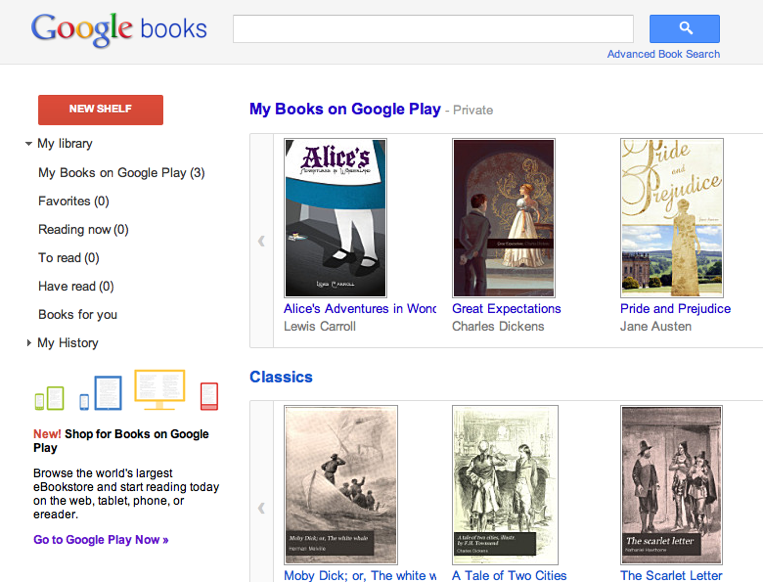
Google is also developing a consumer-facing experience for organizing purchased e-books at the home of its former online ebookstore, an Amazon-like shopping portal found at books.google.com/books. To be clear, that’s a separate storefront from its books search engine books.google.com (which also now points to Google Play). The stalled effort at creating a home for users’ purchased ebooks now has a second chance, complete with a library of books on Google Play, including a few pre-loaded classics like Great Expectations and Pride and Prejudice. Audiobooks would fit in well here, if Google moved in that direction.

Also of note, there are magazines available in this ebooks portal too, but not in the Google Play store. It’s clearly only a matter of time before the two sites (Play and Books) are even further merged making those magazines easy to find and purchase using the revamped Android Market…err…Google Play service. After all, if you have ‘em, promote ‘em.

Not surprisingly, there’s a placeholder help page for that, too, dubbed “magazines and journals.” Newspapers and TV placeholder help pages don’t yet exist, however.”

Read the whole article here.

Read Full Post »

« Newer Posts - Older Posts »