Feeds:
Posts
Comments

Archive for the ‘Board Of Intellectual Capital’ Category

Article from PandoDaily.

China Internet giant Tencent has just released version 4.0 of Weixin, a social instant messaging app for mobile that now counts 100 million users. In true China cut-and-paste fashion, the new release combines elements of Instagram, Path, Google+, GroupMe, Bump, HeyTell, and Facebook in one powerful offering that the blog TechRice suggests could one day overtake Sina Weibo, the Twitter-like microblogging platform that claims 300 million users. It also offers an English-language version called WeChat.

Weixin, which is essentially the mobile version of the massively popular QQ instant messenger, presents a fascinating study in China’s Internet economics. For a start, it was built by Tencent, much like Q Pai, the Instagram-like photo app we mentioned the other day. The in-house approach accords with Tencent’s general strategy to build its own products and leverage its 700 million-strong QQ user-base. Alongside Weixin, Instagram’s 40 million user count seems trivial.

Weixin also offers a prime example of how Chinese Internet companies are not only willing to “borrow” ideas from their American counterparts, but also tweak them to provide a better (or, at the very least, different) consumer experience. For many Chinese users, though, there is no question: This thing is big.

Among the new features that some think will make 2012 the Year of Weixin are Instagram-like photo-editing effects (why not?), Path-style photo albums that auto-upload to user timelines, and controlled social sharing features that closely resemble Google+ Circles. Tencent has also opened up the Weixin API to allow third parties to feed their content into the platform. One of the coolest uses of this comes from the integration of QQ Music, which lets users stream songs from within their timelines. Why doesn’t this feature exist in US-made social mobile apps? (Okay, maybe Facebook has that for Spotify, but I haven’t seen it on my mobile app.)

There are a bunch of other intriguing Weixin features. One of them is the ability to shake your phone to find new friends. You’ll then be automatically connected with people within a 1km radius (that’s .062 mile), who happen to be shaking their phones at the same time. The chances of a serendipitous connection are not as slight as you might think: The service records 100 million shakes a day.

There’s also a cute “message in a bottle” game, in which users can “throw” a message out to sea in the hope that some random stranger will pick it up and reply. I gave this a whirl and had an interesting conversation with a 22-year-old finance graduate student at Nanjing University. During the course of the chat, I discovered that I could exchange voice messages with this person – just like HeyTell, but with a ChatRoulette twist. Our conversation went like this (edited for sense and brevity):

Original message from Chinese stranger: Nothing to say

Me: Agreed. Where are you?

Chinese stranger: China. And u?

Me: USA. Do you like this app?

CS: Just so so. But it’s popular among young people.

Me: How old are you?

CS: I’m 22.

Me: Ok cool. Do you think it will be bigger than Sina Weibo one day?

CS: … they are different.

Me: I’m a reporter and I’m writing about this app. That’s why I’m asking all these questions.

CS: 😦 Commercial spy

Weixin doesn’t offer quite the slickly designed experience that Path or Instagram does so well, but US-based startups could learn something from Tencent’s multilateral thinking here. While there is value in the likes of Path, Instagram, and Pair in focusing tightly on niches, Weixin also demonstrates that a catch-all, centralized experience also has its appeal. And the app, by the way, is totally cross-platform, available on Android, iPhone, Windows Phone, and Symbian handsets.

Industry watchers say that China lags behind the US in mobile development by one to two years. That might be true for now, but as smartphone market growth accelerates in China and savvy players like Tencent make aggressive moves in mobile, that gap will inevitably close. Apps like Weixin represent the beginning of that process.

Read more here.
Read Full Post »

Article from NYTimes.


Institutional Venture Partners has another billion to play with.

The venture capital firm, an investor in Twitter, Zynga and LivingSocial, has raised $1 billion for I.V.P. XIV, its 14th and largest fund to date.

According to a partner, Sandy Miller, the firm initially set a $750 million target but increased it on robust demand. The fund, which was raised over four months, relied mainly on capital from previous investors.

Unlike some of its peers, Institutional Venture Partners does not write a lot of checks, usually not more than a dozen a year. As a later-stage investment firm, it invests $10 million to $100 million in seasoned start-ups in three main buckets: Internet, enterprise technology and mobile.

“I hate to sound dull but we’re doing the same strategy,” Mr. Miller said.

Mr. Miller, a longtime technology investor and co-founder of Thomas Weisel Partners, is optimistic despite recent setbacks in the technology sector.

Skepticism in the public markets, most recently highlighted by Facebook‘s underwhelming initial public offering, has damped enthusiasm for some late-stage start-ups. Zynga, for instance, an Institutional Venture Partners portfolio company, has tumbled more than 44 percent since its debut last year. And plenty of experts question whether another start-up it has backed, LivingSocial, is worth such a high valuation after Groupon, its far bigger rival, has fallen about 50 percent since its I.P.O.

Mr. Miller acknowledges that some valuations may pull back, but he says he invests for the long term.

“I’ve watched the technology market over a 30-year period,” he said. “There’s more interesting, high quality companies today than there has ever been and by a very wide margin.”

He added, “In every market, most deals don’t make sense, and that’s true now, but that’s always been true.”

Read more here.

Read Full Post »

Article from GigaOm.

Microsoft announced Monday that the company has officially acquired social software startup Yammer for $1.2 billion in cash. The purchase was widely reported more than a week ago, but Microsoft confirmed the deal Monday in a press release.

As we noted earlier this month, the purchase could give Microsoft a social dimension to its popular corporate software products. Yammer creates a Facebook-like experience for business clients.

Yammer will join the Microsoft Office division after the acquisition, but CEO David Sacks will continue to lead the group, Microsoft said in the release. Kurt DelBene, president of the Microsoft Office group, offered some thoughts on how Yammer might fit into the Microsoft world in a blog post that accompanied the formal press release:

The combination of Yammer, SharePoint and Office 365 will provide the most comprehensive and flexible solutions for enterprise social networking. Over time, I see opportunity for exciting new scenarios by adding Yammer’s stand-alone service alongside and integrated into our collaboration offerings with SharePoint, Office 365, Dynamics and Skype. I picture people being able to use Yammer to manage and expand their professional relationships, share and collaborate on Office documents, stay informed about content updates, and to seamlessly move from status updates and feeds into voice and video conversations.

Yammer most recently raised $85 million in a February funding round, which brought it to $142 million in total funding. The company currently has more than 5 million corporate users, including customers at 85 percent of Fortune 500 companies, Microsoft and Yammer announced along with the acquisition today.

“We think that Microsoft is a great partner for us,” Sacks said in a conference call Monday with DelBene and Microsoft CEO Steve Ballmer. “I think it’s really the best possible partner in terms of its reach and resources, and its ability to help us scale.”

Ballmer said Yammer’s emphasis on cloud computing fits perfectly with Microsoft’s expansion into that area, and Yammer’s popularity with corporate clients makes it a natural partner:

“What we love about Yammer is that it was built on the notion that things can grow virally,” Ballmer said.

They noted that Yammer will remain in the San Francisco area even after the acquisition with Microsoft, which is headquartered near Seattle.

“When most people thought social networking was for kids, we had a vision for how it could change the way we work,” Sacks wrote in a blog post Monday. “Four years ago, we started paddling out to catch the wave that we’re riding today.”

Read more here.

Read Full Post »

Article from GigaOm.

It was a busy week around our offices. You might have heard that we hosted our Structure 2012 conference. Nevertheless, between all the talk of clouds, software-defined networks and giant data sets, I did manage to read some good articles and wanted to share those with you.

Read original article here.

Read Full Post »

Article from NYTimes.

Locating a tower in San Francisco using Apple’s Maps app.

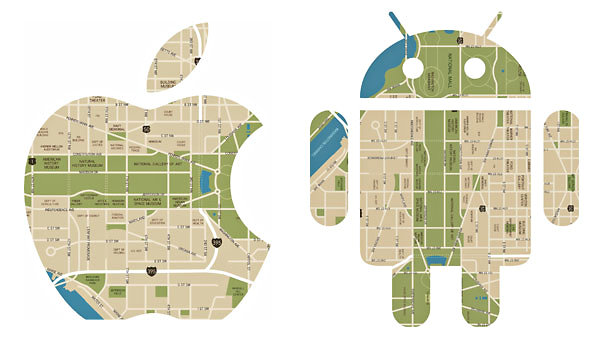
For many people, phones have become an important way to navigate the world, and mobile maps are at the core of the journey. They are often the critical element in commerce, socializing and search. So far, Google has reigned supreme in the mobile map world, with its maps on every iPhone sold so far — and, of course, on every phone based on its own Android operating system.

Last week, though, Apple gave notice it would enter the battle, announcing that in the fall, its phones would no longer carry Google maps, but instead would have Apple’s own map service built in, part of its new mobile operating system. Maps are simply too important to be left to a rival.

The question is: Can Apple build a map service that does as good a job, or a better one, than Google has?

If Apple slips up, consumers in the highly competitive smartphone market may have a good reason to turn to Android phones. If Apple succeeds, Google will be under pressure at a time when it already has to deal with other competitors in map services.

“It makes Apple more valuable and denies Google a lot of user data, and a brand presence, on the iPhone,” said Ben Bajarin, an analyst with the technology research firm Creative Strategies. If Apple cannot meet or exceed Google’s maps, he added, “it will irk their power users,” who are the most valuable customers.

Apple’s move into maps was not exactly a surprise. It has bought a few companies that make mapping features, like three-dimensional visualizations, and has secured rights to data like the names and layouts of streets in over 100 countries from TomTom, a big digital map company based in the Netherlands.

But making digital maps is not easy. Google has spent years working on its services, pouring all kinds of resources into the effort, including its Street View project to photograph and map the world. It will be hard to duplicate that depth and breadth.

“Apple has gotten into a place that is very technical, quite a challenge, and like nothing they’ve done before,” said Noam Bardin, chief executive of Waze, a mapping service that provides real-time traffic information by tracking the movement of phones.

Still, it would be foolish to underestimate Apple, said John Musser, editor of ProgrammableWeb, an online service that follows mobile application development.

“Apple so far has close to nothing in maps, because they never had a product before,” Mr. Musser said. “But they are hardly empty-handed.”

Mapping technology is a growing field that draws on everything from aerial photography to the movement of the continents, to individual comments on Web sites about a favorite hiking trail or a bad dining experience. ProgrammableWeb counts 240 mapping-related services that people building mobile map applications can draw from. That is up 73 percent from a year ago, and 243 percent from 2009.

Apple has offered few details about its plans for the map service, which is part of the new operating system, iOS 6, that was unveiled at the company’s annual developer conference in San Francisco. Some of the features may come from companies that it now owns. Apple may buy other features — like store locations and hours, and information about walking paths, landmarks and public transportation — from data companies, independent developers and consumer information services like Yelp.

Apple can expect to pay a lot of money for this information. Google declined to comment on what it spends on its map business, but others in the industry estimate that the figure is $500 million to perhaps $1 billion annually, equal to a fifth of its budget for research and development.

For consumers, an important part of the Apple service is likely to be the apps that support and enhance it. This week, Apple is set to widely release its instructions, known as a software development kit, to guide developers in designing these apps.

Those instructions are important to hundreds of independent software developers like Scott Rafer, whose start-up is making user-friendly walking directions for maps, based on things like landmarks and street views. He hopes to produce an app that is a hit in the app store, or even wins Apple’s eye as it looks for more partners.

“We’re all trying to figure out the next 100 days” before Apple releases the operating system to consumers, Mr. Rafer said. “Does Apple want gorgeous features, or do they want ubiquity?”

Read more here.

Read Full Post »

« Newer Posts - Older Posts »