Feeds:
Posts
Comments

Archive for the ‘Business Insider’ Category

MICROSOFT INSIDER: ‘It’s A Total Shocker… Something Big Must Have Changed’

steve ballmer

As everyone outside of Microsoft tries to figure out what just happened at the top of the company, Microsoft insiders are having the same conversation.One former senior executive who has been in touch with other senior executives at the company this morning had this to say:

It’s a total shocker. To me and to friends inside the company. The reorg lined everything up behind Steve and people felt he would stay on to see it through.

Something big must have changed, obviously.

I asked what the change might be. The former exec didn’t know, but he speculated:

I really don’t know. It’s a huge surprise.  The people I’ve spoken to don’t know what caused the bit to flip either.

There is a massive technology shift happening, the world of cloud and devices, and whoever leads the company next needs to paint an inspiring vision of the future for Microsoft.  There are amazingly talented people at the company, who will respond to great leadership.

Perhaps Bill [Gates] and the board have come to believe the company should be split into two, consumer and enterprise? I’m not sure anyone could do a better job than Steve under current circumstances. The problem is beyond hard, it may be intractable. Not sure how anyone can manage both an enterprise business and a consumer business when both are changing so fast.

The last sentiment–that the problem is “beyond hard” and “may be intractable”–is one that other long-time Microsoft observers share.

The technology wave that Microsoft surfed almost perfectly for three decades has run its course, and it has been replaced by new waves that Microsoft no longer dominates.

The transformation that Steve Ballmer was trying to oversee, of a packaged software company to a “devices and services company” is as radical as any corporate transformation ever attempted.

The former executive added that he considers Steve Ballmer an “amazing man” and that Microsoft’s next CEO will not likely be hired with the aim of doing what Ballmer is doing but better. Rather, the former exec says, there will likely be “big, big changes ahead.”

Read Full Post »

More Entrepreneurs Should Be Eating Magic Mushrooms, This Startup Founder Says

As cofounder of a local-social network startup called Circle, Evan Reas is no stranger to finding novel solutions to unusual problems.

When you find yourself positively stumped by a creative obstacle, there are the conventional methods of attack – dream something up by yourself, or maybe hire a professional to take care of the problem from beginning to end.

And then there are the more unique, off-the-beaten-path approaches.

Like taking magic mushrooms.

“It completely changes how you think,” Reas told us. “About your problems, about yourself, everything. It forced me to ask, ‘Is what I’m doing important?'”

With 4.5 million people using Circle so far, it would certainly seem so. This iOS and Android app aims to be your local network, showing you who and what is nearby. It can sort your friends by their various Facebook networks (high school, college, workplace) and lets you send them messages.

Reas isn’t alone in his endorsement of the psychedelic experience. The list of public figures affected by mushrooms and similar drugs runs long and varied, featuring a set of names that includes literary heavyweight Aldous Huxley, musical icon Jerry Garcia, and even Francis Crick, who discovered the double helix structure of DNA.

We’re not endorsing this approach, of course. Magic mushrooms are illegal in most states.

Circle and its 10 employees have made the app available for free on iOS and on Android.

Read Full Post »

Tech More: Mobile BI Intelligence Mobile Ads Mobile Advertising
Why Local-Mobile Marketing Is Exploding

Josh Luger      –         BI Intelligence

Location-based mobile marketing promises the sky: high conversion rates, surgical targeting, and rich consumer profiles.
But does it deliver? According to many accounts, it does.

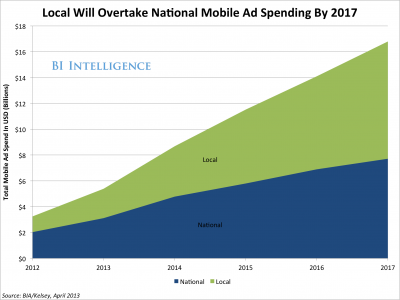
localvnatl-1

Not surprisingly, retailers, brands, and agencies are scrambling to hone their location-based approaches. These encompass everything from “geo-aware” and “geo-fenced” ad campaigns, to hyper-local efforts keyed to Wi-Fi hotspots, and algorithmic location-based targeting of audience segments like soccer moms, bargain hunters, coffee enthusiasts, etc.

In a new report from BI Intelligence on location-mobile marketing, we take a look at key stats on the location-based services marketplace that indicate it’s supremacy in mobile marketing, explain how the most important techniques (such as geo-aware, geo-fenced, audience-based local-mobile campaigns) work, examine the cornerstones – such as data and audience building – to a successful location-based mobile strategy, look at who has the valuable location-based data, and analyze the six most effective local-mobile marketing tactics.

Here’s an overview of the location-mobile marketing explosion:

Location is the new cookie: Collecting data has always been difficult because mobile does not support third-party cookies that travel easily across the ecosystem, allowing for straightforward tracking and data-gathering. That’s where location-based mobile technology comes in. It gives marketers new ways to identify and track mobile audiences, and with the aid of algorithms, it can also group them into behavioral and demographic segments for targeting.
Money is flowing into location-based mobile marketing: A recent survey of 400 brand executives by Balihoo found that 91% planned to increase their investments in location-based marketing campaigns in 2013. Finally, a study by Berg Insight found that location-enabled ad spend reached about 8% of total mobile ad spend for 2012. This proportion is expected to increase to 33% by 2017.
Location-based data is driving much of the interest – and success: Enabling campaigns with local data produces measurable results. In a study of over 2,500 of its mobile marketing campaigns, Verve found that its location-based ad efforts were about twice as effective as the mobile industry average click-through rate (CTR) of 0.4%. Geo-aware ads, geo-fenced ads, and location data paired with audience demographics or purchase intent are all proving to be extremely successful.
Location is extending beyond the smartphone: The location conversation may have started out as a way to take advantage of mobile phones, but as technology continues to evolve, the conversation needs to broaden. In 2012, only 12% of smartphone owners and 17% of tablet owners said they used their device throughout the entire shopping process. This year, one-third of smartphone and tablet owners said they did so. Additionally, more tablet consumers are beginning their shopping process on their tablets. This shows that location ads should be targeted to tablets as well as smartphones, because the first search for a local business might take place on a tablet.
In full, the report:

Takes a look at key stats on the location-based services marketplace that indicate it’s supremacy in mobile marketing;
Explains how the most important techniques, such as geo-aware, geo-fenced, audience-based local-mobile campaigns, work;
Examines the cornerstones – such as data and audience building – to a successful location-based mobile strategy;
Looks at who has the valuable location-based data;
Analyzes the six most effective local-mobile marketing tactics.

Read more: http://www.businessinsider.com/local-mobile-marketing-exploding-2013-6#ixzz2XHehbbNw

Read Full Post »

DEAR ENTREPRENEURS: Here’s How Bad Your Odds Of Success Are

Baby sea turtles

REUTERS/Oswaldo Rivas

As a wise investor puts it: “Many turtles hatch. Few make it to the sea.”

Everyone knows that starting companies — and investing in startups — is a risky way to earn a living.But few people appreciate just how risky it is.

Thanks to a recent tweet from Paul Graham, the founder of “startup school” Y Combinator, we now have a better idea.

Graham says that 37 of the 511 companies that have gone through the Y Combinator program over the past 5 years have either sold for, or are now worth, more than $40 million.

Most entrepreneurs would probably view creating a company worth more than $40 million as a success (unless the company raised more capital than that). And, on its face, the “37 companies” number seems relatively impressive.

In fact, however, the number tells a scary and depressing story.

This number suggests that a startling 93% of the companies that get accepted by Y Combinator eventually fail.

(Not all companies that sell for less than $40 million are “failures,” obviously. Assuming a company hasn’t raised much capital, a sale between $5 million and $40 million could be considered a success. But a high percentage of Y Combinator companies likely end up being worth zero. And for companies that are hand-picked by very smart investors, the 93%-below-$40 million rate is still surprisingly low).

A company accepted by Y Combinator, therefore, has less than a 1-in-10 chance of being a big success.

More alarmingly, the companies accepted by Y Combinator are only a tiny fraction of the companies that apply.

Some have estimated that Y Combinator’s acceptance rate is 3-5%.

If we use the 5% rate, we can estimate that Y Combinator has received about 10,000 applications for the ~500 companies it has chosen over the years.

Assuming Y Combinator has even a modest ability to pick winners, therefore, the odds that a company applying to Y Combinator will be a success are significantly lower than the odds of success of the companies accepted into the program.

If only 37 of the companies that have applied to Y Combinator over the years have succeeded, this is a staggeringly low 0.4% success rate.

Put differently, only one in every 200 companies that applies to Y Combinator will succeed.

The reality is that Y Combinator probably misses a few winners, so the actual odds are probably slightly higher.

But in case any entrepreneur or angel investor is deluding themselves into thinking that startups are an easy way to cash in, they might want to think again.

Read Full Post »

China Is Now Stimulating All Over The Place

Joe Weisenthal | Jul. 15, 2012
Shanghai street

A Hundred Books, a Thousand Miles

A prediction made by many China observers early in the year went like this: The Chinese economy would slow through the first half, then Beijing would step on the gas pedal and numbers would start to rebound.The first parts of the prediction are coming true.

The economy has slowed through the first half of the year. The latest GDP numbers were the slowest since the crisis.

And the gas pedal is being pumped.

China has cut interest rates aggressively.

State direct stimulus spending is starting to crank up again.

And now, according to FT, China has just cut taxes by 50% on foreign entities investing directly in China.

The full on press to lift the economy off of a hard landing is on.

Now we’ll see if the numbers rebound.


Read Full Post »

« Newer Posts - Older Posts »