

For those who Serve, for those who have Served and for those who have paid the ultimate Sacrifice;
With RESPECT, with HONOR and with DIGNITY;
We say “Thank you for your Service”
May GOD Bless and Protect our troops.
For those who Serve, for those who have Served and for those who have paid the ultimate Sacrifice;
With RESPECT, with HONOR and with DIGNITY;
We say “Thank you for your Service”
May GOD Bless and Protect our troops.
Posted in Uncategorized | Tagged Veterans Day | Leave a Comment »

 ConceptsiPhone/YouTube
Next year marks the 10-year anniversary of the iPhone, and all rumors are pointing to a radical redesign.
This month, there was a pretty considerable spill of information by a top industry executive regarding two new features. We also saw rumors about a a third model with a new screen size, as well as some current rumors reinforced by fresh leaks.
Check out the latest rumors surrounding Apple’s next NEXT iPhone.

Apple
MacRumors spotted a report from an analyst at Barclay’s that claims Apple will skip the “S” model this year, which has historically followed each new phone version, and jump directly from the iPhone 7 to the iPhone 8, or possibly “10,” in 2017.
Since 2017 marks the iPhone’s 10th anniversary, it wouldn’t be surprising if Apple does something special to mark the anniversary of its most important product.

ConceptsiPhone/YouTube
Rumors that the iPhone 10 will have an all-display front surface first emerged from John Gruber, the plugged-in Apple blogger and podcaster from Daring Fireball.
Gruber claims he has heard insider scuttlebutt that the iPhone 10’s front won’t have any bezels or borders, and that it’ll be one large display.

Tyler/Flickr
A report from Apple analyst Ming Chi Kuo, who often accurately predicts new Apple products and features, says that the iPhone 10’s body will be made of glass. If so, it could have a similar aesthetic as the iPhone 4 and 4s, both of which had a glass back.
A recent report from Japanese news site Nikkei claims that Apple is, indeed, ditching the metal back design for an all-glass back and metal frame.

A custom iPhone 5s made to look even more premium than the original models.Gold genie
A report from Kuo predicts Apple will release a third “high-end” model with a larger 5.8-inch screen compared to the Plus model’s 5.5-inch screen.
Kuo also claims it’ll have a stainless steel frame rather than the aluminum, which is more often used than steel in smartphones.

REUTERS/Stephen Lam
Nikkei’s report claiming that Apple will use glass instead of metal for the upcoming iPhone’s back also claimed Apple will release a model with a 5-inch display.
If true, Apple would have a decently comprehensive lineup that caters to a wide range of screen-size preferences. We’d have the 4-inch iPhone SE (and its potential successor), as well as 4.7, 5, and 5.5-inch iPhones.

Antonio Villas-Boas/Tech Insider
Gruber claims the home button, which also houses the fingerprint sensor, will be embedded into the front glass panel, making it invisible.
Gruber’s claims line up nicely with rumors posted by tech site i4u that a future iPhone will have an embedded home button.
Recently, Chinese tech giant Xiaomi released new phones with the same technology that Apple described in a patent for alternative home buttons, which could give us an idea of how a future home button on the iPhone 10 could work.

Antonio Villas-Boas/Business Insider
Rumors from The Korea Herald news site suggest the 2017 iPhone will have an AMOLED display, which would look better than the LCD display in current iPhones.
And most recently, Sharp President Tai Jeng-Wu talked to students at the University of Taiwan about future iPhones, saying that new devices will include OLED screen technology.

SCAVidsHD/YouTube
The Barclay’s analyst report summarized by MacRumors claims that the iPhone 10 will have wireless charging.
We also know that Apple is looking into the technology from a patent filed on September 9.
The latest information spill from Sharp President Tai Jeng-Wu to University of Taiwan students included wireless charging.

AP
Since the iPhone 7 doesn’t have a headphone jack, we can expect future iPhones won’t feature a headphone jack, either.

Andri Koolme/Flickr
Ming Chi Kuo believes the dual-lens camera will remain an exclusive feature for the larger iPhone models from 2017 onward.
There might have been a glimmer of hope that the dual-lens camera would make its way down to the smaller iPhone model, as the optical image stabilization (OIS) that was exclusive to the iPhone 6s Plus trickled its way down to the regular iPhone 7. But if Kuo’s predictions are true, this will not be the case.
Posted in Uncategorized | Tagged Antonio Villas-Boas, apple, Business Insider, iPhone 7 | Leave a Comment »

 Microsoft Corporate VP of Devices Panos PanayMatt Weinberger/Business Insider
The whole point of the original Microsoft Surface tablet, released in 2012, was to show PC manufacturers and the world just how good a touchscreen-enabled Windows PC could be, Microsoft CVP of Surface Panos Panay told Business Insider earlier this year.
“We needed to ensure it would happen right,” Panay said at the time.
So when Microsoft last week unveiled the Surface Studio — a gorgeous all-in-one PC that doubles as a touchscreen drafting table for creatives — it raised a big question.
If the Surface was designed to bring the Windows PC industry around to touchscreens, what does the Surface Studio do for Microsoft?
“The entire ecosystem benefits when we create new categories and experiences that bring together the best of hardware and software,” Panay tells Business Insider. He calls the Surface Studio “a new way for people to experience Windows 10, Office, Skype and more.”
To clarify, Panay is saying that the Surface Studio brings Windows 10 and the rest of Microsoft’s family of apps to new audiences. So far, judging from the earliest reviews and impressions, the Surface Studio is at least winning the interest of the artists and creative types that have historically formed much of Apple’s base. Microsoft Surface Studio, with the Surface Dial accessory.Microsoft
That, in turn, brings new users into the Windows 10 fold that otherwise may have stayed on Team Apple. That’s good for Microsoft, as it works around the clock to spur the growth of Windows 10 amid mounting competition. As Panay told us earlier this year, hardware is “part of the growth story for Windows and for Microsoft.”
And in the same way that you saw other companies (including Apple) copy the Surface tablet and Surface Book laptop design for their own devices, Panay says Microsoft is expecting history to repeat itself.
“With Surface, we pioneered new experiences for our customers and we’ve seen others in the industry follow suit,” Panay says. “I expect that we may see the same with this new category, and that would be a great thing for customers and for Windows.”
Which is to say, expect Windows PC manufacturers to follow Microsoft’s lead and build their own takes on the Surface Studio, the same way that companies like Lenovo and Samsung have built their own Surface Pro-like tablets.
On a final note: Back in August, Panay mentioned that despite the Surface Book’s trademark detachable tablet display, Microsoft thought of it as a laptop first and foremost — cool as it is to turn your screen into a standalone tablet, he didn’t expect people would make daily use of the feature.
So I asked Panay how Microsoft is thinking about the Surface Studio. Do they think it’s mostly a desktop PC, or mostly a mega-sized drawing table? Panay says that “every feature was highly scrutinized” to make it something that feels natural, even if you’re constantly switching between using it as a PC or tilted to use it as a drafting table.
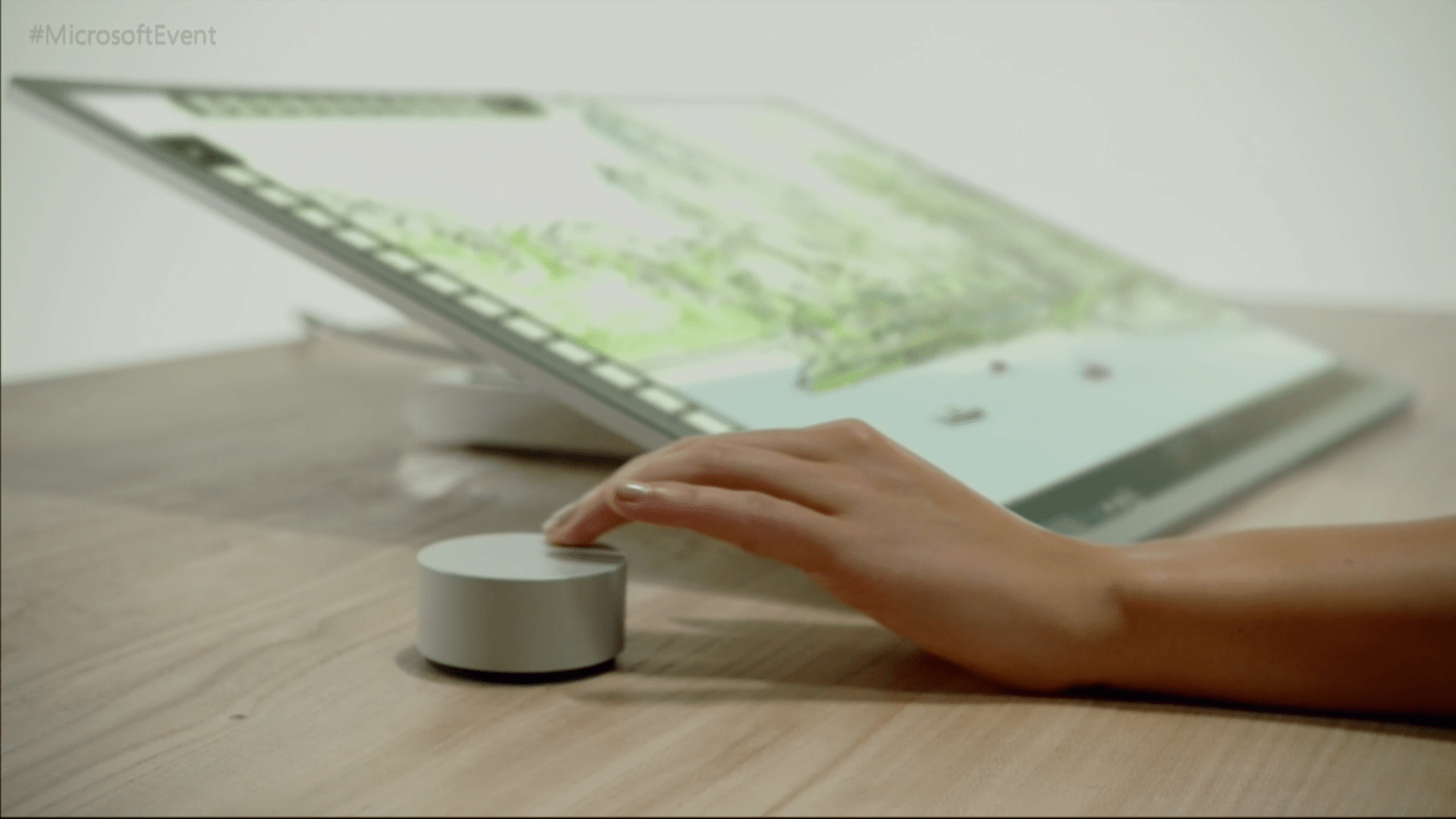 The Microsoft Surface Studio, with the Surface Dial accessory.Microsoft
“We wanted to create a device that follows you through your creative process and adapts to your need in that moment,” Panay says. “We think people will naturally flow between desktop and studio mode as they move through their process and their day.”
The Microsoft Surface studio launches this holiday season starting at $2,999.
Posted in Uncategorized | Tagged Business Insider | Leave a Comment »
If you were alive in 1957, and old enough to enjoy Rock and Roll, you will remember the group, “The Diamonds” who had just launched their super hit “Little Darlin’ “.
For you who are too young to remember – it was a time when the performers were happy, enjoying themselves, respecting their fans, dressed appropriately and their lyrics could be understood. They did not feel obligated to scream, eat the microphone, mumble inaudible lyrics or trash the set.
In 1957, The Diamonds had a hit with “Little Darlin.” 47 years later, they were requested to perform at Atlantic City ….this link leads to both performances. Watch the first one then the new 47 years later.
Tom Hanks father is much better looking than Tom, and even better looking with age. In the linked videos Tom Hank’s father, (who is the Lead Singer of The Diamonds is on the left).
He still has it and in the 1957 version, you can see the resemblance between father and son! When you open the link, click on the the top video to watch it and when it finishes, click on the bottom video to see the difference!!! Hope you enjoy both versions, 47 years apart.
http://www.flixxy.com/the-diamonds-little-darlin-1957-2004.htm
Posted in Uncategorized | Tagged Little Darlin, Rock n Roll, the Diamonds | Leave a Comment »

 Zaid Ali Kahn at LinkedIn’s flagship data center, in Oregon. LinkedIn
In the shadow of its acquisition by Microsoft, LinkedIn has quietly begun talking about an internal project that has the potential to shake up the roughly $175 billion data-center hardware market.
LinkedIn’s plan is somewhat similar to what Facebook is doing with its Open Compute Project. OCP is creating brand-new “open source” data-center hardware, in which the engineers from different companies work together and everyone freely shares the designs.
In its five years, OCP has upended the data-center market and generated a cultlike following so big that when Apple forbade its networking team to join OCP, the whole team up and quit.
Likewise, LinkedIn is designing and building nearly all the pieces and parts of software and hardware that it needs for its data centers, poaching key people from Facebook and Juniper to do it.
“We are not building servers and switches and all these things because we want to be good at it. We are doing it because we believe it gives us an advantage to control our own destiny,” Zaid Ali Kahn, senior director of infrastructure architecture and operations at LinkedIn, told Business Insider.
This is a terrifying trend for vendors like Cisco and Juniper. In the past, only the biggest internet companies like Amazon, Google, and Facebook have gone this route: designing their own IT infrastructure from scratch.
LinkedIn isn’t as big as those guys. It has a handful of data centers in California, Texas, and Virginia — most of them using leased space at a hosting provider — and only recently started designing and building its own in Singapore and Oregon. The one in Portland, Oregon, is its crown jewel, and the other data centers will eventually be upgraded with the new technology.
Internally, this is known as Project Altair, and the plan to build its own network software to run on dirt-cheap commodity network hardware is known as Project Falco.
The story begins with a Facebook network hardware engineer named Yuval Bachar. He was part of a Facebook team in 2013 that had a big goal: reducing the price of building a super-high-speed computer networks tenfold. Facebook had stolen him from Cisco, and he did a stint at Juniper, too.
 Yuval Bachar. YouTube/@Scale
He wanted to pay $1 per gigabyte, or $100 for each piece of network equipment that normally costs $2,500 — and he publicly announced the goal at an industry conference.
He then went on to help Facebook build its industry-changing, l0w-cost, open source Wedge switch that put market leader Cisco on notice. Earlier this month, Facebook announced the second generation of that switch.
About the time Bachar announced his goal, the LinkedIn networking team was struggling with its own network, which wasn’t handling the company’s user growth very well.
“The Production Engineering Operations (PEO) team found it very difficult to meet the demands of our applications when network routers and switches are beholden to commercial vendors, who are in control of features and fixing bugs,” Kahn wrote in a blog post.
In early 2015, the team began to build its own switch, called Pigeon. In the fall, it hired Kahn to help do it. It began testing the switch early this year.
 LinkedIn’s Pigeon switch. LinkedIn
In the meantime, having been a part of OCP, Bachar came up with a similar plan for LinkedIn. OCP started by creating a rack that holds stacks of computers, storage drives, and network switches.
 The Open 19 rack. Open19.org
As a company grows, it simply adds more switches, servers, and disk drives to the rack. But the racks themselves can be expensive, including all sorts of bells and whistles that LinkedIn didn’t need.
Facebook had the same problem, so it built a stripped-down 21-inch rack, then designed its own servers and storage to put in it.
But hardly anyone else uses a 21-inch rack. “Probably 99.5% [of companies] are using a 19-inch rack,” Kahn told us.
That means for LinkedIn (or anyone else) to use Facebook’s rack, it had to renegotiate supply deals with its vendors to get gear in different sizes.
It was deja vu. Bachar led an initiative called Open 19 to create an open standard for a low-cost 19-inch rack. This rack can be stuffed with 96 servers for $50,000 total, saving $25 million across a 500-rack data center, the organization says.
Having seen the impact of OCP, vendors jumped on board, including some of the Chinese contract manufacturers that have made a killing supporting OCP. Hewlett-Packard Enterprise, which was late to OCP, is also a member.
Microsoft, which expects its $26.2 billion acquisition of LinkedIn to close by the end of this year, is a member of OCP and has standardized its 21-inch racks and other OCP technology.
Kahn wouldn’t comment on the impact of the acquisition, but Microsoft has promised to let LinkedIn operate independently. A person with knowledge of the situation told us projects Altair, Falco, and Open 19 are still full-steam ahead.
This person points to the fact that in September, three months after the merger was announced, the company hired Doug Hanks from Juniper Networks.
 Doug Hanks. LinkedIn/Doug Hanks
Hanks was Juniper’s director of product management and strategy, and has written a number of books on Juniper’s tech. He’s now LinkedIn’s director of engineering.
“Doug Hanks reports to me,” Kahn said. “He recently joined and we’re delighted to have him.”
“His focus is to build the network engineering team and take it to the next level and help execute a number of initiatives, understanding the blend between software and networking,” he said.
Our source said that with Hanks on board, LinkedIn plans to be almost fully reliant on its own home-grown network gear in 18 to 24 months, and then “it’s no turning back at that point.”
Kahn insists that LinkedIn’s goal differs from Facebook’s. He’s not looking to pick a public fight with the network industry led by Cisco.
In fact, he’s still buying network gear from a number of commercial vendors — as long as they allow him to ditch their software so he can install his own, he said.
“A lot of vendors are open to that, to meet the needs of a web scale company,” he said.
LinkedIn also hasn’t fully committed to giving away all of its home-grown infrastructure software, the designs of its switch, or other hardware, as OCP has. But Kahn hasn’t ruled out openly sharing its technology either.
“LinkedIn’s culture is open source, so when the time is right we will be open to that,” Kahn said.
In fact, LinkedIn was a founding member in Hewlett-Packard Enterprise’s open source project, called OpenSwitch, to build a Linux-based switch. OpenSwitch is now run by the Linux Foundation (and word is that the initiative is floundering and LinkedIn is looking for alternatives).
Meanwhile, LinkedIn has also been sharing technical articles about its network software.
Internet companies using commercial network gear often spend $40 million to $140 million a year on it with vendors like Cisco, Arista, and others, one person who ran a large internet network recently told Business Insider.
Seeing a company LinkedIn’s size roll its own, they could be encouraged to try that themselves.
One person not associated with LinkedIn who built a huge data center for one of the world’s largest tech companies said that after his company starting building its own network equipment, it drove the costs down by a factor of 10: from $40,000 per Cisco switch to $4,000 per cheaper “commodity” switch capable of running home-grown software.
“Arista, Cisco, Juniper, they are all s—ing themselves about this trend,” said someone familiar with LinkedIn’s project. “The big guys, Google, Amazon, Facebook, are all doing this for economies of scale. For them, it’s all about money. It’s cheaper to build their own. At LinkedIn, cost is not the No. 1 priority at all. They want to have complete control over the user experience, to own everything in the stack. Then they can standardize it.”
Posted in Uncategorized | Tagged Business Insider, Cisco, Julie Bort, LinkedIn | Leave a Comment »

