A Navy SEAL commander told students to make their beds in the best graduation speech of 2014
Peter Jacobs
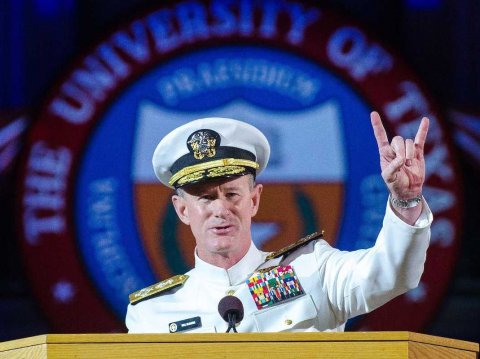
UT alum Adm. William H. McRaven gives students the “hook ’em horns” at the university’s commencement last year.AP Photo/The University of Texas at Austin, Marsha Miller
The University of Texas, Austin has chosen the president of the prestigious Ford Foundation to speak at its commencement this year, but it will be hard for him to outshine last year’s graduation speaker.
US Navy admiral and UT, Austin, alumnus William H. McRaven returned to his alma mater to give seniors 10 lessons from basic SEAL training when he spoke at the school’s 2014 commencement. It was widely considered to be the best graduation speech of the year.
McRaven — a former commander of the US Special Operations Command, who organized the raid that killed Osama bin Laden — stressed the importance of making your bed every morning, taking on obstacles headfirst, and realizing that it’s OK to be a “sugar cookie.”
As McRaven describes in his speech, a “sugar cookie” was a someone who failed uniform inspection during SEAL training, and was ordered to run fully clothed into the ocean and then roll around on the beach until every part of their body was covered with sand.
“Sometimes no matter how well you prepare or how well you perform you still end up as a sugar cookie,” McRaven said. “It’s just the way life is sometimes.”
In another lesson from his speech, McRaven stressed how everyone will likely fail at some point, and how to learn from those failures.
The former Navy admiral described how SEALs would sometimes be ordered to do “circuses” — “two hours of additional calisthenics—designed to wear you down, to break your spirit, to force you to quit.” However, McRaven said, “The pain of the circuses built inner strength-built physical resiliency.”
McRaven’s personal stories from his many years as a Navy SEAL supported all of these lessons.
“While these lessons were learned during my time in the military, I can assure you that it matters not whether you ever served a day in uniform,” McRaven told students. “It matters not your gender, your ethnic or religious background, your orientation, or your social status.”
In January, McRaven took over as chancellor of the University of Texas System.
We first saw this speech at the Military Times. Here’s the video of the full speech with the transcript below:
Here are McRaven’s 10 lessons from his years of experience as a Navy SEAL, via University of Texas, Austin:
I have been a Navy SEAL for 36 years. But it all began when I left UT for Basic SEAL training in Coronado, California.
Basic SEAL training is six months of long torturous runs in the soft sand, midnight swims in the cold water off San Diego, obstacles courses, unending calisthenics, days without sleep and always being cold, wet and miserable.
It is six months of being constantly harassed by professionally trained warriors who seek to find the weak of mind and body and eliminate them from ever becoming a Navy SEAL.
But, the training also seeks to find those students who can lead in an environment of constant stress, chaos, failure and hardships.
To me basic SEAL training was a life time of challenges crammed into six months.
So, here are the ten lesson’s I learned from basic SEAL training that hopefully will be of value to you as you move forward in life.
Every morning in basic SEAL training, my instructors, who at the time were all Viet Nam veterans, would show up in my barracks room and the first thing they would inspect was your bed.
If you did it right, the corners would be square, the covers pulled tight, the pillow centered just under the headboard and the extra blanket folded neatly at the foot of the rack—rack—that’s Navy talk for bed.
It was a simple task—mundane at best. But every morning we were required to make our bed to perfection. It seemed a little ridiculous at the time, particularly in light of the fact that were aspiring to be real warriors, tough battle hardened SEALs—but the wisdom of this simple act has been proven to me many times over.
If you make your bed every morning you will have accomplished the first task of the day. It will give you a small sense of pride and it will encourage you to do another task and another and another.
By the end of the day, that one task completed will have turned into many tasks completed. Making your bed will also reinforce the fact that little things in life matter.
If you can’t do the little things right, you will never do the big things right.
And, if by chance you have a miserable day, you will come home to a bed that is made—that you made—and a made bed gives you encouragement that tomorrow will be better.
If you want to change the world, start off by making your bed.
During SEAL training the students are broken down into boat crews. Each crew is seven students—three on each side of a small rubber boat and one coxswain to help guide the dingy.
Every day your boat crew forms up on the beach and is instructed to get through the surfzone and paddle several miles down the coast.
In the winter, the surf off San Diego can get to be 8 to 10 feet high and it is exceedingly difficult to paddle through the plunging surf unless everyone digs in.
Every paddle must be synchronized to the stroke count of the coxswain. Everyone must exert equal effort or the boat will turn against the wave and be unceremoniously tossed back on the beach.
For the boat to make it to its destination, everyone must paddle.
You can’t change the world alone—you will need some help— and to truly get from your starting point to your destination takes friends, colleagues, the good will of strangers and a strong coxswain to guide them.
If you want to change the world, find someone to help you paddle.
Over a few weeks of difficult training my SEAL class which started with 150 men was down to just 35. There were now six boat crews of seven men each.
I was in the boat with the tall guys, but the best boat crew we had was made up of the little guys—the munchkin crew we called them—no one was over about 5-foot five.
The munchkin boat crew had one American Indian, one African American, one Polish America, one Greek American, one Italian American, and two tough kids from the mid-west.
They out paddled, out-ran, and out swam all the other boat crews.
The big men in the other boat crews would always make good natured fun of the tiny little flippers the munchkins put on their tiny little feet prior to every swim.
But somehow these little guys, from every corner of the Nation and the world, always had the last laugh— swimming faster than everyone and reaching the shore long before the rest of us.
SEAL training was a great equalizer. Nothing mattered but your will to succeed. Not your color, not your ethnic background, not your education and not your social status.
If you want to change the world, measure a person by the size of their heart, not the size of their flippers.
Several times a week, the instructors would line up the class and do a uniform inspection. It was exceptionally thorough.
Your hat had to be perfectly starched, your uniform immaculately pressed and your belt buckle shiny and void of any smudges.
But it seemed that no matter how much effort you put into starching your hat, or pressing your uniform or polishing your belt buckle— it just wasn’t good enough.
The instructors would fine “something” wrong.
For failing the uniform inspection, the student had to run, fully clothed into the surfzone and then, wet from head to toe, roll around on the beach until every part of your body was covered with sand.
The effect was known as a “sugar cookie.” You stayed in that uniform the rest of the day—cold, wet and sandy.
There were many a student who just couldn’t accept the fact that all their effort was in vain. That no matter how hard they tried to get the uniform right—it was unappreciated.
Those students didn’t make it through training.
Those students didn’t understand the purpose of the drill. You were never going to succeed. You were never going to have a perfect uniform.
Sometimes no matter how well you prepare or how well you perform you still end up as a sugar cookie.
It’s just the way life is sometimes.
If you want to change the world get over being a sugar cookie and keep moving forward.
Every day during training you were challenged with multiple physical events—long runs, long swims, obstacle courses, hours of calisthenics—something designed to test your mettle.
Every event had standards—times you had to meet. If you failed to meet those standards your name was posted on a list and at the end of the day those on the list were invited to—a “circus.”
A circus was two hours of additional calisthenics—designed to wear you down, to break your spirit, to force you to quit.
No one wanted a circus.
A circus meant that for that day you didn’t measure up. A circus meant more fatigue—and more fatigue meant that the following day would be more difficult—and more circuses were likely.
But at some time during SEAL training, everyone—everyone—made the circus list.
But an interesting thing happened to those who were constantly on the list. Overtime those students—who did two hours of extra calisthenics—got stronger and stronger.
The pain of the circuses built inner strength-built physical resiliency.
Life is filled with circuses.
You will fail. You will likely fail often. It will be painful. It will be discouraging. At times it will test you to your very core.
But if you want to change the world, don’t be afraid of the circuses.
At least twice a week, the trainees were required to run the obstacle course. The obstacle course contained 25 obstacles including a 10-foot high wall, a 30-foot cargo net, and a barbed wire crawl to name a few.
But the most challenging obstacle was the slide for life. It had a three level 30 foot tower at one end and a one level tower at the other. In between was a 200-foot long rope.
You had to climb the three tiered tower and once at the top, you grabbed the rope, swung underneath the rope and pulled yourself hand over hand until you got to the other end.
The record for the obstacle course had stood for years when my class began training in 1977.
The record seemed unbeatable, until one day, a student decided to go down the slide for life—head first.
Instead of swinging his body underneath the rope and inching his way down, he bravely mounted the TOP of the rope and thrust himself forward.
It was a dangerous move—seemingly foolish, and fraught with risk. Failure could mean injury and being dropped from the training.
Without hesitation—the student slid down the rope—perilously fast, instead of several minutes, it only took him half that time and by the end of the course he had broken the record.
If you want to change the world sometimes you have to slide down the obstacle head first.
During the land warfare phase of training, the students are flown out to San Clemente Island which lies off the coast of San Diego.
The waters off San Clemente are a breeding ground for the great white sharks. To pass SEAL training there are a series of long swims that must be completed. One—is the night swim.
Before the swim the instructors joyfully brief the trainees on all the species of sharks that inhabit the waters off San Clemente.
They assure you, however, that no student has ever been eaten by a shark—at least not recently.
But, you are also taught that if a shark begins to circle your position—stand your ground. Do not swim away. Do not act afraid.
And if the shark, hungry for a midnight snack, darts towards you—then summons up all your strength and punch him in the snout and he will turn and swim away.
There are a lot of sharks in the world. If you hope to complete the swim you will have to deal with them.
So, If you want to change the world, don’t back down from the sharks.
As Navy SEALs one of our jobs is to conduct underwater attacks against enemy shipping. We practiced this technique extensively during basic training.
The ship attack mission is where a pair of SEAL divers is dropped off outside an enemy harbor and then swims well over two miles—underwater—using nothing but a depth gauge and a compass to get to their target.
During the entire swim, even well below the surface there is some light that comes through. It is comforting to know that there is open water above you.
But as you approach the ship, which is tied to a pier, the light begins to fade. The steel structure of the ship blocks the moonlight—it blocks the surrounding street lamps—it blocks all ambient light.
To be successful in your mission, you have to swim under the ship and find the keel—the centerline and the deepest part of the ship.
This is your objective. But the keel is also the darkest part of the ship—where you cannot see your hand in front of your face, where the noise from the ship’s machinery is deafening and where it is easy to get disoriented and fail.
Every SEAL knows that under the keel, at the darkest moment of the mission—is the time when you must be calm, composed—when all your tactical skills, your physical power and all your inner strength must be brought to bear.
If you want to change the world, you must be your very best in the darkest moment.
The ninth week of training is referred to as “Hell Week.” It is six days of no sleep, constant physical and mental harassment and—one special day at the Mud Flats—the Mud Flats are area between San Diego and Tijuana where the water runs off and creates the Tijuana slue’s—a swampy patch of terrain where the mud will engulf you.
It is on Wednesday of Hell Week that you paddle down to the mud flats and spend the next 15 hours trying to survive the freezing cold mud, the howling wind and the incessant pressure to quit from the instructors.
As the sun began to set that Wednesday evening, my training class, having committed some “egregious infraction of the rules” was ordered into the mud.
The mud consumed each man till there was nothing visible but our heads. The instructors told us we could leave the mud if only five men would quit—just five men and we could get out of the oppressive cold.
Looking around the mud flat it was apparent that some students were about to give up. It was still over eight hours till the sun came up—eight more hours of bone chilling cold.
The chattering teeth and shivering moans of the trainees were so loud it was hard to hear anything and then, one voice began to echo through the night—one voice raised in song.
The song was terribly out of tune, but sung with great enthusiasm.
One voice became two and two became three and before long everyone in the class was singing.
We knew that if one man could rise above the misery then others could as well.
The instructors threatened us with more time in the mud if we kept up the singing—but the singing persisted.
And somehow—the mud seemed a little warmer, the wind a little tamer and the dawn not so far away.
If I have learned anything in my time traveling the world, it is the power of hope. The power of one person—Washington, Lincoln, King, Mandela and even a young girl from Pakistan—Malala—one person can change the world by giving people hope.
So, if you want to change the world, start singing when you’re up to your neck in mud.
Finally, in SEAL training there is a bell. A brass bell that hangs in the center of the compound for all the students to see.
All you have to do to quit—is ring the bell. Ring the bell and you no longer have to wake up at 5 o’clock. Ring the bell and you no longer have to do the freezing cold swims.
Ring the bell and you no longer have to do the runs, the obstacle course, the PT—and you no longer have to endure the hardships of training.
Just ring the bell.
If you want to change the world don’t ever, ever ring the bell.
To the graduating class of 2014, you are moments away from graduating. Moments away from beginning your journey through life. Moments away starting to change the world—for the better.
It will not be easy.
But, YOU are the class of 2014—the class that can affect the lives of 800 million people in the next century.
Start each day with a task completed.
Find someone to help you through life.
Respect everyone.
Know that life is not fair and that you will fail often, but if take you take some risks, step up when the times are toughest, face down the bullies, lift up the downtrodden and never, ever give up—if you do these things, then next generation and the generations that follow will live in a world far better than the one we have today and—what started here will indeed have changed the world—for the better.
Thank you very much. Hook ’em horns.
Read Full Post »

 GoPro
GoPro 


 Blog of Intellectual Capital