Feeds:
Posts
Comments


The Toxic Term Sheet: Founders beware

shutterstock_111914708.toxic

By John Backus, New Atlantic Ventures

Its official. The unicorn has jumped the shark. The Wall Street Journal and Dow Jones Venturesource established The Billion Dollar Startup Club this year. The special feature on unicorns comes with an interactive infographic, which tracks private, venture-backed companies valued at more than $1 billion.

Companies like Uber, Airbnb, Palantir, SpaceX and Pinterest remain in the top 10 right now. There are also a few more recognizable names on the list. And then there is a collection of supposed billion-dollar companies as recognizable as the characters in the bar scene of “Star Wars”.

Enter the Toxic Term Sheet

In real estate, there’s a saying that goes something like this: “You set the price and I will set the terms.” If you want to sell your million-dollar house for $5 million, fine. I will pay you $4,167 a month for 100 years.”

That very same dynamic is playing out today, right before our eyes, in the world of private investing. Naïve entrepreneurs who want to join the unicorn club, who want a billion-dollar valuation, are setting the price.

But savvy investors are setting the terms. They are using “Toxic Term Sheets.” This usually means some combination of preferred stock, a senior liquidation preference, cumulative dividends, heavy anti-dilution protection (down-round protection) or guaranteed returns. In other words, these savvy late-stage investors have almost no downside—unless the company is a total bust.

Try selling your common stock at a billion-dollar value in this scenario. Good luck with that. In many of these cases, the REAL value of the company is closer to the value of the investor’s preference stack.

If you just raised $100 million at a $1 billion value, via a Toxic Term Sheet, and your company ultimately sells for $200 million, the investors will be just fine. They will get their $100 million. And then some more. The prior investors may also be fine (so long as they invested less than $100 million). The founders? They are toast in this scenario.

The Faustian bargain

Heidi Roizen did a good job explaining the dark side of unicorns, in her blog post. In short, if the performance of your business does not grow into that unicorn valuation, then when your business is ultimately sold, you, as the founder, along with your employees, may see nothing. Just add up the costs of the preference stack and guaranteed returns you offered to your investors in exchange for that mirage of a unicorn crown.

There are actually some really good reasons entrepreneurs want unicorn-status. It helps recruit top talent. Customers believe in you. You’re sought after by journalists. You crowd out your competitors because they will have a more difficult time convincing other VCs to back them. And you get to be on that Billion Dollar Startup Club list.

But entrepreneurs can make a painful, costly, rookie mistake by seeking that $1 billion prize at any cost.

VCs aren’t without blame here either. Unicorns give them bragging rights, as well. It may help them raise their next fund. It can even lead to a spot for the VC partner on the Forbes Midas List. Some VCs are even “buying” unicorn logos so that they can put them on their website, and brag to the world about how many unicorns they backed, even though unicorn logo shopping trend does not serve the VC’s investors, their limited partners. And that is what I call the Faustian bargain.

Rewarding investors for dragons

We should reward angels, seed investors, microVCs, early-stage VCs and expansion-stage VCs for finding, backing and helping entrepreneurs build unicorns over the long haul. Investing in unicorns is easy, because as the VC, you write the term sheet and often set the price. But as I’ve suggested previously, the yardstick that institutional investors should measure VCs by is not the number of unicorns they invested in, but how many unicorns, and other companies turned out to be Dragons for their funds. A Dragon is a company that returns the entire underlying venture fund, as I explained earlier this year on CNBC.

Should we be worried about all of these unicorns? Not really. In the long run, the private capital market is efficient (even though it does not correct in real time as the public stock market does.). Private companies with unicorn valuations will either grow in to those valuations, or, their valuations will adjust downwards—to match the true value of the business—the next time that business raises money.

The rise of the private IPO

Like I said in the Los Angeles Times, “the rise of unicorns and other startups represents a fundamental shift in the way companies are funded.” Venture-backed companies are raising late-stage money privately with increasing speed and ease, and will continue to rely on private market financing for longer in their lives.

In Q2 of 2015, there were 26 companies that raised late-stage funding rounds of $100 million or more, according to the MoneyTree Report published in July by PwC and the NVCA. I call these “private IPOs.” As a former entrepreneur who took a company public myself in 1995, I can see why smart founders might say: “Why raise money in the public markets if you can receive the same valuation, with much less hassle, in the private markets?”

But there is a silver lining here. Today’s unicorns are very different from the accidental IPOs of the late 1990s. Most of today’s unicorns are real businesses, with real metrics, and real scale. And most of their investors are sophisticated institutions. When these companies do go public—and many eventually will—they will be much safer investments for retail investors. Less upside perhaps, but also much less downside.

And for institutional investors in VC funds, there is a gold lining. Longer holding periods and private IPOs result in more value creation while the company is private, accruing directly those institutional investors.

But we should be worried that entrepreneurs are hurting themselves with the stampede to join the Unicorn Club.

The Toxic Term Sheet is a great tool for sophisticated investors to take advantage of naive entrepreneurs. For them, it is “Heads I win. Tails you lose.”

Don’t fall for it!

So if you want to be the next unicorn, fine. Set your price. But be careful of the terms you accept as part of your Faustian bargain.

John Backus is a venture capital investor at NAV. He can be reached by email at backus@nav.vc or you can follow him on twitter @jcbackus.

This guest column first appeared in affiliate magazine Venture Capital Journal, which is published by Buyouts Insider. Subscribers can read the full story by clicking here. To subscribe to VCJ, click here for the Marketplace.

Sirens are sounding for tech companies hitting the IPO market

A growing percentage of companies that filed for initial public offerings this year disclosed so-called ‘material weaknesses,’ according to research from PwC.

Just under a third of all companies that filed for an IPO through September did so. More than half of the tech companies made such a disclosure – up from 30% last year.

These material weaknesses relate to deficiencies in financial reporting that mean there is a “reasonable possibility that a material misstatement” of annual or interim financial statements will not be prevented or detected, according to the Securities and Exchange Commission.

There’s two ways to look at this. Material weaknesses are a sign of immaturity, or that companies aren’t prepared to be public – and that’s a risk for investors. On the other hand, companies are being more upfront about possible risks.

“In the past few years, more companies have reported material weaknesses in advance of their IPO. With the timing of this disclosure, companies are alerting investors but also disclosing remediation plans in their initial registration statements.”

The weaknesses range from things like insufficient accounting personnel to lack of procedures to insufficient technology systems. More than 90% of the companies disclosing weaknesses included remediation plans in the documents, with the hiring of additional personnel the most popular solution.

Tech companies are most likely to disclose material weaknesses, according to the PwC study, with more than half of all the technology companies that have filed so far this year including MW disclosures.

Material weaknessPwC

The smaller the company, the greater the likelihood it will disclose a material weakness, the PwC survey says. Companies with less than $500 million in revenues are more likely to experience a material weakness, according to the report.

The report comes at a difficult time for the IPO market. Grocery chain Albertsons was forced to pull its IPO temporarily and First Data’s initial public offering first priced beneath its anticipated range, of $18-$20 a share, then disappointed in trading for the first two days after the IPO. 

Global Venture Capital Report – Q3 2015 KPMG and CB Insights: VC-backed Companies Haul in US$37.6 Billion Globally in Q3 2015 Due to Mega-Rounds and Continued Crossover Investor Activity- from CB Insights

An in-depth analysis into the financing trends including unicorn growth, mega-rounds, country breakdowns, the most active investors, and more.

https://www.cbinsights.com/research-q3-2015-venture-capital-report?goal=0_9dc0513989-5882a30484-86855673

gp_nl_header-1
San Francisco – October 2015 Targeted Acqui-Hire Transaction: E-Commerce division of a globally branded Fortune 100 consumer products company is seeking to acquire a web, e-commerce and/or mobile applications development team and property. The target company should be designing and building highly scalable apps and platforms with the potential to be used by millions of people on a global scale.
Objective/Capabilities of Team

The acquirer is looking for an experienced development team with a strong background in web, e-commerce and mobile app development that wishes to collaborate under the umbrella of a global brand. The target team will include experienced practitioners with design/UX, product/project management, system architecture, development, testing/QA and consumer product experience and be capable of hitting the ground running. The target team must be able to take a concept, scope and build an MVP, and then be able to rapidly iterate to deliver innovative solutions that will transform the consumer experience centered around major premium brands for consumers from around the world.

Opportunity

A newly created ventures group imbedded within a larger global organization has received a mandate to build disruptive businesses and power revenue through innovative technology. This venture group’s e-commerce team is charged with building a global consumer business that combines commerce, content, and community in new ways, so as to improve the entire category experience from education and selection to purchase and consumption.

The target technology company/team will join a NYC team in order to power this innovative vision. The target team will collaborate with others from around the world to develop deployable “white label” solutions that allow for a quick pilot and phased roll-out of new ideas.

Compensation Package

Competitive, industry compensation and stock incentives will be awarded commensurate with experience and potential for success. The philosophy of this Fortune 100 enterprise is centered around the delivery of results, with upside and bonuses tied to performance. Senior management will be available to discuss this significant opportunity.

For additional information and to meet with the senior executives, please call Steven R. Gerbsman, information below.

About Gerbsman Partners
Gerbsman Partners focuses on maximizing enterprise value for stakeholders and shareholders in under-performing, under-capitalized and under-valued companies and their Intellectual Property. Since 2001, Gerbsman Partners has been involved in maximizing value for 91 Technology, Medical Device, Life Science, Solar, Fuel Cell, Cyber/Data Security and Digital Marketing companies and their Intellectual Property and has restructured/terminated over $810 million of real estate executory contracts and equipment lease/sub-debt obligations. Since inception in 1980, Gerbsman Partners has been involved in over $2.3 billion of financings, restructurings and M&A transactions.

Gerbsman Partners has offices and strategic alliances in San Francisco, Boston, New York, Washington, DC, McLean, VA, Europe and Israel.

gp_nl_footer

GERBSMAN PARTNERS
Phone: +1.415.456.0628, Cell: +1 415 505 4991
Email: steve@gerbsmanpartners.com
Web: www.gerbsmanpartners.com
BLOG of Intellectual Capital: blog.gerbsmanpartners.com

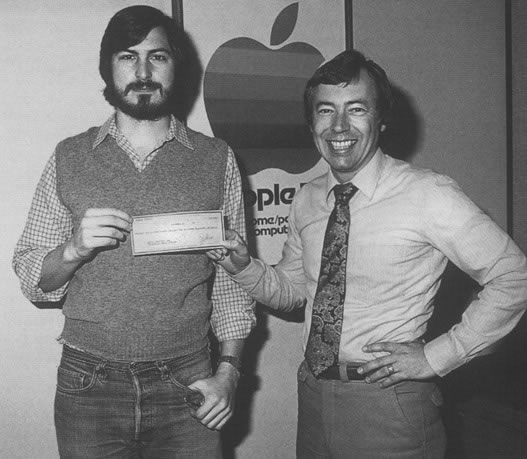
What happened to the first 10 Apple employees

mike markkulaDigiBarn

Apple, unlike any other company in the world, has its identity tied to one individual: Steve Jobs.

And without question, Jobs was the driving force that turned Apple into the world’s most valuable tech company.

That’s why there have been two new movies on Jobs this year — a documentary and a biopic. That’s why there was another best-selling book on Jobs released this year.

But Jobs didn’t do it alone.

He always had a team of talented people helping him build Apple. Most of them have been forgotten, which is why we’ve gathered information on the first 10 employees at the company.

Apple’s first CEO, Michael Scott, gave us a bunch of color on the early days, and Steve Wozniak helped with a list of early employees, though it was based on his memory. We got our full list from another early employee.

The Apple employee numbers aren’t the order each person joined the company. When Scott came to Apple he had to give out numbers to each employee to make life easier for the payroll department.

Go to:  http://www.businessinsider.com/the-first-10-apple-employees-and-where-they-are-now-2015-10 for the detail list.