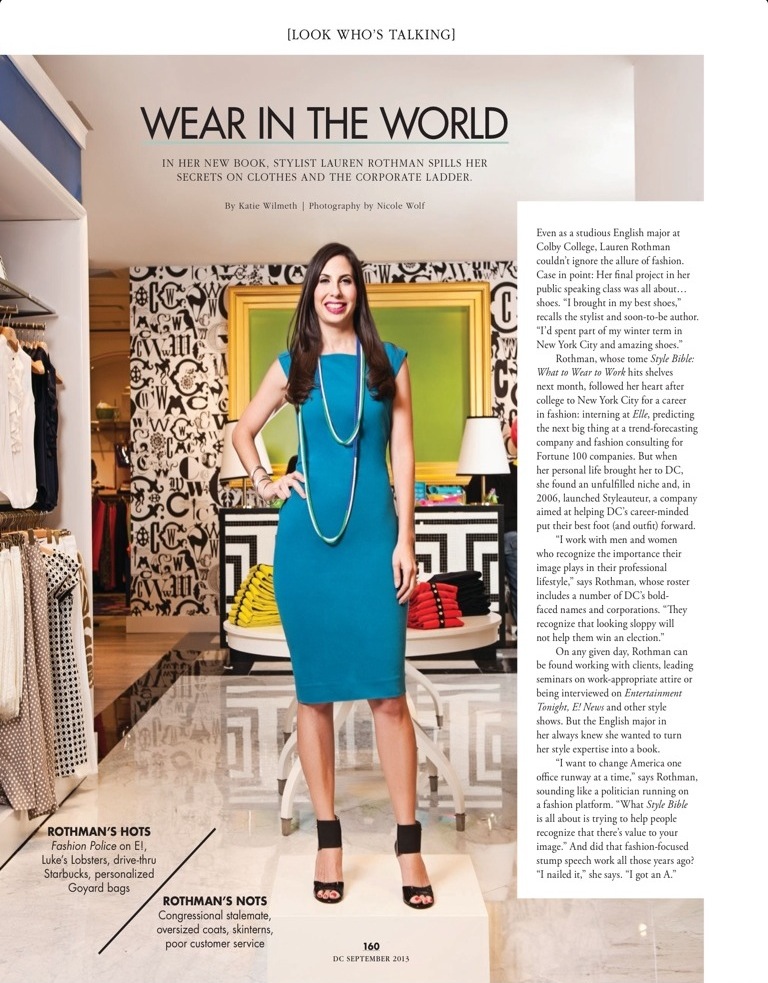
Lauren A. Rothman is the “Styleauteur” – “Style Bible – What to Wear to Work – on Amazon.com
Lauren A. Rothman is the “Styleauteur” – “Style Bible – What to Wear to Work – on Amazon.com
Posted in DC Magazine, Fashion, Lauren Rothman, Style Bible by Lauren Rothman, Style News, Styleauteur | Tagged DC Magazine, fashion, Lauren rothman, styleauteur | Leave a Comment »

Windows Is Dead, Google Killed It
Farhad Manjoo, Slate
Microsoft founder Bill Gates speaks during a news conference in New Delhi in 2008.
Windows is dead. Let’s all salute it — pour out a glass for it, burn a CD for it, reboot your PC one last time.
Windows had a good run. For a time, it powered the world. But that era is over.
It was killed by the unlikeliest of collaborations — Microsoft’s ancient enemies working over decades, in concert: Steve Jobs, Linus Torvalds, and most of all, two guys named Larry and Sergey.
Late on Monday, Microsoft announced its unsurprising $7.2 billion plan to buy Nokia’s smartphone division. Nokia is the world’s largest manufacturer of phones that run Microsoft’s Windows Phone operating system (which is a bit like pointing out that, at 5-foot-6, I’m the tallest member of my immediate family). Microsoft is buying Nokia in order to control both the hardware and software in its devices; this move, Microsoft promises, will improve the phones themselves and make them easier to sell.
But this is the antithesis of the company’s Windows strategy. Though Microsoft insists otherwise, when this deal is done, the thing sold as Windows won’t be what it’s always been — it won’t be software that runs on lots of companies’ hardware, a platform to unite disparate manufacturers’ devices. Instead, Windows will be much like Apple’s operating systems, iOS and Mac OS. Windows will be proprietary software attached to proprietary hardware — Microsoft’s code running on Microsoft’s devices.
In a document that lays out the “strategic rationale” for the deal, Microsoft makes a stirring case for vertical integration: for a single company that makes both mobile software and hardware together. By purchasing Nokia, Microsoft says it will be able to create better phones by reducing “friction” between hardware and software teams that now reside in separate companies. Combining the companies also improves marketing “efficiency” and “clarity” — Microsoft can sell a single Microsoft device that bakes in the best services from both firms (Skype, Office, Nokia’s mapping systems).
Finally, vertical integration helps Microsoft’s bottom line. Today, for every Windows-powered phone that Nokia sells, Microsoft gets less than $10 in software licensing fees. When it owns Nokia, Microsoft will be able to book profits on hardware, too. Rather than make less than $10 per phone, it will make more than $40.
Steve Jobs long pushed against Bill Gates’ idea that hardware and software should be made by different firms. And back in the PC era, Gates was right. Gates recognized that most computer users didn’t understand hardware. We couldn’t tell the difference — and didn’t really care much about — the processors, drives, displays, and other physical components that made up one PC versus another. As a result, making PC hardware was destined to be a bruising commodity business, with low brand recognition, constant price battles, and dwindling profits.
But software, Gates saw, was a different story. Software had a face. Software imprinted itself on users — once you learned one Windows PC, you understood every Windows PC. Unlike hardware, software enabled network effects: The more people who used Windows, the more attractive it became to developers, which meant more apps to make Windows computers more useful, which led to more users, and on and on. Finally, software was wildly, almost unimaginably profitable. After writing code once, you could copy it endlessly, at no marginal cost, for years to come — and make money on every single copy you sold.
But mobile devices altered that calculation. Today, hardware matters. Unlike in a PC that you kept hidden under your desk, the design of your mobile device affects its usefulness. Things like your phone’s weight or the way your tablet feels in your hand are all important considerations when you’re buying a device; you won’t choose a phone based on software alone, and you might pay a premium for a device that’s particularly well-designed. In the mobile world, as Apple has proved, hardware can command just as much of a profit as software.
You might argue that once the basic design of a good phone or tablet becomes well known, lots of companies will copy it, and that hardware will again become a commodity. That’s the tide Apple is now battling against. At some point mobile components will become good enough and cheap enough that a $50 phone might function just as well as a $100 or $200 phone. When that happens, people will again start choosing devices by price, and hardware profits will dwindle to nothing. And, as happened with PCs, software, not hardware, will become the industry’s dominant business.
All that may well occur. (The fear of commoditized hardware explains Apple’s languishing share price.) But if mobile hardware does become a commodity and software once again becomes the determining factor in your choice of phone, we won’t see Microsoft profit from the shift. That’s because, in the last five years, a brutal, profit-destroying force has emerged in the tech world: Android.
Google’s mobile operating system — which is based on Linux, the open-source OS whose fans had long dreamed would destroy Windows — is free. Any mobile phone manufacturer can use and alter Android however it pleases. This accounts for Android’s stunning market share — close to 80 percent, according to IDC — and that market share gives Android the benefit of the network effects that once worked so well for Microsoft. Nokia was paying Microsoft $10 for every phone it sold, and in return it got an OS that can’t even run Instagram. Microsoft says that it wants to keep licensing Windows Phone to other manufacturers even after it purchases Nokia, but because they can always choose Android (which runs Instagram and everything else), few phone-makers are likely to take it up on that deal.
That’s why the Nokia purchase signals the end of Windows as a standalone business. There are now only two ways to sell software. Like Apple, you can make devices that integrate software and hardware together and hope to sell a single, unified, highly profitable product. Or, like Google, you can make software that you give away in the hopes of creating a huge platform from which you can make money in some other way (through ads, in Google’s case).
But you can’t do what Windows did — you can’t make profitable software on other companies’ commodity hardware. Thanks to Android, code is now a commodity, and Windows is dead.
Posted in Uncategorized | Tagged Android, Bill Gates, Microsoft, windows | Leave a Comment »
Tech More: Apple iWatch Steve Wozniak
Here’s The New-Product Wishlist Apple’s Wozniak Is Begging CEO Tim Cook To Make
Julie Bort

Apple cofounder Steve Wozniak has a wish list of stuff he’d like Apple to make.
When Reuters’ Sareena Dayaram asked during a video interview what advice Woz would give to CEO Tim Cook, Woz smiled and said, “I wouldn’t dare because I have a feeling the comeback would be more like a fight. And I’m really a non-conflict type of person.”
But, he said, “I can talk about what I want.”
He grabbed his wrist and said, “I want my wearable devices that are basically as complete as my iPhone in their functionality.”
He also wants larger screens on iPhones and other features that iPhone competitors have that are “better” than what the iPhone offers (though he didn’t name those features).
Most importantly, he wants Apple “dreamers” thinking up products that change the world “with some new product you wouldn’t even call a phone.” (The Apple iGlass perhaps?)
Here’s the full interview. Skip ahead to 3:50 to hear his Apple wish list.
Posted in Apple, Business Insider, Julie Bort, Steve Wozniak, Uncategorized | Tagged apple, Business Insider, Julie Bort, Steve Wozniak | Leave a Comment »


Lauren A. Rothman shares tips on what to wear to work in the September issue of People StyleWatch magazine!




Learn more about Lauren’s new book – STYLE BIBLE: What to Wear to Work

To schedule an interview with On-Air Style Expert
Lauren A. Rothman, please contact:
Phone: +1.202.631.8878
Email: lauren@styleauteur.com
Web: www.styleauteur.com
Twitter: twitter.com/styleauteur
Facebook: facebook.com/styleauteur
TV Clips: styleauteur.com/press
Style Bible on AMAZON: http://ow.ly/1XAzXv
Follow @Styleauteur on Twitter & ‘Like’ Styleauteur on Facebook
Posted in Fashion, Huffington Post, Lauren Rothman, People StyleWatch, Style Bible by Lauren Rothman, Styleauteur, The Fashion Whip, Uncategorized | Tagged fashion, Lauren A Rothman, People StyleWatch, Style Bible by Lauren Rothman, styleauteur | Leave a Comment »

Mark Lennihan / AP

Stephen Roach is a member of the faculty at Yale University, is Non-Executive Chairman of Morgan Stanley Asia and the author of The Next Asia.

NEW HAVEN – The global economy could be in the early stages of another crisis. Once again, the US Federal Reserve is in the eye of the storm.As the Fed attempts to exit from so-called quantitative easing (QE) – its unprecedented policy of massive purchases of long-term assets – many high-flying emerging economies suddenly find themselves in a vise. Currency and stock markets in India and Indonesia are plunging, with collateral damage evident in Brazil, South Africa, and Turkey.
The Fed insists that it is blameless – the same absurd position that it took in the aftermath of the Great Crisis of 2008-2009, when it maintained that its excessive monetary accommodation had nothing to do with the property and credit bubbles that nearly pushed the world into the abyss. It remains steeped in denial: Were it not for the interest-rate suppression that QE has imposed on developed countries since 2009, the search for yield would not have flooded emerging economies with short-term “hot” money.
As in the mid-2000’s, there is plenty of blame to go around this time as well. The Fed is hardly alone in embracing unconventional monetary easing. Moreover, the aforementioned developing economies all have one thing in common: large current-account deficits.
According to the International Monetary Fund, India’s external deficit, for example, is likely to average 5% of GDP in 2012-2013, compared to 2.8% in 2008-2011. Similarly, Indonesia’s current-account deficit, at 3% of GDP in 2012-2013, represents an even sharper deterioration from surpluses that averaged 0.7% of GDP in 2008-2011. Comparable patterns are evident in Brazil, South Africa, and Turkey.
A large current-account deficit is a classic symptom of a pre-crisis economy living beyond its means – in effect, investing more than it is saving. The only way to sustain economic growth in the face of such an imbalance is to borrow surplus savings from abroad.
That is where QE came into play. It provided a surplus of yield-seeking capital from investors in developed countries, thereby allowing emerging economies to remain on high-growth trajectories. IMF research puts emerging markets’ cumulative capital inflows at close to $4 trillion since the onset of QE in 2009. Enticed by the siren song of a shortcut to rapid economic growth, these inflows lulled emerging-market countries into believing that their imbalances were sustainable, enabling them to avoid the discipline needed to put their economies on more stable and viable paths.
This is an endemic feature of the modern global economy. Rather than owning up to the economic slowdown that current-account deficits signal – accepting a little less growth today for more sustainable growth in the future – politicians and policymakers opt for risky growth gambits that ultimately backfire.
That has been the case in developing Asia, not just in India and Indonesia today, but also in the 1990’s, when sharply widening current-account deficits were a harbinger of the wrenching financial crisis of 1997-1998. But it has been equally true of the developed world.
America’s gaping current-account deficit of the mid-2000’s was, in fact, a glaring warning of the distortions created by a shift to asset-dependent saving at a time when dangerous bubbles were forming in asset and credit markets. Europe’s sovereign-debt crisis is an outgrowth of sharp disparities between the peripheral economies with outsize current-account deficits – especially Greece, Portugal, and Spain – and core countries like Germany, with large surpluses.
Central bankers have done everything in their power to finesse these problems. Under the leadership of Ben Bernanke and his predecessor, Alan Greenspan, the Fed condoned asset and credit bubbles, treating them as new sources of economic growth. Bernanke has gone even further, arguing that the growth windfall from QE would be more than sufficient to compensate for any destabilizing hot-money flows in and out of emerging economies. Yet the absence of any such growth windfall in a still-sluggish US economy has unmasked QE as little more than a yield-seeking liquidity foil.
The QE exit strategy, if the Fed ever summons the courage to pull it off, would do little more than redirect surplus liquidity from higher-yielding developing markets back to home markets. At present, with the Fed hinting at the first phase of the exit – the so-called QE taper – financial markets are already responding to expectations of reduced money creation and eventual increases in interest rates in the developed world.
Never mind the Fed’s promises that any such moves will be glacial – that it is unlikely to trigger any meaningful increases in policy rates until 2014 or 2015. As the more than 1.1 percentage-point increase in 10-year Treasury yields over the past year indicates, markets have an uncanny knack for discounting glacial events in a short period of time.
Courtesy of that discounting mechanism, the risk-adjusted yield arbitrage has now started to move against emerging-market securities. Not surprisingly, those economies with current-account deficits are feeling the heat first. Suddenly, their saving-investment imbalances are harder to fund in a post-QE regime, an outcome that has taken a wrenching toll on currencies in India, Indonesia, Brazil, and Turkey.
As a result, these countries have been left ensnared in policy traps: Orthodox defense strategies for plunging currencies usually entail higher interest rates – an unpalatable option for emerging economies that are also experiencing downward pressure on economic growth.
Where this stops, nobody knows. That was the case in Asia in the late 1990’s, as well as in the US in 2009. But, with more than a dozen major crises hitting the world economy since the early 1980’s, there is no mistaking the message: imbalances are not sustainable, regardless of how hard central banks try to duck the consequences.
Developing economies are now feeling the full force of the Fed’s moment of reckoning. They are guilty of failing to face up to their own rebalancing during the heady days of the QE sugar high. And the Fed is just as guilty, if not more so, for orchestrating this failed policy experiment in the first place.
This article was originally published by Project Syndicate. For more from Project Syndicate, visit their new Web site, and follow them on Twitter orFacebook.
Posted in Business Insider, Project Syndicate | Tagged Business Insider, Project Syndicate, Stephen Roach | Leave a Comment »

