Above the Crowd
By Bill Gurley
A Rake Too Far: Optimal Platform Pricing Strategy
April 18, 2013: In a casino, the term “rake” refers to the commission that the house earns for operating a poker game. With each hand, a small percentage of the pot is scraped off by the dealer, which in essence becomes the “revenue” for the casino. While casinos use the term “rake,” a plethora of interesting word choices exist which all describe the same thing – keeping a little bit of the revenue for the company that is running the service. Examples include “commission,” “fee,” “toll,” “tax,” “vig” or “vigorish,” “juice,” “the take”, and “graft” (although this last one is typically associated with corruption in politics).
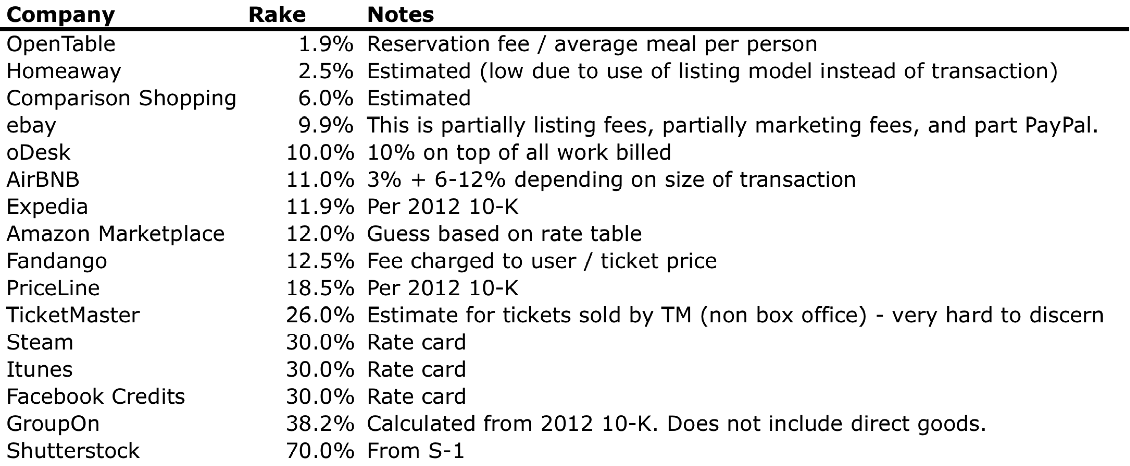 Many Internet marketplaces also have a rake or vig. The percentage rake is the amount that the marketplace charges as a percentage of GMS (gross merchandise sales), which typically represents net revenues for the marketplace. As an example, eBay’s 2011 marketplace revenues were approximately $6.6B against GMS of approximately $68.6B for a rake percentage of just under 10%. It may seem tautological that a higher rake is always better – that charging more would be better than charging less. But in fact, the opposite may often be true. The most dangerous strategy for any platform company is to price too high – to charge a greedy and overzealous rake that could serve to undermine the whole point of having a platform in the first place.
Before discussing the merits of low rakes versus high rakes, let us first take a look at current examples of different rakes across the Internet. The table above shows estimated rakes for several online businesses as a percentage of GMS. Do not assume that these numbers are specifically accurate as some vendors make these very hard to deduce.* There is also the added noise of kick-backs that are common in industries like ticketing. You can see very high rakes in the case of iTunes, Facebook, and GroupOn down to especially low rakes for the likes of OpenTable and HomeAway. Amazon marketplace fees are published on their website, and vary by category, but they basically range from 6-15%, so lets say the average is approximately 12%. eBay recently launched an aggressive campaign attacking Amazon’s rate table on a vertical-by-vertical basis (those percentages can be found here). One company with an astonishingly high rake is recently IPOed Shutterstock, a photo-purchasing marketplace where the content owner receives only 30% of gross receipts. As we will argue below, this could in fact be a very fragile situation.
When evaluating new marketplace investments, we are naturally biased towards entrepreneurs who understand the strategic rationale behind the argument for a lower rake. If your objective is to build a winner-take-all marketplace over a very long term, you want to build a platform that has the least amount of friction (both product and pricing). High rakes are a form of friction precisely because your rake becomes part of the landed price for the consumer. If you charge an excessive rake, the pricing of items in your marketplace are now unnaturally high (relative to anything outside your marketplace). In order for your platform to be the “definitive” place to transact, you want industry leading pricing – which is impossible if your rake is the de facto cause of excessive pricing. High rakes also create a natural impetus for suppliers to look elsewhere, which endangers sustainability. These reasons are likely behind the struggles in GroupOn’s core Daily Deals business (North America Third Party Revenue is down in Q4 both YOY and QOQ). With a rake of approximately 38% (and this is “after” asking the merchant to underwrite a 50% discount to the consumer) the recovery from each transaction for the supplier is only 30%, representing an “effective” rake of 70%.
High volume combined with a modest rake is the perfect formula for a true organic marketplace and a sustainable competitive advantage. A sustainable platform or marketplace is one where the value of being in the network clearly outshines the transactional costs charged for being in the network. This way, suppliers will feel obliged to stay on the platform, and consumers will not see prices that are overly burdened by the network provider. Everyone wins in this scenario, but particularly the platform provider. A high rake will allow you to achieve larger revenues faster, but it will eventually represent a strategic red flag – a pricing umbrella that can be exploited by others in the ecosystem, perhaps by someone with a more disruptive business model. As Jeff Bezos is fond of saying, “your margin is my opportunity.”
Many people do not know this, but one of the most amazing Internet success stories is the European division of The Priceline Group, which operates under the brand Booking.com. Booking.com is the unquestioned leader in online travel in Europe, and represents a substantial portion of TPG’s astounding $35B market capitalization. Booking.com was not always the online leader in Europe – in fact they were a disrupter stealing the flag from other large incumbents. In the late 1990’s companies like Expedia and Travelocity had become enamored with what is known as the “merchant model.” Basically, these companies would “package” vacation offerings for the consumer and sell them as a bundled offering. The merchant model could produce a rake of well over 30%, and was therefore attractive to companies like Expedia. Booking.com took a much more aggressive approach (perhaps because it was the only one available) . They started with a 10% “agency model,” which not only represented a lower rake, but also provided better cash flow terms to the supplier. As such, they were able to signup nearly every small hotel in Europe. This resulted in more selection for the consumer and more support from the supplier base. Dennis Schall at Skift.com has a wonderfully detailed account of how Booking.com came to dominate Europe, along with a more recent article addressing the lingering ramifications of the industry’s natural shift to the lower friction (lower rake) agency model.
It turns out that the average rake at Priceline Group is even higher today, as they allow merchants to voluntarily bid up their rake for better placement in the network (you can see this in the table above). This is one of my favorite marketplace business model “tweaks.” You start with a low rake to get broad-based supplier adoption, and you add in a market-driven pricing dynamic that allows those suppliers who want more volume or exposure to pay more on an opt-in basis. This way no one leaves the network due to excessive fees, yet you end up with a higher average rake over time due to the competitive dynamic. And when prices go up due to bidding and competition, the suppliers blame their competition not the platform (part of the genius of the Google AdWords business model). This also allows you to extract more dollars from those suppliers who desire to spend more to promote themselves (without raising the tax on those that don’t).
Here is another interesting story related to rakes. In 2006, Benchmark started spending time with Gary Swart and the team at oDesk. We were quite enamored with their marketplace for skilled global talent, and were amazed at how the tools in their online workplace allowed customers to hire, manage, and pay for work from distributed teams. Combined with a bidding and reputation system, oDesk had built an “ebay for work.” At the same time, there were several larger players in the market such as Freelancer and Rent-a-coder. After discussing competition at length, the team came upon the idea of lowering the commission from 30% (which was standard in the industry) to 10% of overall costs. We were excited to hear such aggressive strategic thinking from the team, and they were excited to hear from an investor with a long-term perspective (this change obviously reduced current period revenue to 1/3 of its current level). The rest is history. By 2009 oDesk surpassed the nearest competitor, and they are now the clear leader (larger than their top competitors combined) in the rapidly emerging “online work” industry.
All of which leads us to two very interesting rake examples that are front and center in today’s Internet – Facebook and Apple. Both of these companies charge a hefty 30% fee for transactions on their platform. Because most of the developers building on these platforms make software, the developers do not experience immediate pain when they share 30% of top-line revenue. After all, marginal costs are near zero, and therefore the fee is tolerable. But the real question is: Does the 30% marketplace on top of the platform help to reinforce the strategic positioning of the platform itself? Or is it merely a revenue extraction exercise? And if so, is there a risk that a “rake too far” could be a net-negative from a strategic standpoint?
 Let’s start with Facebook. For the first several years, Facebook’s application platform was a smashing success. The distribution power of their pervasive platform proved a remarkable vehicle for many companies; particularly games companies. The platform was so successful so quickly that many early adopters of the platform rocketed to hundreds of millions in sales. Zynga, which was particularly adept at surfing the Facebook wave, catapulted to $1 billion in revenue in its sixth year of existence! Everything looked incredible. Fast-forward to today (only a few years later), and games companies are no longer betting their whole company on Facebook. Oddly, they are aggressively and strategically looking to expand non-FB distribution.
It is really hard to pinpoint exactly what went wrong. One might question Facebook’s commitment to being a game platform. Some might also highlight the lack of breadth in its success, and argue that Zynga had it “too good” versus other players in the field. And some might point to the rise of mobile which created a difficult platform transition for Facebook (which we will address shortly). In addition to these issues, there is also a strong argument that 30% was simply an excessive rake.
When you consider that many of these same game companies were also large buyers of Facebook’s ad products, it suggests that the “actual” rake, the real cost of being competitive on the platform, was much higher than 30%. Given Facebook’s position as the leading global social network with high barriers to entry, there was no need to maximize revenue on day one. It was far more important to prove the platform as a viable and efficient distribution mechanism for a broad range of products and services, and to convince all partners of the unquestioned efficacy of the platform itself.
Last November, Zynga and Facebook together renegotiated their previous long-term business agreement. According to the old agreement, Zynga was required to shell out 30% of their revenue even if they generated revenue “off Facebook”. That is a very aggressive rake. Now Zynga is freed from many commitments it had made to the Facebook platform, and is allowed to build independent revenue streams outside of Facebook. The reality is that Zynga is still highly dependent on Facebook. However, Zynga shareholders are now tracking Zynga’s percentage of revenue tied to Facebook and consider it a positive if they can reduce this dependency. The bottom line is that the entire gaming industry has lost some of its enthusiasm for the Facebook platform, and it will be difficult for Facebook to recreate the magic and momentum they once had.
The Apple case is more extreme as the impact is more consequential. Despite the fact that Apple had/has industry leading hardware margins on its incredible computing products, Apple felt the need to take 30% of the revenue that was created by its app ecosystem as well as 30% of the revenue from media rentals and sales. In retrospect, demanding to be paid on both sides was a sign of overconfidence. However, the truth is they made this work for a very long time. Many companies, thriving on the Apple platform, didn’t exist and wouldn’t exist were it not for iOS. For itself, Apple has created billions and billions of high margin revenue and corresponding bottom line profits as a result of the amazing success of its 30% rake. All of which helped catapult Apple to the very top of the business hierarchy – the largest market capitalization company in the world.
The single-biggest problem with Apple’s aggressively high rake was its impact on potential long-term strategic partnerships. Specifically, two companies that potentially could have helped to reinforce the success of the iOS platform blinked, paused, and then went on to support a competitive platform. Both Amazon and Facebook could have been and should have been BFFs with Apple. And if Apple could go back in time, they would surely opt to be BFFs also. The most threatening company for all three players was clearly Google. However, Amazon owns a digital media business built around Kindle. And Facebook, as discussed, has a 30% rake business helping game developers distribute and monetize games throughout its network. When Facebook and Amazon read the terms of service of the iOS platform, and came to grips with the reality of the 30% rake, they saw an instant road-block – a show-stopper to their potential success on that platform. It was very hard to imagine their business model and Apple’s business model coexisting, and so they eventually punted on a full commitment to iOS.
The bottom line is they could have been amazing partners. If Apple had a lower rake, or even had they been less obstinate about their existing rake, a partnership could have formed (ask anyone in Hollywood – “splits” can solve any problem). iOS could have been both the definitive Facebook mobile device, AND the definitive Amazon shopping device. They could have been integrated from the beginning at a deep level: your social network in contacts; your Amazon 1-click credentials a fingertip away. Jeff Bezos, Mark Zuckerburg, and Steve Jobs on a stage together talking about the truly amazing things these companies have done together. It could have been awesome. But it didn’t play out that way.
Instead, as you are aware, Facebook’s new Home mobile application is available only on Google’s Android, Apple’s key nemesis of the past decade. There are currently no plans to offer Home on iOS, and Eric Schmidt, Google’s esteemed Chairman, cheered along in appreciation at the recent Dive Into Mobile Conference, “I think it’s fantastic — I love it,” Schmidt said. Instead of becoming a platform differentiator for Apple, Facebook is now aiding and abetting Apple’s only real competition.
The Amazon situation vis-a-vis Apple is more severe. In stiff-arming Amazon over its “30%” Apple not only alienated a key partner but launched a competitor. Amazon has obviously designed its Kindle Fire system on top of an Android variant. But that is only half the problem. Amazon, in true Amazon fashion, is now attacking Apple’s exposed business underbelly: the fat margins they receive by charging both high hardware margins and a high rake on content. As outlined in its recent Letter to Shareholders, Amazon does not believe that its customer should have to pay fat margins on hardware AND content. “Our business approach is to sell premium hardware at roughly breakeven prices. We want to make money when people use our devices – not when people buy our devices.” Amazon plans to subsidize the hardware platform and live solely on the content margin. The 30% rake basically launched a nasty competitor with a disruptive pricing model.
Number one on the list of Peter Drucker’s Five Deadly Business Sins is “Worship of high profit margins and premium pricing.” As Drucker notes: “The worship of premium pricing always creates a market for the competitor. And high profit margins do not equal maximum profits. Total profit is profit margin multiplied by turnover. Maximum profit is thus obtained by the profit margin that yields the largest total profit flow…” Most venture capitalists encourage entrepreneurs to price-maximize, to extract as much rent as they possibly can from their ecosystem on each transaction. This is likely short-sighted. There is a big difference between what you can extract versus what you should extract. Water runs downhill.
*Please let us know if you have other names you would add to the table, or if there are numbers you think need correcting. I will update the table and put the rolling updates in the answer to this quora post on the same topic.